Issue 7.12

Issue 7.12 is now online!
The final 2016 issue of Methods is now online!

This month’s issue contains four Applications articles and two Open Access articles, all of which are freely available.

– iNEXT: The R package iNEXT (iNterpolation/EXTrapolation) provides simple functions to compute and plot the seamless rarefaction and extrapolation sampling curves for the three most widely used members of the Hill number family (species richness, Shannon diversity and Simpson diversity).

– camtrapR: A new toolbox for flexible and efficient management of data generated in camera trap-based wildlife studies. The package implements a complete workflow for processing camera trapping data.

– rotl: An R package to search and download data from the Open Tree of Life directly in R. It uses common data structures allowing researchers to take advantage of the rich set of tools and methods that are available in R to manipulate, analyse and visualize phylogenies.

– Fluctuating-temperature chamber: A design for economical, programmable fluctuating-temperature chambers based on a relatively small commercially manufactured constant temperature chamber modified with a customized, user-friendly microcontroller.

Continue reading “Issue 7.12”

Senior Editor Vacancy at Methods in Ecology and Evolution

Issue 6.7_Kakadu FloodplainsThe British Ecological Society (BES) is a thriving learned society established in 1913 whose vision is a world inspired, informed and influenced by ecology. It publishes five successful journals, and a quarterly newsletter, the Bulletin, that is distributed to its 5,000 members worldwide. At present, the BES is seeking an outstanding ecologist to join the team of Senior Editors on Methods in Ecology and Evolution.

Methods in Ecology and Evolution (MEE) is a high-profile broad-scope journal which promotes the development of new methods in ecology and evolution and facilitates their dissemination and uptake by the research community. It brings together papers from previously disparate sub-disciplines to provide a single forum for tracking methodological developments in all areas. The journal has excellent citation metrics including a current Impact Factor of 6.34 and an active social media presence.

Submissions to MEE are growing and we are seeking an Senior Editor to strengthen and complement the editorial team and to continue raising the journal’s profile worldwide. The journal’s editorial team currently consists of three Senior Editors who are supported by an international board of around 60 Associate Editors and dedicated editorial office personnel. The Editors work together to determine journal strategy and to increase the reputation and quality of the journal, in addition to making decisions on around 800 manuscripts submitted each year. Further details about the Journal and its current editorial team can be found at www.methodsinecologyandevolution.org. Continue reading “Senior Editor Vacancy at Methods in Ecology and Evolution”

What is Methods in Ecology and Evolution?

In a new Methods in Ecology and Evolution podcast, the Senior Editors – Rob Freckleton, Bob O’Hara and Jana Vamosi – discuss the past, present and future of the journal. They talk about what sets it apart from other journals, their favourite articles and the kinds of papers that they would like to see more of. If you’re thinking about submitting to Methods in Ecology and … Continue reading What is Methods in Ecology and Evolution?

Issue 7.11

Issue 7.11 is now online!

The November issue of Methods is now online!

This month’s issue contains four Applications articles and two Open Access articles, all of which are freely available.

– moveHMM: This R package allows ecologists to process GPS tracking data into series of step lengths and turning angles, and to fit a hidden Markov model to these data, allowing, in particular, for the incorporation of environmental covariates.

– BORIS: An open-source and multiplatform standalone program that allows a user-specific coding environment to be set for a computer-based review of previously recorded videos or live observations. Being open to user-specific settings, the program allows a project-based ethogram to be defined that can then be shared with collaborators, or can be imported or modified.

– inbreedR: An R package that provides functions to measure variance in inbreeding – through the strength of correlation in heterozygosity across marker loci – based on microsatellite and SNP markers with associated P-values and confidence intervals. Within the framework of Heterozygosity–fitness correlation theory, inbreedR also estimates the impact of inbreeding on marker heterozygosity and fitness.

– Terrestrial Precipitation Analysis: This package is comprised of the Precipitation Trends (P-Trend), Precipitation Attributes (P-Att) and Precipitation Manipulation (P-Man) tools. Combined, these web tools allow researchers to easily calculate fundamental precipitation statistics for past, present and projected future precipitation regimes for any terrestrial location in the world.

Continue reading “Issue 7.11”

Scat Collection Protocols for Dietary DNA Metabarcoding

DNA dietary analysis is a non-invasive tool used to identify the food consumed by vertebrates. The method relies on identifying prey DNA in the target animals’ scats. It’s especially useful for marine animals such as seals and seabirds as it is difficult to watch their feeding events.

In the video below, Julie McInnes describes scat collection protocols that she (along with Rachael Alderman, Bruce Deagle, Mary-Anne Lea, Ben Raymond and Simon Jarman) developed to optimise the detection of food DNA in vertebrate scat samples. The authors use the shy albatross to demonstrate their new methods.

Continue reading “Scat Collection Protocols for Dietary DNA Metabarcoding”

Issue 7.10

Issue 7.10 is now online!

The October issue of Methods is now online!

This month’s issue contains three Applications articles and two Open Access articles, all of which are freely available.

– CODYN: New analytical tools applied to long-term data demonstrate that ecological communities are highly dynamic over time. The R package, library(“codyn”), helps ecologists implement these tools and gain insi–ghts into ecological community dynamics.

– Geometric Morphometrics: A tool for the R statistical environment that optimises the smoothing procedure for 3D surfaces used in Geometric Morphometrics.

– TRAPPER: Open source, multi-user software that facilitates analysis of videos and images, provides spatial filtering and web-mapping, allows flexible implementation of specific data collection protocols, and supports data re-use and (re)discovery.

Continue reading “Issue 7.10”

Automatic Camera Monitoring: A Window into the Daily Life of Pollinators

Post provided by Ronny Steen

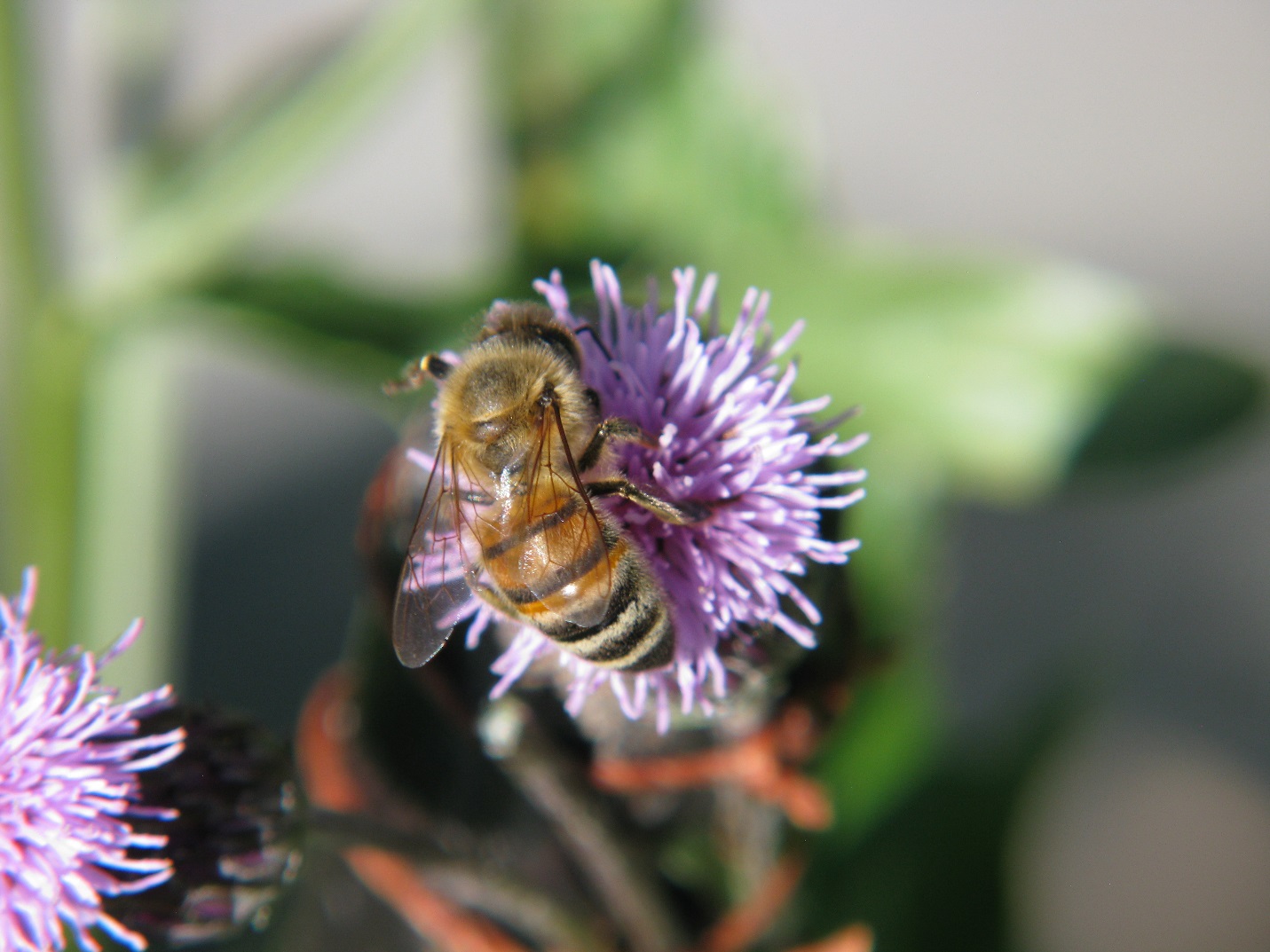
Image from the Canon PowerShot camera with CHDK script ‘Motion Detect Plus’. The thistle flower being visited by ♀ honeybee Apis mellifera L.

Pollinators have fascinated ecologists for decades, and they have traditionally been monitored by on-site human observations. This can be a time-consuming enterprise and – more importantly – species identification and recordings of behaviour have to be registered at the time of observation. This has two complications:

  1. While writing notes, or recording them electronically, the observer cannot continue focusing on the animal or behaviour in question.
  2. Such data then have to be transcribed, with the risk of making transcription errors.

Bringing Monitoring into the 21st Century

Although on-site human observations have predominated, today’s widespread availability of digital monitoring equipment has enabled unique data on flower visitors to be collected. In my research, I have used a time-efficient automated procedure for monitoring flower-visiting animals – namely foraging bumblebees visiting focal white clovers and honeybees visiting thistles.

Continue reading “Automatic Camera Monitoring: A Window into the Daily Life of Pollinators”

Animal Density and Acoustic Detection: An Interview with Ben Stevenson

David Warton (University of New South Wales) interviews  interviews  Ben Stevenson (University of St Andrews) about his 2015 Methods in Ecology and Evolution paper ‘A general framework for animal density estimation from acoustic detections across a fixed microphone array’. They also discuss what Ben is currently up to, including an interesting new method for dealing with uncertain identification in capture-recapture, published in Statistical Science as ‘Trace-Contrast Models for Capture–Recapture Without Capture Histories’.

Continue reading “Animal Density and Acoustic Detection: An Interview with Ben Stevenson”

Issue 7.9

Issue 7.9 is now online!

The September issue of Methods is now online!

This month’s issue contains two Applications articles and three Open Access articles, all of which are freely available.

– Arborist Throw-Line Launcher: A cost-effective and simple alternative for collecting leaves and seeds from tall trees. The authors have also provided some tutorial videos on YouTube.

– ctmm: An R package which implements all of the continuous-time stochastic processes currently in use in the ecological literature and couples them with powerful statistical methods for autocorrelated data adapted from geostatistics and signal processing.

Continue reading “Issue 7.9”

New Associate Editor: Marie Auger-Méthé

Today, we are pleased to be welcoming a new member of the Methods in Ecology and Evolution Associate Editor Board. Marie Auger-Méthé joins us from Dalhousie University in Canada and you can find out a little more about her below.

Marie Auger-Méthé

Marie Auger-Méthé

“I am broadly interested in developing and applying statistical tools to infer behavioural and population processes from empirical data. My work tends to focus on marine and polar mammals, but the methods I develop are often applicable to a wide range of species and ecosystems. My recent work has centred on modelling animal behaviour using movement data and I generally analyse data with spatial and/or temporal structure.”

Marie has been reviewing for Methods in Ecology and Evolution for a few years and has contributed articles to some of the other journals of the British Ecological Society too. Earlier this month, her article titled ‘Evaluating random search strategies in three mammals from distinct feeding guilds‘ was published in the Journal of Animal Ecology. Continue reading “New Associate Editor: Marie Auger-Méthé”