New Associate Editor: Michael Morrissey

Today, we are pleased to be welcoming a new member of the Methods in Ecology and Evolution Associate Editor Board. Michael Morrissey joins us from the University of St Andrews in Scotland and you can find out a little more about him below.

Michael Morrissey

“I am an evolutionary quantitative geneticist. I am interested in the selection, genetics, and evolutionary trajectories of traits in natural populations. I typically work at the interface of statistics, evolutionary theory, and empirical problems.”

Michael has been an active reviewer for Methods for the past few years and has provided excellent comments and recommendations on a number of papers. He also had an article – ‘In search of the best methods for multivariate selection analysis‘ – published in the journal in 2014 (which will become freely available in October this year).
Continue reading “New Associate Editor: Michael Morrissey”

Uncertainty in biological monitoring : An interview with Viviana Ruiz-Gutierrez

David Warton (University of New South Wales) interviews Viviana Ruiz-Gutierrez (Cornell University) about her recent paper Uncertainty in biological monitoring: a framework for data collection and analysis to account for multiple sources of sampling bias. They discuss the main contributions of the paper, the effect false positives can have on occupancy estimates (when not accounted for) and her current position at Cornell. They finish off (in Spanish!) discussing the next step in her research agenda.

Continue reading “Uncertainty in biological monitoring : An interview with Viviana Ruiz-Gutierrez”

Issue 7.8

Issue 7.8 is now online!

The August issue of Methods is now online!

This month’s issue contains two Applications articles and two Open Access articles, all of which are freely available.

Plant-O-Matic: A free iOS application that combines the species distribution models with the location services built into a mobile device to provide users with a list of all plant species expected to occur in the 100 × 100 km geographic grid cell corresponding to the user’s location.

RClone: An R package built upon genclone software which includes functions to handle clonal data sets, allowing:

  • Checking for data set reliability to discriminate multilocus genotypes (MLGs)
  • Ascertainment of MLG and semi-automatic determination of clonal lineages (MLL)
  • Genotypic richness and evenness indices calculation based on MLGs or MLLs
  • Describing several spatial components of clonality

Continue reading “Issue 7.8”

Why You Should Use a Thermocycler Instead of an Incubator

High-throughput genomic methods are increasingly used to investigate invertebrate thermal responses with greater dimensionality and resolution than previously achieved. However, corresponding methods for characterising invertebrate phenotypes are still lacking. Jacinta Kong and her co-authors propose a novel use of thermocyclers as temperature-controlled incubators for characterising invertebrate phenotypes. Why use a thermocycler instead of current methods to characterise thermal phenotypes? In this video they outline key advantages of … Continue reading Why You Should Use a Thermocycler Instead of an Incubator

Issue 7.7

Issue 7.7 is now online!

The July issue of Methods is now online!

This month’s issue contains two Applications articles and two Open Access articles, all of which are freely available.

– MO-Phylogenetics: A software tool to infer phylogenetic trees optimising two reconstruction criteria simultaneously and integrating a framework for multi-objective optimisation with two phylogenetic software packages.

– PHYLOMETRICS: An efficient algorithm to construct the null distributions (by generating phylogenies under a trait state-dependent speciation and extinction model) and a pipeline for estimating the false-positive rate and the statistical power of tests on phylogenetic metrics..

Continue reading “Issue 7.7”

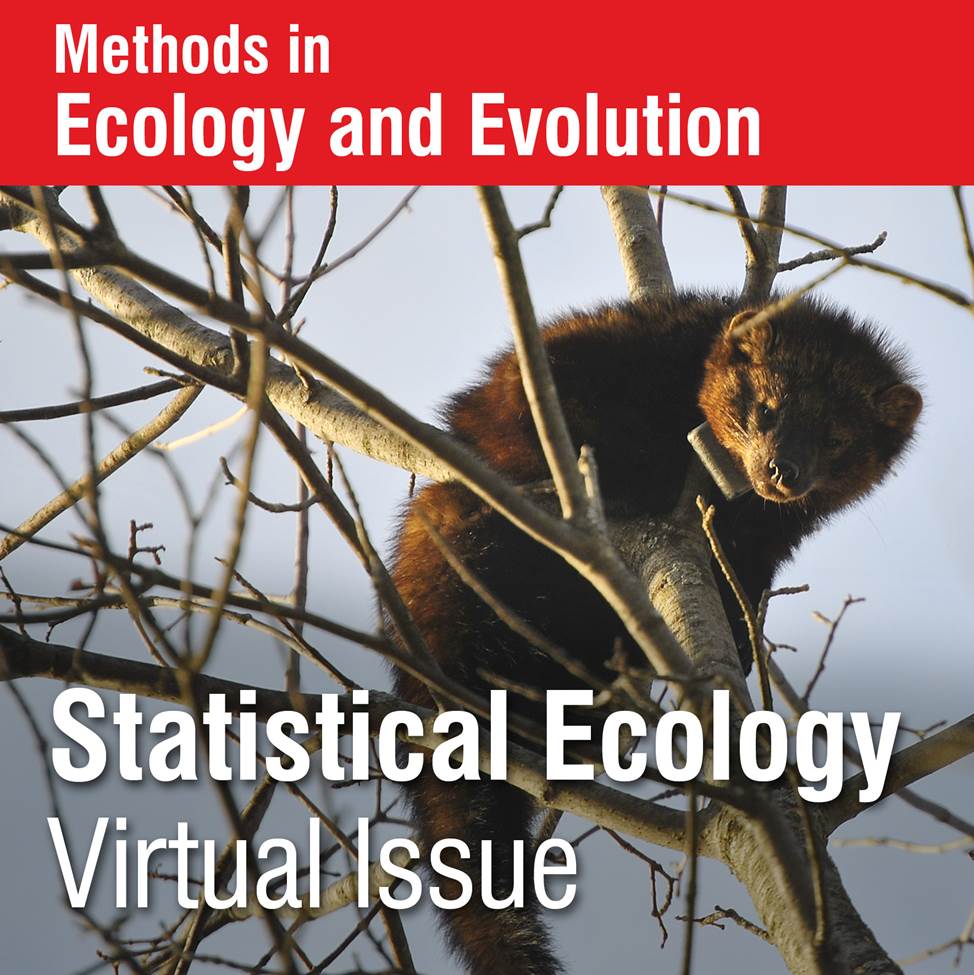
Statistical Ecology Virtual Issue

StatEcolVI_WebAdAt the last ISEC, in Montpellier in 2014, an informal survey suggested that Methods in Ecology and Evolution was the most cited journal in talks. This reflects the importance of statistical methods in ecology and it is one reason for the success of the journal. For this year’s International Statistcal Ecology Conference in Seattle we have produced a virtual issue that presents some of our best recent papers which cross the divide between statistics and ecology. They range over most of the topics covered at ISEC, from statistical theory to abundance estimation and distance sampling.

We hope that Methods in Ecology and Evolution will be equally well represented in talks in Seattle, and also – just as in Montpellier – some of the work presented will find its way into the pages of the journal in the future.

Without further ado though, here is a brief overview of the articles in our Statistical Ecology Virtual Issue: Continue reading “Statistical Ecology Virtual Issue”

Issue 7.6: Methods in Ecology and Evolution 5th Anniversary Special Feature

Issue 7.6 is now online!

The June issue of Methods, which includes our latest Special Feature – “5th Anniversary of Methods in Ecology and Evolution” – is now online!

Our 5th Anniversary Special Feature is a collection of six articles (plus an Editorial from Executive Editor Rob Freckleton) that highlights the breadth and depth of topics covered by the journal so far. It grew out of our 5th Anniversary Symposium – a joint event held in London, UK and Calgary, Canada and live-streamed around the world in April 2015 – and contains papers by Associate Editors, a former Robert May prize winner and regular contributors to the journal.

The six articles are based on talks given at last May’s Symposium. They focus on:

In his Editorial for the Special Feature, Rob Freckleton looks to the future. In his words: “we hope to continue to publish a wide range of papers on as diverse a range of topics as possible, exemplified by the diversity of the papers in this feature”.

All of the articles in the Special Feature will be freely available for a limited time. In addition to this, two of the articles (Shedding light on the ‘dark side’ of phylogenetic comparative methods and Perturbation analysis of transient population dynamics using matrix projection models) are Open Access.
Continue reading “Issue 7.6: Methods in Ecology and Evolution 5th Anniversary Special Feature”

Issue 7.5

Issue 7.5 is now online!

The May issue of Methods is now online!

This month’s issue contains two Applications articles and two Open Access articles, all of which are freely available.

piecewiseSEM: A practical implementation of confirmatory path analysis for the R programming language. This package extends the method to all current (generalized) linear, (phylogenetic) least-square, and mixed effects models, relying on familiar R syntax. The article also includes two worked examples.

 RPANDA: An R package that implements model-free and model-based phylogenetic comparative methods for macroevolutionary analyses. It can be used to:

  1. Characterize phylogenetic trees by plotting their spectral density profiles
  2. Compare trees and cluster them according to their similarities
  3. Identify and plot distinct branching patterns within trees
  4. Compare the fit of alternative diversification models to phylogenetic trees
  5. Estimate rates of speciation and extinction
  6. Estimate and plot how these rates have varied with time and environmental variables
  7. Deduce and plot estimates of species richness through geological time. Continue reading “Issue 7.5”

New Associate Editor: Will Pearse

Today, we are pleased to be welcoming a new member of the Methods in Ecology and Evolution Associate Editor Board. Will Pearse joins us from McGill University in Canada and you can find out a little more about him below. Will Pearse “I am an evolutionary ecologist and use phylogeny to link the evolution of species’ traits with their ecological community assembly. I’m interested in phylogenetic methods, macro-evolution of species’ traits, community assembly … Continue reading New Associate Editor: Will Pearse