Tips for Publishing Methods Papers in Ecological Journals

At the 2015 Eco-Stats Conference at the University of New South Wales there was a Q&A panel discussion of tips for authors publishing methods papers. The panel was chaired by Methods in Ecology and Evolution Associate Editor David Warton. It included Jane Elith (winner of the Methods Recognition of Achievement award), Associate Editor Matt Schofield and former Associate Editor Shinichi Nakagawa. There was also a late appearance, straight off a long haul flight from China, by Doug Yu (another current Associate Editor).

Continue reading “Tips for Publishing Methods Papers in Ecological Journals”

The Arborist Throw-line Launcher

Collecting leaves or seeds from tall trees is a difficult task that many plant physiologists, ecologists, geneticists and forest managers encounter repeatedly. In a series of videos on the Methods in Ecology and Evolution YouTube channel, Kara N. YoungentobChristina Zdenek and Eva van Gorsel demonstrate how to use the arborist throw-line launcher, which significantly simplifies this task. This new way of collecting seeds and leaves from tall trees is explained in their Applications article ‘A simple and effective method to collect leaves and seeds from tall trees‘. As this is an Applications paper, it is freely available to everyone.

Basic Techniques for the Arborist Throw-line Launcher

The first of the three videos is a basic overview of the method. In this tutorial, the authors teach you how to find the ideal branch, how to use the throw-line launcher and go through some important safety information. Continue reading “The Arborist Throw-line Launcher”

Issue 7.4

Issue 7.4 is now online!

The April issue of Methods is now online!

This month’s issue contains two Applications articles and one Open Access article, all of which are freely available.

CPW Photo Warehouse: freely available software that has been customized to identify, archive, and transform photographs into data formats required for statistical analyses. Users navigate a series of point-and-click menu items that allow them to input information from camera deployments, import photos and store data. Images are seamlessly incorporated into the database windows, but are stored separately.

SIMR: An R package that allows users to calculate power for generalized linear mixed models from the lme4 package. The power calculations are based on Monte Carlo simulations. It includes tools for (i) running a power analysis for a given model and design; and (ii) calculating power curves to assess trade-offs between power and sample size.

Continue reading “Issue 7.4”

New Associate Editor: Sarah Goslee

Today, we are pleased to be welcoming a new member of the Methods in Ecology and Evolution Associate Editor Board. Sarah Goslee joins us from the USDA Agricultural Research Service in the USA and you can find out a little more about her below.

Sarah Goslee

“‘Why is this plant growing here?’ Tackling this question has led me through wetlands, forests, deserts and grasslands. I’ve poked at this question from the scale of plant traits all the way up to satellite imagery. I employ tools that include multivariate analysis, community and landscape diversity metrics, simulation modelling, and spatial classification. My current focus is on agricultural decision support tools for pasture and rangeland.”

Sarah will be handling Applications articles for the journal. Applications papers describe new software, equipment or other practical tools, with the intention of promoting and maximising the uptake of these new approaches. All of our published Applications articles are freely available to everyone.
Continue reading “New Associate Editor: Sarah Goslee”

Issue 7.3

Issue 7.3 is now online!

The March issue of Methods is now online!

This month’s issue contains two Applications articles and two Open Access articles, all of which are freely available.

METAGEAR: A comprehensive, multifunctional toolbox with capabilities aimed to cover much of the research synthesis taxonomy: from applying a systematic review approach to objectively assemble and screen the literature, to extracting data from studies, and to finally summarize and analyse these data with the statistics of meta-analysis.

Universal FQA Calculator: A free, open-source web-based Floristic Quality Assessment (FQA) Calculator. The calculator offers 30 FQA data bases (with more being added regularly) from across the United States and Canada and has been used to calculate thousands of assessments. Its growing repository for site inventory and transect data is accessible via a REST API and represents a valuable resource for data on the occurrence and abundance of plant species. Continue reading “Issue 7.3”

2015 Robert May Prize Winner: Kim Calders

The Robert May Prize is awarded annually for the best paper published in Methods in Ecology and Evolution by an Early Career Researcher. We’re delighted to announce that the 2015 winner is Kim Calders, for his article ‘Nondestructive estimates of above-ground biomass using terrestrial laser scanning.

Kim led the work on this article and had an international team of co-authors. They have developed a way to harness laser technology for use in measurements of vegetation structure of forests. The study is an important development in the monitoring of carbon stocks for worldwide climate policy-making. Continue reading “2015 Robert May Prize Winner: Kim Calders”

New Associate Editors

Today we are welcoming three new Associate Editors to Methods in Ecology and Evolution: Nick Golding (University of Melbourne, Australia), Rachel McCrea (University of Kent, UK) and Francesca Parrini (University of the Witwatersrand, South Africa). They have all joined on a three-year term and you can find out more about them below. Nick Golding “I develop statistical models and software for mapping the distributions of species and diseases. I’m particularly interested in … Continue reading New Associate Editors

Issue 7.2: Demography Beyond the Population

Issue 7.2 is now online!

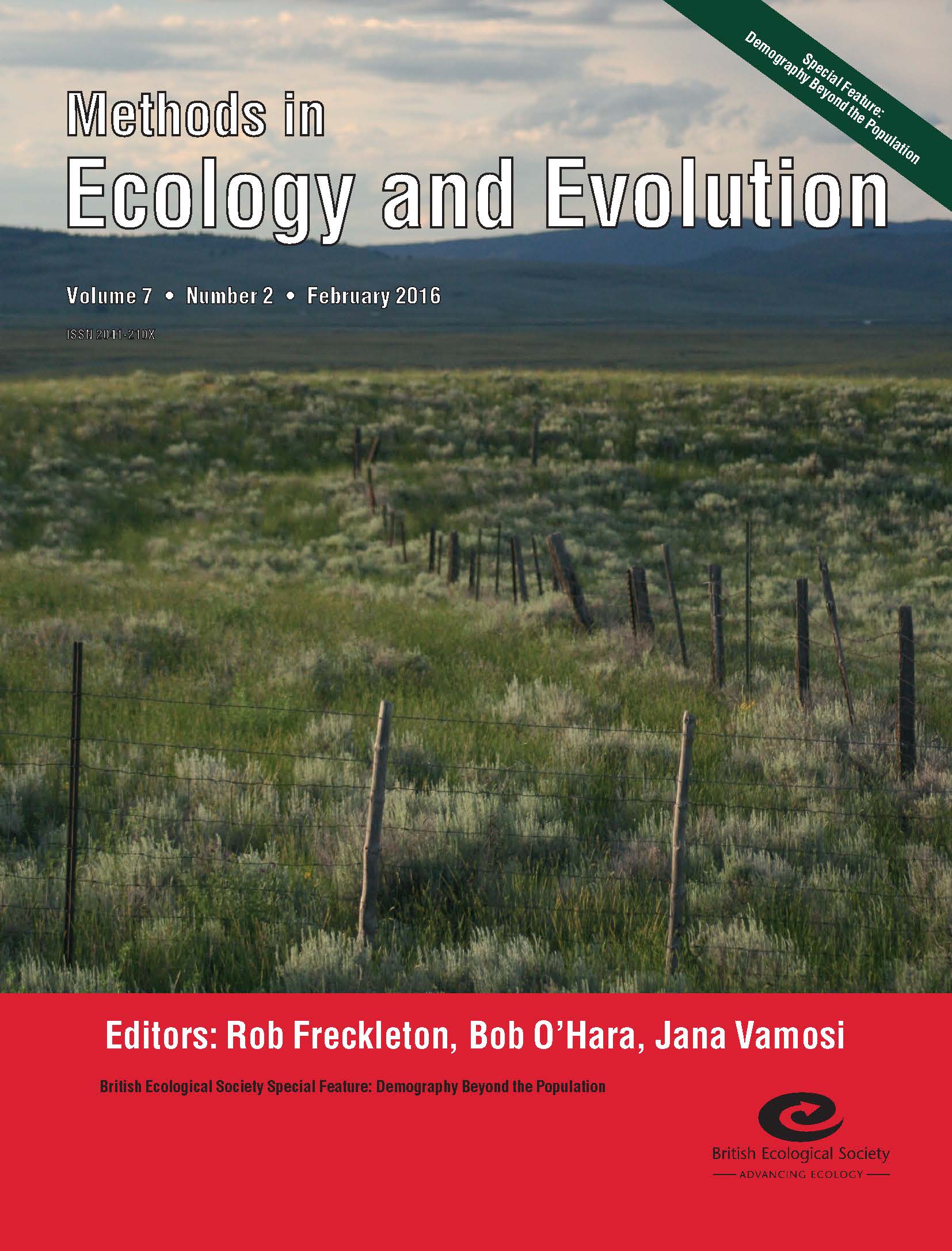
Sagebrush steppe in eastern Idaho, USA
© Brittany J. Teller

The February issue of Methods is now online! As you may have seen already, it includes the BES cross-journal Special Feature: “Demography Beyond the Population“. There are also eight other wonderful articles to read.

We have four articles in the Demography Beyond the Symposium Special Feature. You can read an overview of them by two of the Feature’s Guest Editor Sean McMahon and Jessica Metcalf here (Sean and Jessica are also Associate Editors of Methods).

If you’d like to find out more about each of the individual papers before downloading them, we have blog posts about each one. Daniel Falster and Rich Fitzjohn discuss the development of plant and provide some advice on creating simulation models in Key Technologies Used to Build the plant Package (and Maybe Soon Some Other Big Simulation Models in R). There is a look back at the evolution of Integral Projection Models from Mark Rees and Steve Ellner in How Did We Get Here From There? A Brief History of Evolving Integral Projection Models. In Inverse Modelling and IPMs: Estimating Processes from Incomplete Information Edgar González explains how you can estimate process that you can’t observe. And keep an eye out for Brittany Teller’s blog post coming next week!

Don’t wait too long to get the Demography Beyond the Population Special Feature papers though, they’re freely available for a limited time only

Continue reading “Issue 7.2: Demography Beyond the Population”

Methods Beyond the Population

Post Provided by SEAN MCMAHON and JESSICA METCALF

Demography Beyond the Population” is a unique Special Feature being published across the journals of the British Ecological Society.  The effort evolved from a symposium of the same name hosted in Sheffield, UK last March. Both the meeting and the Special Feature were designed to challenge ecologists from a range of fields whose research focuses on populations.

The participants were charged with sharing how they are pushing the work they do beyond the stage where the population is the focus into research where the population is just the beginning and the focus spans scales, systems and tools. This encompasses a broad suite of biological research, including range modelling, disease impacts on communities, biogeochemistry, evolutionary theory, and conservation biology. The meeting was a great success, and this Special Feature should be equally valuable to the broad readership of the BES journals.

Methods in Ecology and Evolution has a special place in the Special Feature, hosting four papers. These papers not only introduce new efforts in population biology, they provide the methods that other scientists can use to implement them. With the tools provided by these four papers, researchers will be able to advance forest modelling, evolutionary theory, climate change biology and statistical inference of hidden population parameters.  Seriously good stuff! Continue reading “Methods Beyond the Population”

Demography Beyond the Population Webinar: Register for Free Now

Webinar logoRegister for FREE for the first ever BES Publishing webinar based on our forthcoming Demography Beyond the Population Special Feature.

This hour long webinar will begin at 1pm (GMT) on Tuesday 1 March. It highlights some of the excellent articles soon to be published in the British Ecological Society journals Special Feature entitled “Demography Beyond the Population”. The Special Feature is a collaborative effort including articles in all six BES journals. This is the first time such a large ecological collaboration has been attempted worldwide. Using a cross-journal approach has allowed us to highlight the strongly interdisciplinary nature of the field of demography to its fullest potential as well as to lay down the foundations for future directions at the interface of ecology, evolution, conservation biology and human welfare. The webinar has several international speakers and will discuss the articles in the Special Feature and the implications for demography research going forward. Continue reading “Demography Beyond the Population Webinar: Register for Free Now”