Biogeographic Regions: What Are They and What Can They Tell Us?

Post provided by Leonardo Dapporto, Gianni Ciolli, Roger L.H. Dennis, Richard Fox and Tim G. Shreeve

Every species in the world has a unique geographic distribution. But many species have similar ranges. There are many things that can cause two (or more) species to have similar ranges – for example shared evolutionary histories, physical obstacles (mountains, oceans etc.) or ecological barriers limiting their dispersal. As a consequence, different regions of the globe are inhabited by different sets of living organisms.

In the mid-19th century ecologists recognised that the earth could be divided into different biogeographic regions. Alfred Russel Wallace (1823–1913) played a key role in defining and recognising biogeographic regions. He improved the existing maps of  biogeographic regions and provided basic rules to identify them. His observation that some of these regions are home to similar species, despite being far away from each other and separated by significant barriers was the inspiration for Alfred Wegener’s theory of continental drift. In more recent years regionalisation has been used to understand the spatial drivers of biological evolution and to protect those regions characterised by particularly unique flora and fauna.

The biogeographic regions identified by Alfred Russel Wallace from The Geographical Distribution of Animals (1876)

Despite the long history of biological regionalisation, the methods to identify biogeographic regions are still being improved. We are currently working in this exciting field of research and recently published ‘A new procedure for extrapolating turnover regionalization at mid-small spatial scales, tested on British butterflies’ in Methods in Ecology and Evolution. Continue reading “Biogeographic Regions: What Are They and What Can They Tell Us?”

Uncertainty in biological monitoring : An interview with Viviana Ruiz-Gutierrez

David Warton (University of New South Wales) interviews Viviana Ruiz-Gutierrez (Cornell University) about her recent paper Uncertainty in biological monitoring: a framework for data collection and analysis to account for multiple sources of sampling bias. They discuss the main contributions of the paper, the effect false positives can have on occupancy estimates (when not accounted for) and her current position at Cornell. They finish off (in Spanish!) discussing the next step in her research agenda.

Continue reading “Uncertainty in biological monitoring : An interview with Viviana Ruiz-Gutierrez”

Celebrating Owl Research on International Owl Awareness Day

Post provided by LEANNE HEISLER

snowy-owl-981653_640Today, on International Owl Awareness Day (August 4), we celebrate the research we have done to better understand owls and their prey. There are over 200 extant species of owls, a handful of which have geographic distributions spanning several continents (i.e., barn owl, snowy owl, short-eared owl, long-eared owl). So no matter where you are in the world you’re probably not too far away from an owl.

Ecologists and paleontologists have taken advantage of this to study owls and their prey. One of the most widely used methods for this is collecting and dissecting owl pellets. We discuss some of the major benefits of studying owl pellets in our recent Methods in Ecology and Evolution Review article ‘Owl pellets: a more effective alternative to conventional trapping for broad-scale studies of small mammal communities’. Continue reading “Celebrating Owl Research on International Owl Awareness Day”

Planning Habitat for Very Long-Distance Connectivity under Climate Change

Post provided by JENNY HODGSON

Climate change and habitat fragmentation are interacting threats: it is likely that many species cannot reach newly suitable areas at the cool edge of their range because there is not enough habitat, in the right places, to support range expansion over multiple generations. Conservation efforts are already underway to restore large areas of habitat, and to improve the “connectivity” within networks of habitat. However, there are multiple ways of measuring connectivity and few of them address the scale of shifts that are likely to be needed under climate change. This could be a problem if it leads to inefficient conservation prioritisation.

The Conductance Metric

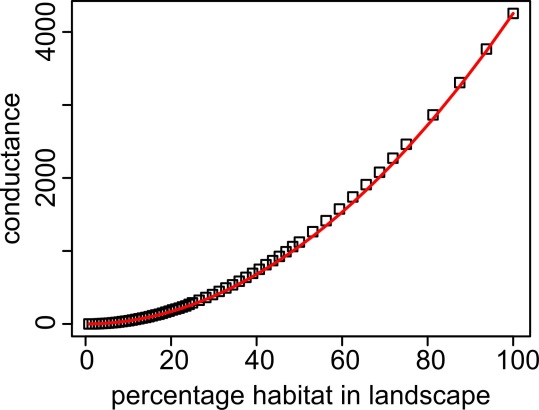
How conductance generally depends on the amount of habitat in the landscape. Squares show the conductance of landscapes with a random selection of cells chosen to be habitat. The red line is based only on the 100% point and the expectation that conductance is proportional to amount of habitat squared.

We first developed the conductance metric in 2012 and we found that it is correlated to the speed with which a species can spread through a landscape, from a specified source location to a specified target. A key difference between this and most other connectivity metrics is that it incorporates both reproduction within habitat patches and dispersal between habitat patches, over multiple generations (further explanation here). Sometimes there could be many very well-connected patches in a network, and yet no easy way for a species to cross the landscape from end to end. This could be a problem for the species’ survival, if staying within its current regions of occupancy is unsustainable, for example if it is being pushed northwards by climate change. Continue reading “Planning Habitat for Very Long-Distance Connectivity under Climate Change”

rotl Paper Published

THIS PIECE WAS ORIGINALLY POSTED ON THE ROPENSCI BLOG.

We (Francois MichonneauJoseph Brown and David Winter) are excited to announce a paper describing rotl, our package for the Open Tree of Life data, has been published. The full citation is:

Michonneau, F., Brown, J. W., Winter, D. J. (2016), rotl: an R package to interact with the Open Tree of Life data. Methods in Ecology and Evolution. doi: 10.1111/2041-210X.12593

The paper, which is freely available, describes the package and the data it wraps in detail. Rather than rehash the information here, we will use this post to briefly introduce the goals of the package and thank some of the people that helped it come to be.

What Data Does Open Tree Have and How Can rotl Help You Get It?

The Open Tree of Life combines knowledge from thousands of scientific studies to produce a single source of information about the relationships among all species on earth. In addition to storing the trees and taxonomies that go into this project, the Open Tree provides a “synthesis tree” that represents this combined knowledge. The Open Tree data can be accessed via the web page linked above, and through an API. rotl takes advantage of this API to give R users the ability to search for phylogenetic information and import the results into their R sessions. The imported data can then be used with the growing ecosystem of packages for phylogenetic and comparative biology in R. Continue reading “rotl Paper Published”

Why You Should Use a Thermocycler Instead of an Incubator

High-throughput genomic methods are increasingly used to investigate invertebrate thermal responses with greater dimensionality and resolution than previously achieved. However, corresponding methods for characterising invertebrate phenotypes are still lacking. Jacinta Kong and her co-authors propose a novel use of thermocyclers as temperature-controlled incubators for characterising invertebrate phenotypes. Why use a thermocycler instead of current methods to characterise thermal phenotypes? In this video they outline key advantages of … Continue reading Why You Should Use a Thermocycler Instead of an Incubator

European Bison, Rewilding and Dung Fungal Spore

Post provided by AMBROISE BAKER

In the US, July is National Bison Month but most people in Europe are totally oblivious to it. I wasn’t even aware of it before being asked to write this blog post in connection with our recent Methods in Ecology and Evolution paper about quantifying population sizes of large herbivores. Some will argue that it is because we don’t ‘do’ day, month, state or national animals on this side of the Atlantic as much as the Americans do.

The European bison survived from extinction thanks to about 50 individuals kept in zoos. The species has been reintroduced in the wild in several European countries but remains ‘Vulnerable’ according to the IUCN criteria.
The European bison survived extinction thanks to ~50 individuals kept in zoos. It has been reintroduced in several countries but remains ‘Vulnerable’. ©4028mdk09

But another reason is that the European bison, Bison bonasus bonasus, is simply not sufficiently well-known or associated with European nature in the public’s mind. This is particularly true in Western Europe where this species has been extinct since medieval times.

Early European accounts from North America reported huge bison populations – with estimates of up to 60 million – moving to and fro in the great bison belt. These past migratory movements across the Great Plains are familiar well beyond the US and feed our view of untamed wilderness prior to the impact of European ’civilisation’. In contrast, there are hardly any records of European bison numbers until just before the last wild one was reported killed in Poland in 1921. Continue reading “European Bison, Rewilding and Dung Fungal Spore”

State-and-Transition Models: An Interview with Marie-Josee Fortin

David Warton (University of New South Wales) interviews Marie-Josee Fortin (University of Toronto) about a recent article on state-and-transition models from her group in Methods in Ecology and Evolution. David and Marie-Josee also discuss what motivated her career to date in spatial ecology, and what she sees as the main advances in this area and current challenges in the field.

Continue reading “State-and-Transition Models: An Interview with Marie-Josee Fortin”

Predicting Disease Outbreaks Using Environmental Changes

Below is a press release about the Methods paper ‘Environmental-mechanistic modelling of the impact of global change on human zoonotic disease emergence: a case study of Lassa fever‘ taken from the University College London.

The multimammate rat (Mastomys natalensis) transmits Lassa virus to humans. ©Kelly, et al.
The multimammate rat transmits Lassa virus to humans. ©Kelly, et al.

A model that predicts outbreaks of zoonotic diseases – those originating in livestock or wildlife such as Ebola and Zika – based on changes in climate, population growth and land use has been developed by a UCL-led team of researchers.

“This model is a major improvement in our understanding of the spread of diseases from animals to people. We hope it can be used to help communities prepare and respond to disease outbreaks, as well as to make decisions about environmental change factors that may be within their control,” said lead author Professor Kate Jones, UCL Genetics, Evolution & Environment and the Zoological Society of London. Continue reading “Predicting Disease Outbreaks Using Environmental Changes”

Canopy Camera Trapping: Heightening Our Knowledge of Arboreal Mammals

Post provided by FARAH CARRASCO-RUEDA and TREMAINE GREGORY

We wanted to test whether arboreal mammals were using natural canopy bridges – connections between tree branches over a clearing – to travel over a natural gas pipeline in the Peruvian Amazon. The challenge was figuring out how to monitor branches 100 feet up in the tree tops. In this case, the clearing was a 30-foot-wide pipeline path, and we expected arboreal mammals – like monkeys, squirrels and porcupines – to prefer crossing on the branches rather than on the ground. The ground is an unfamiliar and often dangerous place for an animal that’s spent its life way up in the canopy.

The path captured by the camera.
The yellow arrow shows the path captured by the camera trap.

In fact, we wondered if without branches, would arboreal mammals cross at all? How could we find out if animals were using the branches? There were 13 canopy bridges and finding a person to sit and wait all day (and night) under each of them for animals to cross wasn’t an option. With our goal of a year’s worth of monitoring, we had a conundrum. We needed a more efficient way to gather the data and concluded that camera traps – motion sensitive cameras – could be an excellent way to monitor the bridges continuously and remotely.

But, we discovered that no one had ever really used camera traps in the high canopy before. How were we going to get them all the way up there? If we were able to get up to the canopy, how could we make sure they were taking photos of the correct points where animals would potentially cross? Continue reading “Canopy Camera Trapping: Heightening Our Knowledge of Arboreal Mammals”