Understanding and Presenting YOUR Data

A Beginner’s Guide to Data Exploration and Visualisation with R
by Elena N. Ieno and Alain F. Zuur

A Beginner's Guide to Data ExplorationIn 2010 Alain Zuur, Elena Ieno and Chris Elphick published a paper in Methods in Ecology and Evolution entitled ‘A protocol for data exploration to avoid common statistical problems‘ (Volume 1, Issue 1). Little did they know at the time that this paper would become one of the journal’s all-time top downloaded and top cited papers, with a total of 22,472 downloads between 2010 and 2014.

Based on this success they decided to extend the material in the paper into a book.

Zuur and his colleagues at Highland Statistics ltd. give about 25 five-day statistics courses per year. Their typical audience consists of biological scientists at the post-graduate and post-doctoral levels. Early on in each course they have the following conversation with the participants:

Speaker: “Do you review submitted manuscripts for journals?”
Audience: “Yes.”
Speaker: “Do you like the statistical part of these manuscripts?”
Audience: “No!”
Speaker: “Do you understand the statistical part?”
Audience: “Not always.”

What if there were ways you could make reviewing your paper easier and more enjoyable for reviewers? What if making your manuscript easier to understand and nicer to read would increase the likelihood of your work being published?

A Beginner’s Guide to Data Exploration and Visualisation with R explains how you can do exactly that! Alain Zuur and Elena Ieno use ecological datasets to discuss the data exploration and visualisation tools you can use to make your paper simpler for readers and reviewers to understand. The authors also explain how to visualise the results of statistical models, an important aspect of scientific papers. Continue reading “Understanding and Presenting YOUR Data”

Issue 6.3

Issue 6.3 is now online!

The March issue of Methods is now online!

We have three freely available Applications articles in this issue. Anyone can access these with no subscription required and no charge to download.

TR8: This R package was built to provide plant scientists with a simple tool for retrieving plant functional traits from freely accessible online traitbases.

StereoMorph: A new R package for the rapid and accurate collection of 3D landmarks and curves using two standard digital cameras.

MotionMeerkat: A new standalone program that identifies motion events from a video stream. This tool reduces the time needed to review videos and accommodates a variety of inputs.

This month we have a total of FIVE Open Access articles. That makes eight articles in this issue of Methods in Ecology and Evolution that you can read for free!

Continue reading “Issue 6.3”

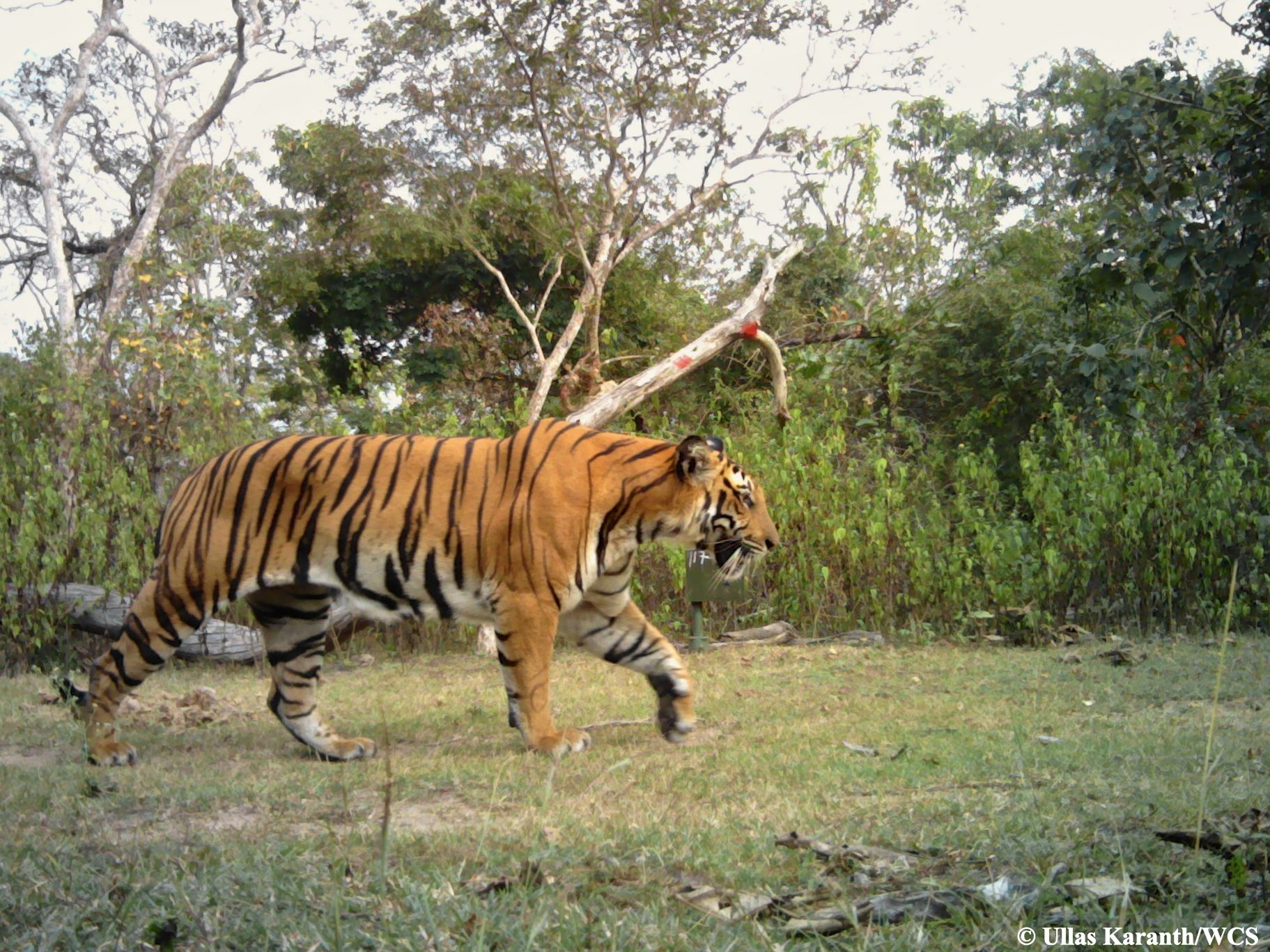
Flawed Method puts Tiger Rise in Doubt

The following is a press release about the Methods paper ‘An examination of index-calibration experiments: counting tigers at macroecological scales‘ taken from the University of Oxford News and Events page:

Flaws in a method commonly used in censuses of tigers and other rare wildlife put the accuracy of such surveys in doubt, a new study suggests.

A team of scientists from theNH_QT_K2934024 University of Oxford, Indian Statistical Institute, and Wildlife Conservation Society exposes, for the first time, inherent shortcomings in the ‘index-calibration’ method that means it can produce inaccurate results. Amongst recent studies thought to be based on this method is India’s national tiger survey (January 2015) which claimed a surprising but welcome 30 percent rise in tiger numbers in just four years.

The team urges conservation practitioners to guard against these sources of error, which could mislead even the best conservation efforts, and suggests a constructive way forward using alternative methods of counting rare animals that avoid the pitfalls of the index-calibration approach.

A report of the research is published this week in the journal Methods in Ecology and Evolution.

Continue reading “Flawed Method puts Tiger Rise in Doubt”

Issue 6.2

Issue 6.2 is now online! The February issue of Methods is now online! This month we have two applications articles. Both are free to access, no subscription required. – NLMpy: A PYTHON software package for the creation of neutral landscape models (there are also two videos associated to this paper on our Youtube channel) – BAT – an R package for the measurement and estimation of … Continue reading Issue 6.2

Issue 6.1

Issue 6.1 is now online! Our first issue of 2015 is now online! This month we include one freely available Applications article: – A biochemical approach for identifying plastics exposure in live wildlife We also have two wonderful Open Access papers, ‘Evaluation and management implications of uncertainty in a multispecies size-structured model of population and community responses to fishing‘ by Robert B. Thorpe, Will J. … Continue reading Issue 6.1

NLMpy: a python software package for the creation of neutral landscape models

In this video Thomas Etherington shows how to use the NLMpy Python package to create neutral landscape models.  The video demonstrates how the paper’s Supporting Information documentation, Python scripts, and GIS data can be used to create a the example neutral landscape models that are shown in the paper. Recognising that some ecologists may not be very familiar with Python, the authors have also created … Continue reading NLMpy: a python software package for the creation of neutral landscape models

Issue 5.11

Issue 5.11 is now online! This month we include 2 freely available application articles: – ENMeval: An R package for conducting spatially independent evaluations and estimating optimal model complexity for Maxent ecological niche models – enaR: An r package for Ecosystem Network Analysis We also have 4 interesting open access papers, ‘The accuracy of Fastloc-GPS locations and implications for animal tracking‘ by Antoine Dujon et … Continue reading Issue 5.11

Modelling Demographic Processes in Marked Populations: Proceedings of the EURING 2013 analytical meeting

By Charles M. Francis, Richard J. Barker, Evan G. Cooch This joint Special Feature (published in MEE and the open access journal Ecology and Evolution) brings together a series of papers presented at the EURING 2013 technical conference that, collectively, cover many of the latest developments in the analysis of data from marked individuals to estimate demographic parameters, such as survival, recruitment, nest success, density, population size … Continue reading Modelling Demographic Processes in Marked Populations: Proceedings of the EURING 2013 analytical meeting

Laser scanning accurately ‘weighs’ trees

Below is a press release and video about the Methods paper, ‘Nondestructive estimates of above-ground biomass using terrestrial laser scanning‘, taken from UCL News:

Tree scanning 1
Lidar point cloud from a scanned Eucalyptus tree (left) with colours correlating to point density (blue to red moving from high to low density). On the right is the reconstructed tree volume from which mass can be estimated.

A terrestrial laser scanning technique that allows the structure of vegetation to be 3D-mapped to the millimetre is more accurate in determining the biomass of trees and carbon stocks in forests than current methods, according to new research involving UCL.

The research paper, an international collaboration led by Wageningen University, is published today in Methods in Ecology and Evolution and demonstrates the technique in Australian forests.

The study authors believe it could be an important development in the monitoring of carbon stocks for worldwide climate policy-making. Both above-ground biomass and carbon stocks are important details for UN-REDD, the United Nations initiative on Reducing Emissions from Deforestation and forest Degradation that is striving to keep the destruction of forests in check and thereby preserve the uptake of carbon by trees.

Paper co-author Dr Mat Disney (UCL Geography) said: “This new paper shows how effectively we can now turn highly-accurate laser measurements, comprising millions of 3D laser points, into estimates of tree mass. Weighing trees is really hard – time Continue reading “Laser scanning accurately ‘weighs’ trees”

Seabirds’ plastic diet shows up in their feather oil

BY CHRISTOPHER DOYLE This article has been taken from ABC Environment. Scientists have developed a new technique to assess how much plastic a seabird has eaten. It involves a quick massage and a cotton swab. A TEAM OF AUSTRALIAN scientists has developed a new method for assessing how much plastic debris a seabird has eaten while foraging on the open ocean, leading to a better … Continue reading Seabirds’ plastic diet shows up in their feather oil