Measuring canopy fuel loads in boreal forests accurately and efficiently using a smartphone

Our Associate Editor Ryan Chisholm of the National University of Singapore tells us about the recent Practical Tools article he handled for MEE which presents a method for estimating canopy fuel load from hemispherical photographs. Fire is a natural process in many ecosystems, but large-scale intense fires can threaten biodiversity, as well as human life and property. Although the annual global area burnt has decreased … Continue reading Measuring canopy fuel loads in boreal forests accurately and efficiently using a smartphone

MEEin3: Adapting a turkey fryer to manipulate water temperature

Got just five minutes to spare? Listen to our brand new podcast! In this episode, we interview Cassandra Konecny and Graham Brownlee about their recent publication “Adapting a propane turkey fryer to manipulate temperature in aquatic environments”. As the likelihood of extreme temperatures increases due to climate change, there is a growing need to better understand the potential impacts of altered thermal regimes on biodiversity … Continue reading MEEin3: Adapting a turkey fryer to manipulate water temperature

Flora Incognita – more than just a plant identification app

Post provided by Michael Rzanny & Jana Wäldchen

Species identification is an essential tool for recording biodiversity, especially in an era of habitat loss and climate change. Developing skills to correctly identify plants to a species or even a genus level can take many years of training, but a new app called Flora Incognita aims to empower citizens with botanical expertise while also collecting data for scientific analysis.

In this blog post, Michael Rzanny and Jana Wäldchen reveal the inspiration behind this new app and discuss highlights from their new paper “The Flora Incognita app – interactive plant species identification” recently published in Methods in Ecology & Evolution

Continue reading “Flora Incognita – more than just a plant identification app”

The worldwide use of wildlife detection dogs – and how they became part of our life

Post provided by Annegret Grimm-Seyfarth

Border Collie Zammy is trained to search for Eurasian otter scat and pond, alpine and great crested newts. Photo: André Künzelmann.

For those not directly working with them, using wildlife detection dogs always sound like a new fancy idea that should be tested somehow. However, this method is neither new nor rare, and people working with wildlife detection dogs often call them their best method in finding their target species. In this post, Annegret Grimm-Seyfarth discusses her paper ‘Detection dogs in nature conservation: A database on their worldwide deployment with a review on breeds used and their performance compared to other methods’, which shows the broad and worldwide applications of wildlife detection dogs.

Continue reading “The worldwide use of wildlife detection dogs – and how they became part of our life”

Cover Stories: The journey from designing to employing an automated radio telemetry system to track monarch butterflies

Post provided by Kelsey E. Fisher

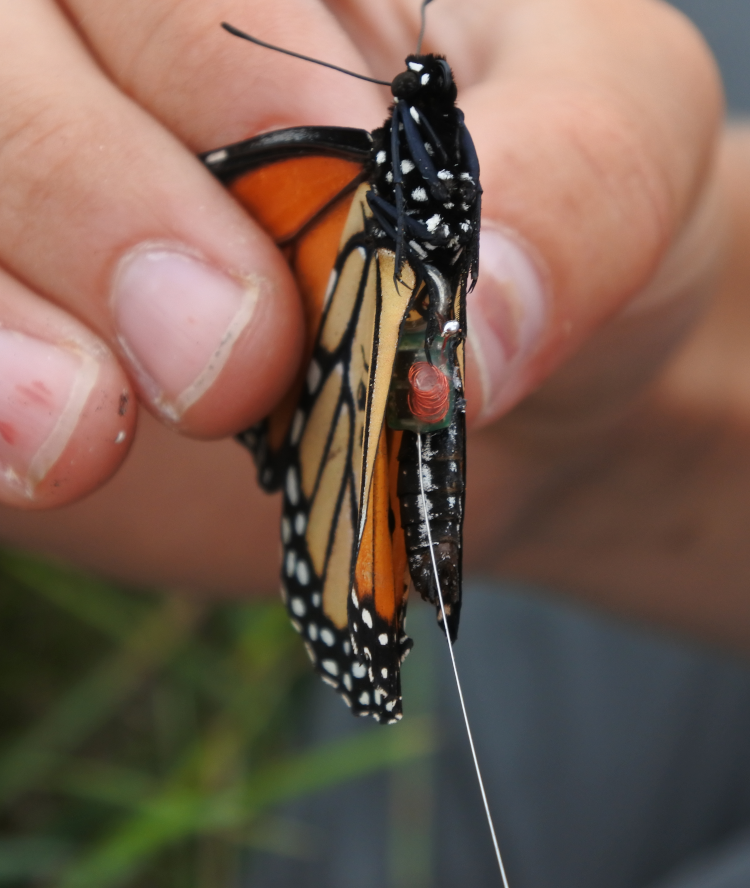
Kelsey Fisher describes the motivations and challenges in the development of a novel automated radio telemetry method to track the movement of butterflies at the landscape scale published in their new Methods article ‘Locating large insects using automated VHF radio telemetry with a multi‐antennae array’.

LB-2X transmitter attached to a monarch butterfly.

Understanding animal movement across varying spatial and temporal scales is an active area of fundamental ecological research, with practical applications in the fields of conservation biology and natural resource management. Advancements in tracking technologies, such as GPS and satellite systems, allow researchers to obtain more location information for a variety of species than ever before. It’s an exciting time for movement ecologists! However, entomologists studying insect movement are still limited because of the large size of tracking devices relative to the small size of insects.

Continue reading “Cover Stories: The journey from designing to employing an automated radio telemetry system to track monarch butterflies”

10th Anniversary Volume 11: Updates on the ClimEx Handbook

Post provided by Aud H. Halbritter

To celebrate the 10th Anniversary of the launch of Methods in Ecology and Evolution, we are highlighting an article from each volume to feature in the Methods.blog. For Volume 11, we have selected ‘The handbook for standardized field and laboratory measurements in terrestrial climate change experiments and observational studies (ClimEx)’ by Halbritter et al. (2019).

Continue reading “10th Anniversary Volume 11: Updates on the ClimEx Handbook”

Tracking the fate of fish

Post provided by David Villegas Ríos

David Ríos tells us about investigating the movement of aquatic animals using telemetry technology and the new Methods article ‘Inferring individual fate from aquatic acoustic telemetry data’.

Photo by Carla Freitas

Aquatic animal telemetry has revolutionized our understanding of the behaviour of aquatic animals. One of the important advantages of telemetry methods, including acoustic telemetry, is that they provide information at the individual level. This is very relevant because it enables investigating the natural variability in behaviour within populations (like here or here), but also because one can investigate what happens to each individual animal and relate it to its natural behaviour. Knowing “what happens to each individual” is normally referred to as “fate” and it can take many forms: some fish may end-up eaten by predators, other may be fished, some of them may disperse, etc. Knowing the fate of each individual fish is crucial as it links ecological processes at the individual level to evolutionary outcomes at the population level.

Continue reading “Tracking the fate of fish”

10th Anniversary Volume 6: Nondestructive estimates of above‐ground biomass using terrestrial laser scanning

Post provided by Kim Calders, Glenn Newnham, Andrew Burt, Pasi Raumonen, Martin Herold, Darius Culvenor, Valerio Avitabile, Mathias Disney, and John Armston

To celebrate the 10th Anniversary of the launch of Methods in Ecology and Evolution, we are highlighting an article from each volume to feature in the Methods.blog. For Volume 6, we have selected ‘Nondestructive estimates of above-ground biomass using terrestrial laser scanning by Calders et al. (2014).

In this post, the authors discuss the background and key concepts of the article, and changes in the field that have happened since the paper was published.

Terrestrial laser scanning (TLS) calculates 3D locations by measuring the speed of light between a transmitted laser pulse and its return. Firing hundreds of thousands of pulses per second, these instruments can represent the surroundings in detailed 3D, displaying them as virtual environments made up of high density points. The main applications of commercial instruments in the early 2000s were engineering or mining, but their application in natural forested environments was in its infancy. Forest ecosystems are structurally complex; clear reference points used to register multiple scans are rare and trees move due to wind creating artefacts in the data.

Continue reading “10th Anniversary Volume 6: Nondestructive estimates of above‐ground biomass using terrestrial laser scanning”

10th Anniversary Volume 3: Phylogenetics Editor’s Choice

To celebrate our 10th Anniversary, we are highlighting a key article from each of our volumes. For Volume 3, we selected ‘paleotree: an R package for paleontological and phylogenetic analyses of evolution‘ by David W. Bapst (2012).

In this post, three of our Associate Editors with expertise in phylogenetics Simone Blomberg, Will Pearse and Michael Matschiner share their favourite MEE papers in the field of phylogenetics and beyond.

Continue reading “10th Anniversary Volume 3: Phylogenetics Editor’s Choice”

How to Sample Nectar of Flowers at Height

Post provided by Daniela Scaccabarozzi, Tristan Campbell and Kenneth Dods.

Daniela Scaccabarozzi, Tristan Campbell and Kenneth Dods tell us about the logistical challenges of sampling flowers at height and their new ground-based method for overcoming these problems.

Operational maneuvers while using the practical ground-based tool for nectar collection, prior to placing the organza bag over the inflorescence. Picture credit: Tristan Campbell.

Sampling flower nectar from forest canopies is logistically challenging, as it requires physical access to the canopy at a height greater than can be achieved by hand. The most common solutions comprise the use of cherry pickers, cranes or tree climbers, however these techniques are generally expensive, complex to organise, and often involve additional safety risk assessment and specialised technicians.

Continue reading “How to Sample Nectar of Flowers at Height”