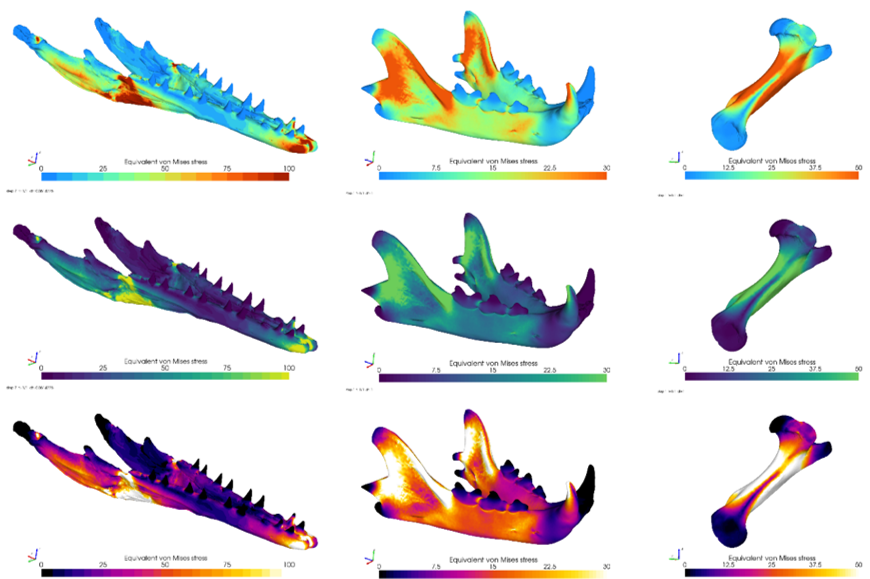
FOSSILS: free, fast, and open-source biomechanical modelling

Post provided by Narimane Chatar (She/Her) Romain Boman (He/Him), Valentin Fallon Gaudichon (He/Him), Jamie A. MacLaren (He/Him), Valentin Fischer (He/Him).

Understanding the way that bones and other biological materials deal with the stresses and strains of everyday life is fundamental for interpreting the behaviour of modern and extinct organisms. Researchers frequently do this by using a digital simulation which can predict the behaviour of materials by breaking complex objects down into much smaller elements – this is known as finite element modelling. In this blog post, Narimane Chatar and her co-authors discuss their new protocol for performing finite element modelling aimed at life-sciences and biomechanics which is fast, open-source, and free for all to use.

Continue reading “FOSSILS: free, fast, and open-source biomechanical modelling”

voluModel: a new R package to model species distributions in 3 dimensions

Post provided by Hannah Owens (she/her)

One of the base units of analysis for biogeography and conservation science is the species range map. Once we know where a species is, we can ask questions like “Why is it there?”, “How did it get there?”, or “What can we do to make this place better for it?” Especially these days, I am very interested in mapping marine fish distributions, which, it turns out, is not as simple as mapping terrestrial species.

Continue reading “voluModel: a new R package to model species distributions in 3 dimensions”

How to weigh a whale

Post provided by Nathan Hirtle (he/him)

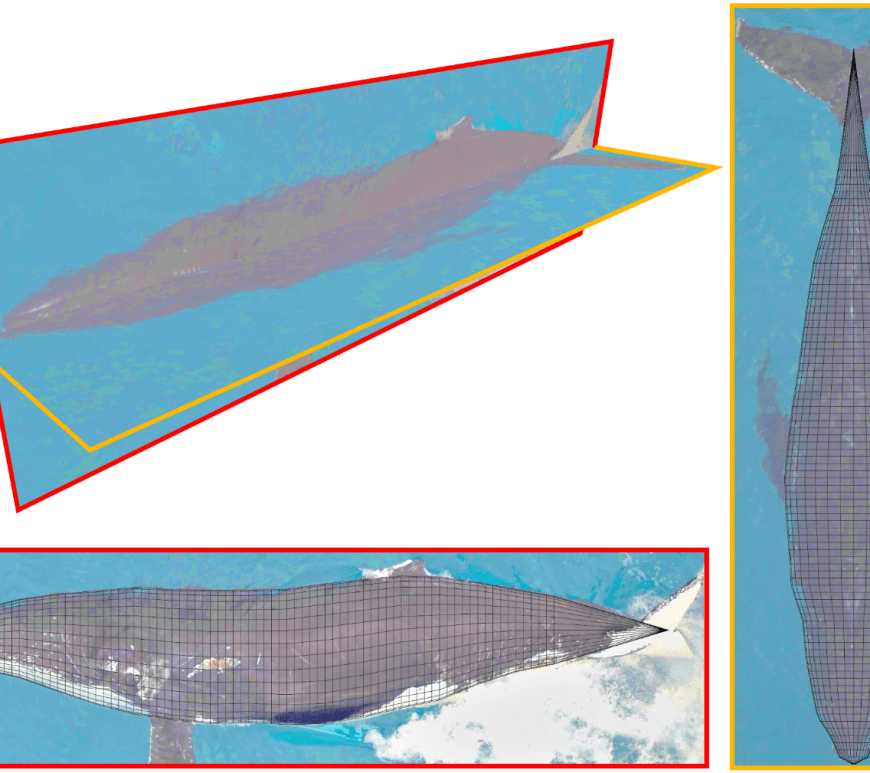
A whale’s size not only provides information on its own health, but also the status of the marine ecosystem in which it lives. So how do scientists weigh the biggest creatures on planet? In this blog post, Nathan Hirtle shares insight from his recent paper on measuring the volume of whales using drone images.

Continue reading “How to weigh a whale”

Random errors are neither: interpretation of correlated data

Post provided by Anthony Ives

It was a true privilege to be asked to write the inaugural E. C. Pielou Review for Methods in Ecology and Evolution. The first ecology book I bought as an undergraduate was her Ecological Diversity (1975) which still sits on my bookshelf full of marginalia. Both ecology and evolution have long and rich histories of theoretical and empirical work, yet sometimes theory and observation have been only loosely connected. Pielou’s work made it possible to link theory and observation more tightly by providing quantitative, statistical metrics to describe patterns in the world that can be related back to theory.

Continue reading Random errors are neither: interpretation of correlated data

Best practices for taxonomic harmonization, an overlooked yet crucial step in biodiversity analyses

Post provided by Matthias Grenié, Emilio Berti, Juan Carvajal-Quintero, Gala Mona Louise Dädlow, Alban Sagouis and Marten Winter.

Merging taxonomic datasets from diverse sources for use in macroecological studies can prove challenging, as there is no standardised methodology, taxonomic names often change over time, and even close colleagues can format the exact same data using different approaches. Researchers at iDiv, the German Centre for Integrative Biodiversity, held a workshop to discuss strategies for harmonizing taxonomy which led to a review of best practice being published in Methods in Ecology and Evolution. In this post, Matthias Grenié and co-authors share insight on this process.    

Continue reading “Best practices for taxonomic harmonization, an overlooked yet crucial step in biodiversity analyses”

Revealing the hidden lives of cryptic mountain lions using GPS data and a Moving-Resting Motion model

Post provided by Mark Elbroch, Chaoran Hu, Tom Meyer, Vladimir Pozdnyakov & Jun Yan

Female mountain lion collared in Washington USA in late December 2021.

Information on how and even why terrestrial mammals move through their habitat landscapes is important for forming the foundation of how to manage and conserve species. For elusive mountain lions, GPS data is particularly vital for monitoring these important apex predators in relation to their ecosystems and the people they share the land with. In this blog post, the team discusses their novel motion model, published in Methods in Ecology and Evolution, which helps us understand the movement of mountain lions from GPS location data.

Continue reading “Revealing the hidden lives of cryptic mountain lions using GPS data and a Moving-Resting Motion model”

plantR: Managing species records from biological collections

Post provided by Renato Lima

Many biodiversity studies, covering a wide range of goals, need species records. These records are becoming readily available online, however there is minimal standardisation for these records at this stage, therefore requiring final users to spend a significant amount of time formatting records prior to using data. To overcome this, Renato Lima et al. have created plantR – an open-source package that provides a comprehensive toolbox to manage species records from biological collections. In this blog post, Renato discusses the workflow of the package and describes how this package can help researchers better assess data quality and avoid data leakage.

Continue reading “plantR: Managing species records from biological collections”

A Multiple-Part Morphospace

Post provided by Daniel Thomas

Many biologists dedicate their careers to finding out why life has taken the shape it has. Darwinian natural selection gives us the how, but researchers are deeply interested in why we find particular morphologies amongst certain organisms, when these morphologies arose, and what these morphologies mean for the organisms and the communities in which they reside. In this post, Daniel Thomas (Massey University, New Zealand) describes the philosophy behind the new morphoBlocks package for R. The package is presented in a new paper within the ‘Realising the promise of large data and complex models’ Special Feature for Methods in Ecology and Evolution. Researchers interested in exploring the morphoBlocks package are encouraged to try these three vignettes.

Continue reading “A Multiple-Part Morphospace”

Do-it-yourself fishing and climate scenario experiments with a marine ecosystem model

Post provided by Michael Heath, Tom Doherty,  Jack Laverick & Douglas Speirs

Herring is a planktivorous fish species. Credit: Atle Grimsby.

World Fisheries Day, celebrated on November 21, is dedicated to highlighting the critical importance of healthy ocean ecosystems and to ensure sustainable stocks of fisheries in the world. Pressure to find ecologically sustainable strategies for harvesting food from the sea is getting ever stronger, especially in the face of changing climate. However, the question is complex because the harvestable species live in a complex food web where everything is directly or indirectly connected to everything else. Models for carrying out scenario analyses on the impact of fisheries management options on food webs are usually the preserve of trained experts.

In this blog post, Michael Heath of the University of Strathclyde guides us through how using a new marine modelling package and online app, published in their recent Methods in Ecology and Evolution paper ‘StrathE2E2: An R package for modelling the dynamics of marine food webs and fisheries.’, makes these analyses easily accessible to anyone with just basic website skills.

Continue reading “Do-it-yourself fishing and climate scenario experiments with a marine ecosystem model”

Let’s get real: translating species distribution models into conservation practice

Post provided by Veronica F. Frans

Species distribution models (SDMs) are popular methods for identifying important habitats for species, but what does it take to translate SDMs into conservation practice? In this post, Veronica Frans discusses the applications of iSDMdb as featured in the paper, “Integrated SDM database: enhancing the relevance and utility of species distribution models in conservation management”, recently published in Methods in Ecology and Evolution.

Continue reading “Let’s get real: translating species distribution models into conservation practice”