Methods in Ecology and Evolution: International Women’s Day 2024 

To celebrate International Women’s Day 2024, we are excited to share a collection of blog posts showcasing the work of some of our new Associate Editors. In each post, our editors discuss their experiences in ecology, as well as what this year’s theme, ‘Inspire Inclusion‘, means to them.   Dr Lorna Hernandez-Santin (She/her)  What work do you do?  These days I work mostly with restoration ecology. … Continue reading Methods in Ecology and Evolution: International Women’s Day 2024 

Spooky ecology: A celebration of bats

Marking the end of Bat appreciation month and Halloween explore some of the BES journals articles all about our favourite flying mammal! Bats are Important in many ways including as pollinators (Tremlett et al. 2020) , insect control, seed dispersal and can even  act as indicators of habitat health. Echolocation is a vital communication and navigation method and aid in locating prey (Lewanzik et al. … Continue reading Spooky ecology: A celebration of bats

Our January issue is now online and open access!

Our January issue is now online now open access! This issue contains 23 articles about the latest methods in ecology and evolution, including a special feature on Large data and complex models, methods on food web visualisation, biologging and much more! Read our first open access issue to find out about this month’s featured articles and the article behind our cover. Special feature Realising the Promise … Continue reading Our January issue is now online and open access!

Blog Associate Editor Wanted!

We are looking for an engaging researcher with expertise in the fields of evolutionary biology and ecology and a passion for communicating new methods. They will work with our current Editor to continue delivering high-quality content on the blog. The Editor will gain excellent experience in commissioning, writing and editing – as well as having early access to articles on the most cutting-edge methods in … Continue reading Blog Associate Editor Wanted!

Animal Social Networks Joint Special Feature out now!

We are excited to announce that our January Issue, including the Animal Social Networks Special Feature, is now online! All the articles in this issue are free to access – find out more about them below.

Joint with the Journal of Animal Ecology, we held a successful open call for papers, soliciting original research capturing novel methodological developments or applications of social network theory to new empirical questions.

Read all about the Special Feature in the editorial Animal social networks: Towards an integrative framework embedding social interactions, space and time by editors Sebastian Sosa, David Jacoby, Mathieu Lihoreau and Cédric Sueur.

Continue reading “Animal Social Networks Joint Special Feature out now!”

Our August Issue is OUT NOW

The August issue of Methods is now online!Cover JPEG

We have a larger issue of 14 articles this month, featuring tools for microbial evolution experiments, automatic biomass estimation of invertebrates, labeling biological samples and much more.

Senior Editor Bob O’Hara has selected five featured articles this month – find out about them below. We also have four Applications, one Practical Tools article and 10 articles that are freely available to everyone – no subscription required!

Continue reading “Our August Issue is OUT NOW”

Happy 10th Anniversary to us!

This year is our 10th Anniversary! To celebrate, we’ve made a timeline of highlights from the past decade, from the first paper ever submitted, to a top-cited article with 3,295 citations. We’d like to give a big thanks our dedicated editors, plus all the authors and reviewers who are developing the fields of ecology and evolution with groundbreaking new methods. Here’s to 10 more years! Continue reading Happy 10th Anniversary to us!

Neo was right—The Matrix explains everything

Post provided by Jody Reimer

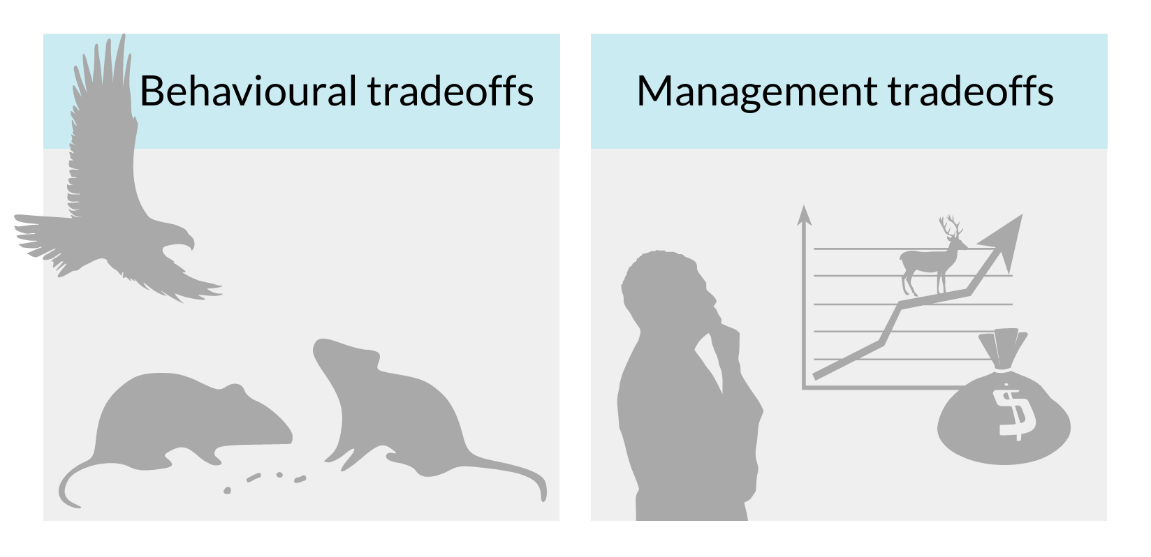
One of the unifying themes in ecology may be the acknowledgement that we live in a world of finite resources, and so we also live in a world of tradeoffs. A diverse range of research questions can be distilled into a question about tradeoffs. For example, how should an animal forage in the presence of predation? Which selective forces determine the life history of a flowering perennial? How should we manage a population to maximize the sustainable harvest rate?
Jody

Questions as varied as these can all be addressed using the same method of stochastic programming[1] (SDP) (see McNamara and Houston, 1986; Rees et al. 1999; and Runge and Johnson, 2002, respectively). SDP has been used extensively to study optimal tradeoffs in a wide range of applications in ecology, evolutionary biology, and management. It is a flexible and powerful modelling framework that allows for simultaneous consideration of an individual’s state, how an optimal decision might explicitly depend on time, and for a probabilistic landscape of risks and rewards. 

[1] Also known as Markov Decision Processes

Continue reading “Neo was right—The Matrix explains everything”

Issue 11.6: goats, camera traps, coral imaging and more!

The June issue of Methods is now online!

June Cover

This month’s issue features articles on designing camera trap studies, measuring coral growth rates, quantifying carbon assimilation by marine calcifiers and much more.

Senior Editor Rob Freckleton has selected six featured articles this month – find out about them below. We’ve also got three Applications and a Practical Tools article which are freely available to everyone – no subscription required!

Continue reading “Issue 11.6: goats, camera traps, coral imaging and more!”

Issue 11.5: Our May issue is now online!

The May issue of Methods is now online! As well as four Application and two Practical Tools articles, the latest issue of Methods in Ecology and Evolution includes six Featured Articles handpicked by our editors – you can find out more about them below.     Featured Articles Tree-based inference of species interaction networks from abundance data To be relevant, any network inference methodology needs … Continue reading Issue 11.5: Our May issue is now online!