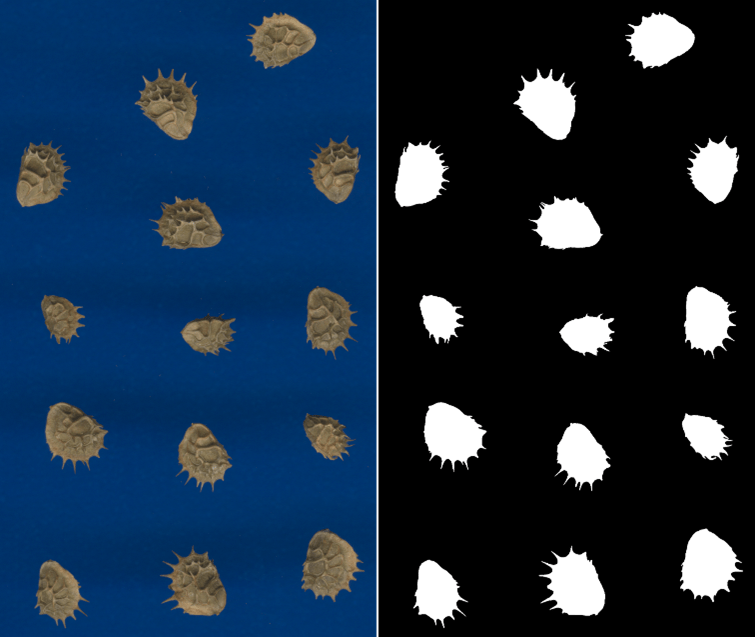
FOSSILS: free, fast, and open-source biomechanical modelling

Post provided by Narimane Chatar (She/Her) Romain Boman (He/Him), Valentin Fallon Gaudichon (He/Him), Jamie A. MacLaren (He/Him), Valentin Fischer (He/Him).

Understanding the way that bones and other biological materials deal with the stresses and strains of everyday life is fundamental for interpreting the behaviour of modern and extinct organisms. Researchers frequently do this by using a digital simulation which can predict the behaviour of materials by breaking complex objects down into much smaller elements – this is known as finite element modelling. In this blog post, Narimane Chatar and her co-authors discuss their new protocol for performing finite element modelling aimed at life-sciences and biomechanics which is fast, open-source, and free for all to use.

Continue reading “FOSSILS: free, fast, and open-source biomechanical modelling”

Robert May Early Career Researcher Shortlist Announced

The Robert May Prize is awarded to the best paper written by in the journal by an author at the start of their research career. With entries spanning out 13th volume our senior editors have selected the following 8 papers. Tanya  Strydom with Food web reconstruction through phylogenetic transfer of low-rank network representation Sandra Simon with ISSRseq: An extensible method for reduced representation sequencing Carrie … Continue reading Robert May Early Career Researcher Shortlist Announced

Our March issue is out now!

Our March issue is now online now! This issue contains 23 articles about the latest methods in ecology and evolution, including a special feature on Methods in Ecological forecasting, fossils citizen science and much more! Read to find out about this month’s featured articles and the article behind our cover. Ecological niche modelling (ENM), species distribution modelling and related spatial analytical methods were first developed in … Continue reading Our March issue is out now!

voluModel: a new R package to model species distributions in 3 dimensions

Post provided by Hannah Owens (she/her)

One of the base units of analysis for biogeography and conservation science is the species range map. Once we know where a species is, we can ask questions like “Why is it there?”, “How did it get there?”, or “What can we do to make this place better for it?” Especially these days, I am very interested in mapping marine fish distributions, which, it turns out, is not as simple as mapping terrestrial species.

Continue reading “voluModel: a new R package to model species distributions in 3 dimensions”

A guide to sample design for GPS-based studies in animal societies

Post provided by Charlotte Christensen (she/her) and Damien Farine (he/him)

Miniaturisation of technology has made GPS tags increasingly accessible for studying animal behaviour. However, limitations in battery life introduces challenging trade-offs in data collection. In this blog post, Charlotte Christensen and Damien Farine discuss how these sampling trade-offs can impact studies that use GPS tags to study social animals.

Continue reading “A guide to sample design for GPS-based studies in animal societies”

Reconsidering how we measure forests with LiDAR

Post provided by Jeff W. Atkins (he/him)

Ecological researchers have adopted light detection and ranging (LiDAR) as a means of quantifying ecosystem structure over the past 25+ years. This is especially true in forest-related research, as LiDAR provides the ability to estimate ecosystem structure with incredibly fine detail, over broad areas. LiDAR can work at the scale of individual trees—for example crown delineation algorithms that identify singular tree canopies—or the stand-level with aggregate structural metrics. In this blog post, Jeff shares insight from he and his co-author’s recent publication “Scale dependency of LiDAR-derived forest structural diversity,” which proposes that using LiDAR requires statistical reassessment to ensure we are measuring what we think we are.

Continue reading “Reconsidering how we measure forests with LiDAR”

Our February Issue is out now!

Our February issue is now online now! This issue contains 32 articles about the latest methods in ecology and evolution, including a special feature on Leveraging Natural History Collections to Understand the Impacts of Global Change, robot herding and much more! Read to find out about this month’s featured articles and the article behind our cover. Special Feature This issue contains 11 articles which are part … Continue reading Our February Issue is out now!

How to weigh a whale

Post provided by Nathan Hirtle (he/him)

A whale’s size not only provides information on its own health, but also the status of the marine ecosystem in which it lives. So how do scientists weigh the biggest creatures on planet? In this blog post, Nathan Hirtle shares insight from his recent paper on measuring the volume of whales using drone images.

Continue reading “How to weigh a whale”

Our January issue is now online and open access!

Our January issue is now online now open access! This issue contains 23 articles about the latest methods in ecology and evolution, including a special feature on Large data and complex models, methods on food web visualisation, biologging and much more! Read our first open access issue to find out about this month’s featured articles and the article behind our cover. Special feature Realising the Promise … Continue reading Our January issue is now online and open access!

Random errors are neither: interpretation of correlated data

Post provided by Anthony Ives

It was a true privilege to be asked to write the inaugural E. C. Pielou Review for Methods in Ecology and Evolution. The first ecology book I bought as an undergraduate was her Ecological Diversity (1975) which still sits on my bookshelf full of marginalia. Both ecology and evolution have long and rich histories of theoretical and empirical work, yet sometimes theory and observation have been only loosely connected. Pielou’s work made it possible to link theory and observation more tightly by providing quantitative, statistical metrics to describe patterns in the world that can be related back to theory.

Continue reading Random errors are neither: interpretation of correlated data