The sending of letters under the pen name ‘St. Valentine’ began back in the middle ages as a way of communicating affection during the practice of courting. Fast forward to 2020 and Valentine’s Day is a day for celebrating romance, but now it typically features the exchange of gifts and cards between lovers.
Executive Editor Rob Freckleton has selected six Featured Articles this month. You can find out about all of them below. We’ve also got six Applications articles and five Open Access articles in the February issue – we’ll talk about all of those here too.
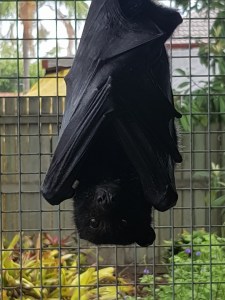
An Australian black flying fox – missing an ear, but fit for release.
Bats. They’re amazing creatures. Long-lived (with relevance to their body size), echolocating (for microbats and some megabats), metabolically-resilient (apparently resilient to most virus infections) flying mammals (with heart beats up to 1200 bpm for hours during flight). There are 1,411 species of this incredible creature. But very little is known about their physiology and unique biological traits. And detailed evolutionary analysis has only just begun.
The problem is, they’re an ‘exotic’ animal (wildlife that most people do not come into contact with). Being a long-lived animal producing minimal offspring (most only have one baby per year), they’re not suited to the kind of experimental studies we do with other animals like mice. Unavoidably, some aspects of biology require the use of tissues and cells. These samples can be used for sequencing, genomics, molecular evolution studies, detailed transcriptomic analysis, functional experiments with specific cell types and much more. Some methodology is beginning to be published – such as capture techniques and wing punch/genomic isolation – but there’s been an absence of protocols for the processing of bats. This is essential for the field to maximise the potential application of each individual and for minimising non-essential specimen collection.
Aurora Borealis in the polar north. Photo: Noel Bauza, Pixabay
For those of us in the Northern Hemisphere, the coldest months of the year are upon us. A combination of post-holiday ‘blues’ and the cold, dark mornings make the daily trudge to work all that less inspiring. Recent snow storms in locations such as Newfoundland (Canada), have made it nearly impossible for many people to leave their homes, let alone commute to work. Now cast your mind to a little over 2,000 km north of Newfoundland and imagine the challenges faced with carrying out a job during the coldest, darkest months of the year.
As with every other biome on the planet, polar biomes contain a variety of different species, from bugs to baleen whales. To better understand the different species at our poles, scientists need to collect ecological data, but this is far from a walk in the park.
Iceberg in the Gerlache Strait, Antarctica. Photo: Liam Quinn, flikr.
We’re starting 2020 with a great issue – and ALL of the articles are completely free. And they’ll remain free for the whole year. No subscription required.
You can find out more about our Featured Articles (selected by the Senior Editor) below. We also discuss this month’s Open Access, Practical Tools and Applications articles. There are also articles on species distributions, biotic interactions, taxonomic units and much more.
Methods in Ecology and Evolution is turning 10 years old! Back in 2010, we launched the journal because of feedback from the community that there was a need for a journal that promoted the publication of new methods. Founding Editor Rob Freckleton and Graziella Iossa (now a member of the Editorial Board) summarised the aims and ambitions for the journal in the first issue. They … Continue reading Ten Years of Methods in Ecology and Evolution
Climate change is threatening biodiversity and ecosystems around the world. We urgently need to better understand how species and ecosystems respond to these changes. There are already thousands of climate change experiments and observational studies out there that could be used to synthesise findings across systems and regions. But it turns out that making meaningful syntheses isn‘t always so straightforward!
The Need for Standardised Methods and Reporting
There are two major challenges (and some minor ones too) for synthesising data across different experiments. First, the data are not always available. This problem arises because key study information – such as metadata, covariates or methodological details – are often not adequately or consistently reported across studies.
The second problem is that scientists use different protocols. This leads to a diversity of ways of measuring and quantifying the same variables. Different protocols may measure or report the same variables in slightly different ways, so the data are not compatible. Consistency in measurements and protocols is one reason why working in large networks – such as ITEX, Herbivory, or NutNet – to name only a few, is so powerful. In these networks, experiments and observations are repeated across large regions or worldwide using strict protocols for experimental design and measurements. Continue reading “Standardising Methods in Climate Change Experiments: A Community Effort”
Coming to the BES Annual Meeting? Planning to submit a paper to a BES journal? Then you should sign up for the Speed Review Session on Thursday 12 December! (sign-up sheets will be on the BES Stand in the Exhibition Hall.) Find out more about this session below.
Essentially, Speed Review is a chance for you to get a Senior Editor’s opinion on your manuscript. All you need to do is sign-up and bring along a figure or a key finding from your research to centre the discussion on. Each session will be limited to five minutes, so try to have a succinct summary of your manuscript ready as well. The Editor you speak to will let you know what they think of your paper and try to give you some advice about any areas to highlight or any potential concerns that they might have about it. Continue reading “Speed Review at the BES Annual Meeting: Get a Senior Editor’s Opinion on YOUR Manuscript”
You can find out more about our Featured Articles (selected by the Senior Editor) below. We also discuss this month’s Open Access and freely available papers we’ve published in our latest issue (Practical Tools and Applications articles are always free to access, whether you have a subscription or not) .




 Methods Blog