New Technologies Could Help Conservationists Keep Better Track of Serengeti Wildebeest Herds

Below is a press release about the Methods in Ecology and Evolution article ‘A comparison of deep learning and citizen science techniques for counting wildlife in aerial survey images‘ taken from the University of Glasgow.

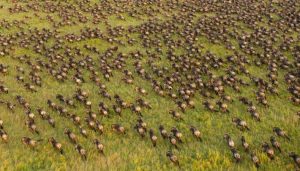
A wildebeest herd in the Serengeti. ©Daniel Rosengren

Mathematicians and conservationists from the UK, Africa and the United States have used machine-learning and citizen science techniques to accurately count wildebeest in the Serengeti National Park in Tanzania more rapidly than is possible using traditional methods.

Evaluating wildebeest abundance is currently extremely costly and time-intensive, requiring manual counts of animals in thousands of aerial photographs of their habitats. From those counts, which can take months to complete, wildlife researchers use statistical estimates to determine the size of the population. Detecting changes in the population helps wildlife managers make more informed decisions about how best to keep herds healthy and sustainable. Continue reading “New Technologies Could Help Conservationists Keep Better Track of Serengeti Wildebeest Herds”

R-Ladies: For More Balance in the R Community!

The theme for this year’s International Women’s Day is #BalanceForBetter. So, we decided that we’d like to take this opportunity to promote an organisation that supports and empowers women and gender minorities in STEM fields that still suffer from underrepresentation. As a journal, we publish a lot of articles on software and code that are used in the study of different fields in ecology and evolutionary biology. We have a wide audience of R coders and R users who follow us on social media and read our blog. With that in mind, R-Ladies seemed like a fairly obvious group for us to promote…

Post provided by MAËLLE SALMON and HANNAH FRICK, two members of the R-LADIES GLOBAL TEAM.

What is R-Ladies?

R-Ladies is a global grassroots organisation whose aim is to promote gender diversity in the R community. The R community suffers from an underrepresentation of gender minorities (including but not limited to cis/trans women, trans men, non-binary, genderqueer, agender). This can be seen in every role and area of participation: leaders, package developers, conference speakers, conference participants, educators, users (see recent stats). What a waste of talent!

As a diversity initiative, the mission of R-Ladies is to achieve proportionate representation by encouraging, inspiring, and empowering people of genders currently underrepresented in the R community. So our primary focus is on supporting minority gender R enthusiasts to achieve their programming potential. We’re doing this by building a collaborative global network of R leaders, mentors, learners, and developers to help and encourage individual and collective progress worldwide. Continue reading “R-Ladies: For More Balance in the R Community!”

Quantifying Animal Movement from Videos

Quantifying animal movement is central to research spanning a variety of topics. It’s an important area of study for behavioural ecologists, evolutionary biologists, ecotoxicologists and many more. There are a lot of ways to track animals, but they’re often difficult, especially for people who don’t have a strong background in programming. Vivek Hari Sridhar, Dominique G. Roche and Simon Gingins have developed a new, simple software to … Continue reading Quantifying Animal Movement from Videos

Citizen Science Projects Have a Surprising New Partner – The Computer

Below is a press release about the Methods in Ecology and Evolution article ‘Identifying animal species in camera trap images using deep learning and citizen science‘ taken from the University of Minnesota-Twin Cities.

The computer’s accuracy rates for identifying specific species, like this warthog, are between 88.7 percent and 92.7 percent. Image credit: ©Panthera
The computer’s accuracy rates for identifying specific species, like this warthog, are between 88.7 percent and 92.7 percent. ©Panthera

For more than a decade, citizen science projects have helped researchers use the power of thousands of volunteers who help sort through datasets that are too large for a small research team. Previously, this data generally couldn’t be processed by computers because the work required skills that only humans could accomplish.

Now, computer machine learning techniques that teach the computer specific image recognition skills can be used in crowdsourcing projects to deal with massively increasing amounts of data—making computers a surprising new partner in citizen science projects.

Continue reading “Citizen Science Projects Have a Surprising New Partner – The Computer”

Field Work on a Shoestring: Using Consumer Technology as an Early Career Researcher

Post provided by CARLOS A. DE LA ROSA

Esta entrada de blog también está disponible en español

Champagne Tastes on a Beer Budget

Freshly outfitted with a VACAMS camera and GPS unit, #1691 heads off into the forest with her calf. ©Carlos A. de la Rosa

There’s a frustrating yin and yang to biological research: motivated by curiosity and imagination, we often find ourselves instead defined by limitations. Some of these are fundamental human conditions. The spectrum of light detectable by human eyes, for example, means we can never see a flower the way a bee sees it. Others limitations, like funding and time, are realities of modern-day social and economic systems.

Early career researchers (ECRs) starting new projects and delving into new research systems must be especially creative to overcome the odds. Large grants can be transformative, giving a research group the equipment and resources to complete a study, but they’re tough to get. Inexperienced ECRs are at a disadvantage when competing against battle-hardened investigators with years of grant writing experience. Small grants of up to about $5000 USD, on the other hand, are comparatively easy to find. So, how can ECRs make the most of small, intermittent sources of funding?

I found myself faced with this question in the second year of my PhD field work. Continue reading “Field Work on a Shoestring: Using Consumer Technology as an Early Career Researcher”

Trabajo de Campo a lo Barato: Uso de Tecnología de Productos de Consumo Para un Investigador al Inicio de su Carrera de Investigación

Contribución de CARLOS A. DE LA ROSA

This blog post is available in English

Gusto por champaña con presupuesto de cerveza

Recientemente equipada con una unidad de cámara y GPS VACAMS, la vaca No. 1691 se dirige al bosque con su becerro. ©Carlos A. de la Rosa

Hay un frustrante toma-y-dame en el campo de la investigación biológica: motivados por la curiosidad y la imaginación, a menudo nos encontramos definidos por limitaciones. Algunas de estas, como nuestros sentidos, son condiciones humanas fundamentales. El espectro de luz detectable por los ojos humanos, por ejemplo, significa que nunca podremos ver a una flor de la misma forma en que la ve una abeja. Otras limitaciones, como financiamiento y tiempo, representan las realidades de los sistemas sociales y económicos de hoy día.

Los investigadores al comienzo de sus carreras (Early Career Researchers, o ECRs en sus siglas en inglés) que se embarcan en nuevos proyectos y se involucran con sistemas nuevos de investigación deben ser especialmente creativos para poder superar las probabilidades. Una generosa beca puede ser transformativa, pero un ECR con poca experiencia está en desventaja cuando compite con investigadores ya endurecidos por la batalla, quienes tienen años de experiencia escribiendo propuestas de financiamiento. Por otra parte, las pequeñas becas en el rango de $2.000 a $5.000 son comparativamente fáciles de encontrar. ¿Cómo puede un ECR aprovechar al máximo estas pequeñas e intermitentes fuentes de financiamiento?

En el segundo año del trabajo de campo de mi doctorado me enfrenté con este enigma. Continue reading “Trabajo de Campo a lo Barato: Uso de Tecnología de Productos de Consumo Para un Investigador al Inicio de su Carrera de Investigación”

Using Dual RNA-seq to Investigate Host-Pathogen Systems When Genomic Resources are Limited

Post provided by KAYLEIGH O’KEEFFE

Tall fescue infected with fungal pathogen, Rhizoctonia solani. ©Brooklynn Newberry

Pathogens and the infectious diseases that they cause can have devastating impacts on host individuals and populations. To better understand how pathogens are able to cause disease, we can investigate the genetic mechanisms underlying the infection process. Hosts may respond to infection by upregulating defence pathways. Pathogens, in turn, evade these host immune responses as they infect and cause disease. As this process unfolds and each organism responds to the other, gene expression changes in both the host and the pathogen. These gene expression changes can be captured by dual RNA‐seq, which simultaneously captures the gene expression profiles of a host and of a pathogen during infection. Continue reading “Using Dual RNA-seq to Investigate Host-Pathogen Systems When Genomic Resources are Limited”

‘Eavesdropping’ Technology used to Protect one of New Zealand’s Rarest Birds

Below is a press release about the Methods in Ecology and Evolution article ‘A novel method for using ecoacoustics to monitor post‐translocation behaviour in an endangered passerine‘ taken from the Zoological Society of London.

Juvenile hihi. ©ZSL
Juvenile hihi. ©ZSL

Scientists from international conservation charity ZSL (Zoological Society of London), Imperial College London and conservationists from the Rotokare Scenic Reserve Trust used acoustic monitoring devices to listen in on the ‘conversations’ of New Zealand’s endemic hihi bird, allowing them to assess the success of the reintroduction without impacting the group.

For the first time ZSL scientists were able to use the calls of a species as a proxy for their movement. A happy hihi call sounds like two marbles clanging together in what is known as the ‘stitch’ call. Scientists saw the calls change from an initial random distribution to a more settled home range – marking the hihi reintroduction and the new method a success. Continue reading “‘Eavesdropping’ Technology used to Protect one of New Zealand’s Rarest Birds”