Getting Serious About Transposable Elements

Post Provided by: Gabriel Rech and José Luis Villanueva-Cañas

So Simple yet so Complex

A long standing research topic in evolutionary biology is the genetic basis of adaptation. In other words, how does a novel trait appear (or spread) in response to an environmental change? Despite the rapid advances in sequencing over the last two decades, we have only been able to fully characterize a few adaptations.

As stated by Richard Dawkins in Climbing Mount Improbable, while natural selection is a very simple process, modeling natural selection and determining its causes, effects and consequences is an extremely difficult task. Also, most of our efforts so far have been focused on just one type of genetic variation: single nucleotide polymorphisms (SNPs). Other types of variations such as transposable element (TE) insertions have received much less attention. Paradoxically, some great examples of the role of TEs in adaptation have been right under our noses the whole time, in basic biology textbooks. Continue reading “Getting Serious About Transposable Elements”

Why Soft Sweeps from Standing Genetic Variation are More Likely than You May Think

We coined the term “soft sweeps” in 2005. The term has since become widely used, though not everyone uses the term in the same way. As part of the ‘How to Measure Natural Selection‘ Special Feature in Methods in Ecology and Evolution, we attempt to clarify what “soft sweep” means and doesn’t mean. For example, not every sweep from standing genetic variation is necessarily a … Continue reading Why Soft Sweeps from Standing Genetic Variation are More Likely than You May Think

Evolutionary Quantitative Genetics: Virtual Issue

Post provided by Michael Morrissey

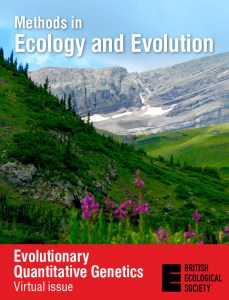
©Dr. Jane Ogilvie, Rocky Mountain Biological Laboratory

Evolutionary quantitative genetics provides formal theoretical frameworks for quantitatively linking natural selection, genetic variation, and the rate and direction of adaptive evolution. This strong theoretical foundation has been key to guiding empirical work for a long time. For example, rather than generally understanding selection to be merely an association of traits and fitness in some general way, theory tells us that specific quantities, such as the change in mean phenotype within generations (the selection differential; Lush 1937), or the partial regressions of relative fitness on traits (direct selection gradients; Lande 1979, Lande and Arnold 1983) will relate to genetic variation and evolution in specific, informative ways.

These specific examples highlight the importance of the theoretical foundation of evolutionary quantitative genetics for informing the study of natural selection. However, this foundation also supports the study other critical (quantification of genetic variation and evolution) and complimentary (e.g., interpretation when environments, change, the role of plasticity and genetic variation in plasticity) aspects of understanding the nuts and bolts of evolutionary change. Continue reading “Evolutionary Quantitative Genetics: Virtual Issue”

Britain’s Smallest Bird Affected by Cold Winters: New Analysis Methods Relate Wildlife Abundance to Weather

Below is a press release about the Methods paper ‘Attributing changes in the distribution of species abundance to weather variables using the example of British breeding birds‘ taken from the University of St Andrews.

©CJ Hughson
The goldcrest is being hit hard by cold winters. ©CJ Hughson

Britain’s smallest bird species, the goldcrest, is being hit hard by cold winters, new analysis methods developed by researchers at the University of St Andrews have revealed.

The data analysis techniques, published today in Methods in Ecology and Evolution, take a longer term view over multiple locations and for a period of several years, compared to previous studies.

They showed that the cold temperatures strongly affected breeding numbers of the goldcrest, while in contrast, the song thrush was not affected by the cold, but benefited from wet and mild summers. Continue reading “Britain’s Smallest Bird Affected by Cold Winters: New Analysis Methods Relate Wildlife Abundance to Weather”

BES Guide to Reproducible Code: Tips and Tricks Needed

This call for tips and tricks has now closed. The Guide to Reproducible Code in Ecology and Evolution has been published and is freely available to everyone. The British Ecological Society is currently working on a Guide to Reproducible Code. This will follow on from our previous Guides to Peer Review, Data Management and Getting Published. All of our Guides are intended to provide Early … Continue reading BES Guide to Reproducible Code: Tips and Tricks Needed

Issue 8.6: How to Measure Natural Selection

Issue 8.6 is now online!

The April issue of Methods, which includes our latest Special Feature – ‘How to Measure Natural Selection – is now online!

Understanding how and why some individuals survive and reproduce better than others, the traits that allow them to do so, the genetic basis of those traits, and the signatures of past and present selection in patterns of variation in the genome remain at the top of the research agenda for evolutionary biology. This Special Feature – Guest Edited by Jeff Conner, John Stinchcombe and Joanna Kelley – draws together a collection of seven papers that highlight new methodological and conceptual approaches to meeting this agenda.

Three of the ‘How to Measure Natural Selection’ papers – Franklin and Morrissey, Thomson and Hadfield, and Hadfield and Thomson – clarify unresolved aspects of the literature in meaningful and important ways. Following on from this Hermisson and Pennings; Lotterhos et al.; and Villanueva‐Cañas et al. tackle the genomic results of evolution by natural selection: namely, how we can detect natural selection from genomic data? Finally, Wadgymar et al. address the issue of how much we know about the underlying loci or agents of selection.

To use the Editors’ own words, the articles in this issue “deal with how we can detect selection in a way that can be used to predict evolutionary responses, how selection affects the genome, and how selection and genetics underlie adaptive differentiation.”

All of the articles in the ‘How to Measure Natural Selection‘ Special Feature will be freely available for a limited time.
Continue reading “Issue 8.6: How to Measure Natural Selection”

Bottom-up Citizen Science and Biodiversity Statistics

Post provided by Ditch Townsend and Robert Colwell

Different Paths to Science

Ditch Townsend on Exmoor in Devon, UK

DITCH: Amateur naturalists from the UK have a distinguished pedigree, from Henry Walter Bates and Marianne North, to Alfred Russel Wallace and Mary Anning. But arguably, the rise of post-war academia in the fifties displaced them from mainstream scientific discourse and discovery. Recently, there has been a resurgence of the ‘citizen scientist’, like me, in the UK and elsewhere – although the term may refer to more than one kind of beast.

To me, the ‘citizen scientist’ label feels a little patronising – conveying an image of people co-opted en masse for top-down, scientist-led, large-scale biological surveys. That said, scientist-led surveys can offer valid contributions to conservation and the documentation of the effects of climate change (among other objectives). They also engage the public (not least children) in science, although volunteers usually have an interest in natural history and science already. For me though, the real excitement comes in following a bottom-up path: making my own discoveries and approaching scientists for assistance with my projects.

Robert Colwell at the Boreas Pass in Colorado, USA

ROB: I grew up on a working ranch in the Colorado mountains, surrounded on three sides by National Forest and a National Wilderness Area. My mother, an ardent amateur naturalist, taught me and my sister the local native flora and fauna and our father instilled a respect for the land in us. For my doctoral research at the University of Michigan, I studied insect biodiversity in Colorado and Costa Rica at several elevations. The challenges of estimating the number of species (species richness) and understanding why some places are species-rich and others species-poor has fascinated me ever since. Continue reading “Bottom-up Citizen Science and Biodiversity Statistics”

‘Size’ and ‘Shape’ in the Measurement of Multivariate Proximity

Ordination and clustering methods are widely applied to ecological data that are non-negative (like species abundances or biomasses). These methods rely on a measure of multivariate proximity that quantifies differences between the sampling units (e.g. individuals, stations, time points), leading to results such as: Ordinations of the units, where interpoint distances optimally display the measured differences Clustering the units into homogeneous clusters Assessing differences between … Continue reading ‘Size’ and ‘Shape’ in the Measurement of Multivariate Proximity

At Last, a Paleobiologist is a Senior Editor for Methods in Ecology and Evolution!

Post provided by Lee Hsiang Liow

An Asian, female Senior Editor under 45? Progressive! I have loved Methods in Ecology and Evolution since it appeared in 2010 and am thrilled to have been selected to join Rob, Bob and Jana to help with the journal’s continued development.
OK, so you want to know who the new Senior Editor on the MEE block is.  I’m just another scientist, I guess. On the outside, we look different but on the inside, we’re all the same. (OK, perhaps we are a little different, even on the inside, but that makes life and research interesting, right?)

Here’s my academic life history: I did my Bachelors thesis on the systematics/phylogenetics of an obscure group of marine pulmonate slugs with one of the greatest Icelandic biologists I know, Jon Sigurdsson, at the National University of Singapore. I followed this up with an almost-half-year stint at the Museum of Natural Science in Berlin as a “nobody”, digitizing data. Then I won the academic lottery and headed up to Uppsala to do my masters in conservation biology on tropical pollinator diversity, (un)supervised by two amazing supervisors that never met each other, the late Navjot Sodhi (National University of Singapore) and Thomas Elmqvist, now at Stockholm University. Continue reading “At Last, a Paleobiologist is a Senior Editor for Methods in Ecology and Evolution!”

The Right Tool for the Job: Using Zeta Diversity to Communicate Uncertainty in Ecological Modelling

Post provided by Mariona Roigé

The Need for Modelling

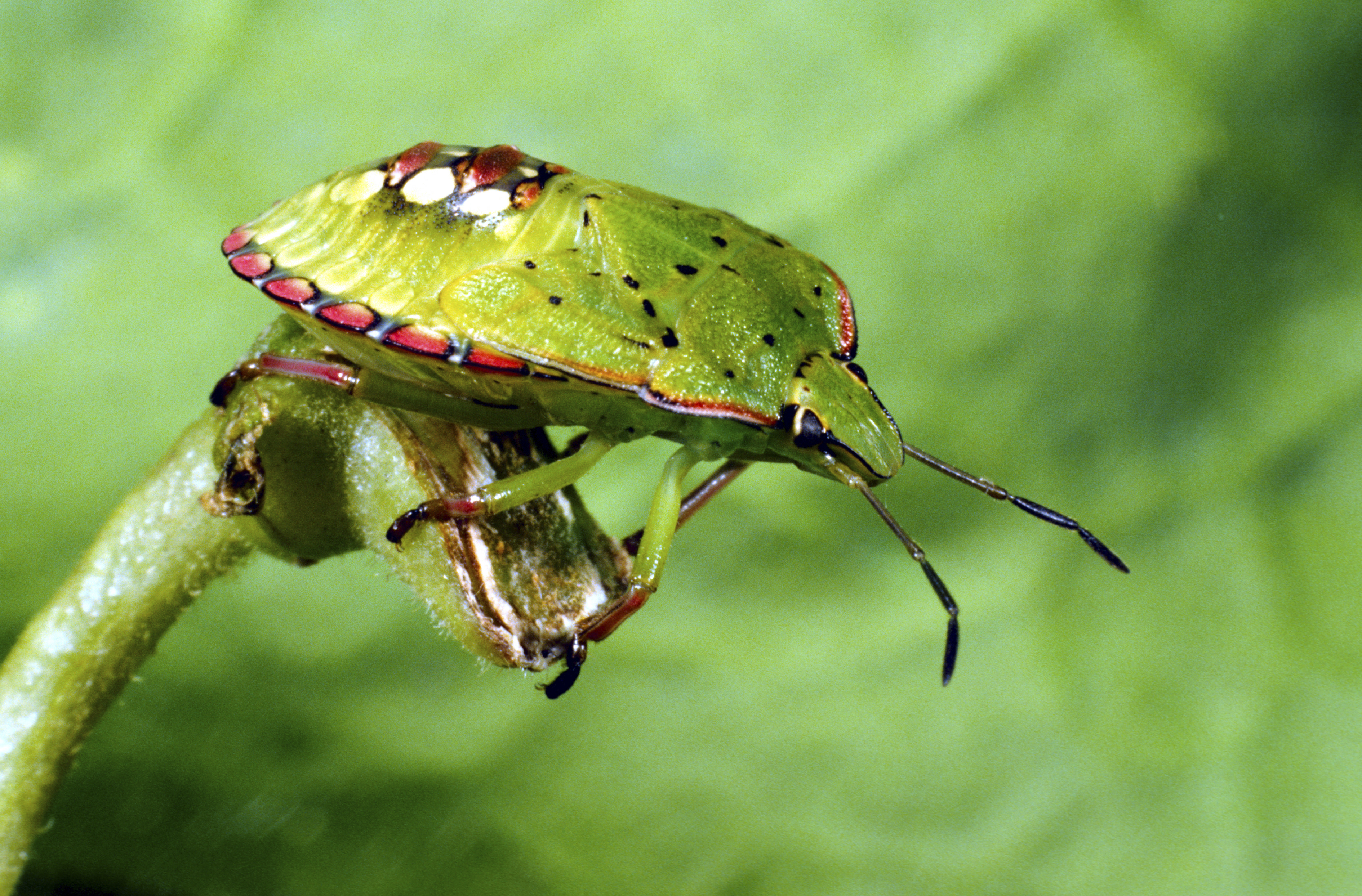
Green vegetable bug nymph (Nezara viridula). ©John Marris. Lincoln University.

Despite how far modelling has taken us in science, the use of models remains controversial. Modelling covers a huge range of common practices, from scaled models of ships to determine the shape that will have the least resistance to water to complex, comprehensive ‘models of everything’. A great example of the latter is the Earth System Model. This model aims to understand the changes in global climate by taking into account the interaction between physical climate, biosphere, the atmosphere and the oceans. Basically, a model of how the Earth works.

The controversy in the use of modelling resides in how accurately the model describes reality and the level of confidence we have in its outputs. The first argument can be a bit counter-intuitive: sometimes, a very simple model can be a great predictor. Actually, the conventional view in ecology is that simple models are more generalisable than complex models, although this view is being challenged. However, the level of confidence, or the level of uncertainty, that we have in the outputs of the model is a crucial point. We need to be able to accurately determine our levels of uncertainty if we want people to trust our models. Continue reading “The Right Tool for the Job: Using Zeta Diversity to Communicate Uncertainty in Ecological Modelling”