Microphone Backpacks for Individual-level Acoustic Recordings

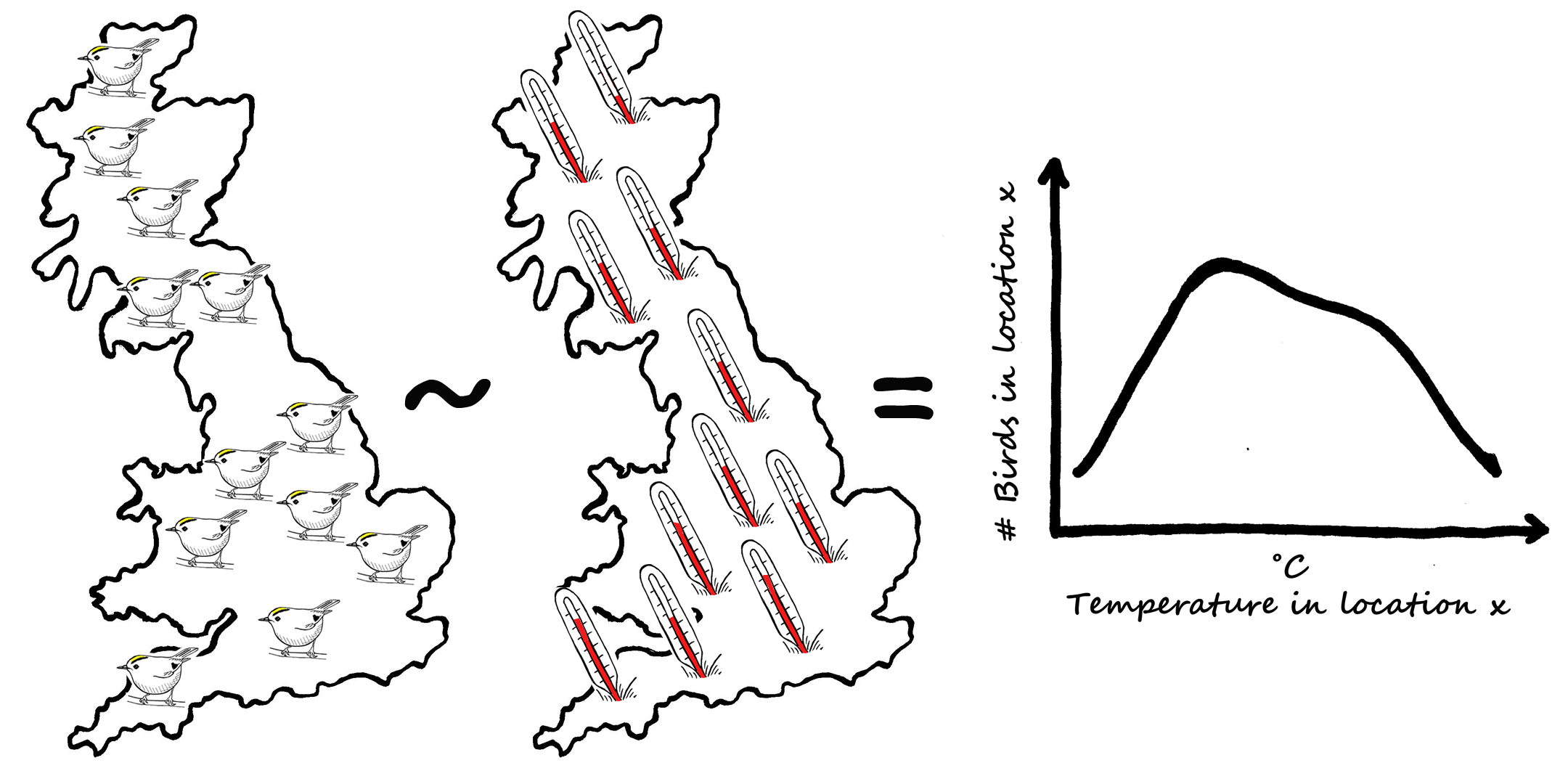
To understand the factors shaping vocal communication, we need reliable information about the communicating individuals on different levels. First, vocal behaviour should be recorded from undisturbed animals in meaningful settings. Then we have to separate and assign the individuals’ vocalisations. Finally, the precise timing of vocal events needs to be stored. Microphone backpacks allow researchers to record the vocal behaviour of individual animals in naturalistic settings – even in acoustically challenging … Continue reading Microphone Backpacks for Individual-level Acoustic Recordings

piecewiseSEM: Exploring Nature’s Complexity through Statistics

Post provided by Jonathan S. Lefcheck

Nature is complicated. As a scientist, you might say, “Well, duh,” but as students of nature, this complexity is probably the single greatest challenge we must face in trying to dissect the hows and whys of the natural world.

History is a Set of Lies Agreed Upon: Moving beyond ANOVA

For a long time, we tried to strip this complexity away by conducting very controlled experiments adhering to rigid designs. The ‘two-way fully-crossed analysis of variance’ will be familiar to anyone who has taken even the most basic stats class, because, for many decades, it was the gold standard for any experiment.

It might be tough to manipulate this whole reef.

The problem is: the real world doesn’t adhere to an ANOVA design. By this, I mean that by their very nature, manipulative experiments are artificial. It’s hard—if not impossible—to manipulate an entire forest or a coral reef, and as such, we retreat to more tractable, smaller investigations. There is certainly a lot of value in determining whether the phenomenon can occur, but these tightly regulated designs say nothing about whether they are likely to occur, particularly at the scales most relevant to humanity.

To get at the latter point, we must leave the safety of the greenhouse. However, our trusty ANOVA toolbox isn’t very useful anymore, because real-world data often violate the most basic statistical assumptions, not to mention the presence of numerous additional influences that may drive spurious relationships. Continue reading “piecewiseSEM: Exploring Nature’s Complexity through Statistics”

Googling for Ecological Answers: Using the Morphic Web Application

Post provided by Gabriella Leighton

Online Images: A Treasure Trove of Ecological Data

In the proclaimed ‘information age’, where answers are available at the click of a button or a swipe of a finger, we have become accustomed to the ability to get an almost instant grasp of any topic. Other fields are already making use of this wealth of easily accessible online data, but biologists and ecologists tend to let it slip by. However, this attitude is slowly beginning to change. Some ecological and evolutionary studies are emerging that have used the internet to gather data – through online citizen science projects (e.g. Evolution MegaLab) or databases (e.g. using Google Trends) – but few have used existing data, particularly publicly available data from image repositories.

We were curious to apply the concept of using existing images on the internet to a fascinating visual biological phenomenon: colour polymorphism (or the occurrence of multiple discrete colour phenotypes). To do this, we planned to exploit an existing penchant people have for uploading photographs of animals to the Internet.

Our search phrases included the common and scientific name of the species, as well as a location-specific term

Continue reading “Googling for Ecological Answers: Using the Morphic Web Application”

2016 Robert May Prize Winner: Gabriella Leighton

The Robert May Prize is awarded annually for the best paper published in Methods in Ecology and Evolution by an Early Career Researcher. We’re delighted to announce that the 2016 winner is Gabriella Leighton, for her article ‘Just Google it: assessing the use of Google Images to describe geographical variation in visible traits of organisms.

‘Just Google it’ marks an important step in converting ecology to an armchair science. Many species (e.g. owls, hawks, bears) are difficult, time-consuming, expensive and even dangerous to observe. It would be a lot easier if we didn’t have to spend time, energy and risk lives having to observe organisms in the field! Continue reading “2016 Robert May Prize Winner: Gabriella Leighton”

Decoupling Functional and Phylogenetic Dissimilarity between Organisms

Francesco de Bello describes the main elements of the method he has recently published in Methods in Ecology and Evolution. The method aims at decoupling and combining functional trait and phylogenetic dissimilarities between organisms. This allows for a more effective combination of non-overlapping information between phylogeny and functional traits. Decoupling trait and phylogenetic information can also uncover otherwise hidden signals underlying species coexistence and turnover, … Continue reading Decoupling Functional and Phylogenetic Dissimilarity between Organisms

New Associate Editors

Today we are welcoming two new people to the Methods in Ecology and Evolution Associate Editor Board. Pierre Durand is joining us from the University of the Witwatersrand (South Africa) and Andrew Mahon joins from Central Michigan University (USA). You can find out more about Pierre and Andrew below. Pierre Durand “My research is broadly focussed on the evolution of complexity. Many of my projects are related to the evolutionary … Continue reading New Associate Editors

Progressive Change BACIPS: Estimating the Effects of Environmental Impacts over Time

Post provided by Lauric Thiault BACIPS (Before-After Control-Impact Paired Series) is probably the best-known and most powerful approach to detect and quantify human interventions on ecosystems. In BACIPS designs, Impact and Control sites are sampled simultaneously (or nearly so) multiple times Before and After an intervention. For each sampling survey conducted Before or After, the difference in the sampled response variable (e.g. density) is calculated. … Continue reading Progressive Change BACIPS: Estimating the Effects of Environmental Impacts over Time

The Field Guide to Sequence-Based Identification of Biodiversity: An Interview with Simon Creer

In a new Methods in Ecology and Evolution podcast, Georgina Brennan (Bangor University) interviews Simon Creer (Bangor University) about his article ‘The ecologist’s field guide to sequence-based identification of biodiversity‘. They talk about about where the idea for the paper came from, what it’s aim are and who will benefit from it. We hear how new sequences can improve and enhance current biomonitoring programmes (and make them … Continue reading The Field Guide to Sequence-Based Identification of Biodiversity: An Interview with Simon Creer

Issue 8.3

Issue 8.3 is now online!

The March issue of Methods is now online!

This issue contains two Applications articles and one Open Access article. These three papers are freely available to everyone, no subscription required.

 Solo: Solo audio recorders are inexpensive, easy to construct and record audible sound continuously for around 40 days. The paper also has a video tutorial explaining how to assemble the required hardware and comes with a companion website with more information.

 The third dimension: A novel design to obtain three-dimensional data on the movements of aquatic organisms at depths of up to 140m. The set-up consists of two synchronised high-speed cameras fixed to two articulated arms and can be used for any underwater applications that require synchronized video recordings of medium- to large-sized animals.

Continue reading “Issue 8.3”

A Homage to EC Pielou: One of the 20th Century’s Most Accomplished Scientists

Post provided by Daniel Simberloff, Nathan Sanders and Pedro Peres-Neto

Evelyn Chrystalla ‘E.C.’ Pielou. © Sharon Niscak

Evelyn Chrystalla ‘E.C.’ Pielou (February 20, 1924 – July 16, 2016) – a towering figure in ecology – was a key pioneer in the incorporation of statistical rigor into biogeography and ecology. She devised many important statistical hypotheses tests for spatial arrangements and patterns ranging in scale from individual plants in a field through to elevational zonation of vegetation to ranges of groups of species distributed over regional through to continental-scale ranges. Her research has provided the impetus for biogeographical analyses for generations.

She published ten books, including several long after her formal retirement in 1988. Her book Biogeography (1979) is a masterpiece. It covers historical biogeography (including inferences from cladograms, which were just beginning to be a hot topic at that time) and ecological biogeography with keen insight and treats topics like long-distance dispersal (that had largely been the subject of just-so stories) with her characteristic statistical rigor. Her books on mathematical ecology have a strong emphasis on models of spatial pattern and ways to estimate biodiversity, and her methods – including the famous Pielou‘s evenness index – are still widely used. Continue reading “A Homage to EC Pielou: One of the 20th Century’s Most Accomplished Scientists”