Post provided by EMILIE AIMÉ, Managing Editor, Methods in Ecology and Evolution This year’s annual ESA meeting is fast approaching. It’s in Fort Lauderdale, Florida and I’ll be heading across the pond, along with Catherine Hill, our Head of Publications, and Hazel Norman, our Executive Director, to chat to delegates about Methods in Ecology and Evolution, as well as our other journals and the British … Continue reading Meet the Team at ESA 2016
High-throughput genomic methods are increasingly used to investigate invertebrate thermal responses with greater dimensionality and resolution than previously achieved. However, corresponding methods for characterising invertebrate phenotypes are still lacking. Jacinta Kong and her co-authors propose a novel use of thermocyclers as temperature-controlled incubators for characterising invertebrate phenotypes. Why use a thermocycler instead of current methods to characterise thermal phenotypes? In this video they outline key advantages of … Continue reading Why You Should Use a Thermocycler Instead of an Incubator
In the US, July is National Bison Month but most people in Europe are totally oblivious to it. I wasn’t even aware of it before being asked to write this blog post in connection with our recent Methods in Ecology and Evolution paper about quantifying population sizes of large herbivores. Some will argue that it is because we don’t ‘do’ day, month, state or national animals on this side of the Atlantic as much as the Americans do.
But another reason is that the European bison, Bison bonasus bonasus, is simply not sufficiently well-known or associated with European nature in the public’s mind. This is particularly true in Western Europe where this species has been extinct since medieval times.
Early European accounts from North America reported huge bison populations – with estimates of up to 60 million – moving to and fro in the great bison belt. These past migratory movements across the Great Plains are familiar well beyond the US and feed our view of untamed wilderness prior to the impact of European ’civilisation’. In contrast, there are hardly any records of European bison numbers until just before the last wild one was reported killed in Poland in 1921. Continue reading “European Bison, Rewilding and Dung Fungal Spore”
David Warton (University of New South Wales) interviews Marie-Josee Fortin (University of Toronto) about a recent article on state-and-transition models from her group in Methods in Ecology and Evolution. David and Marie-Josee also discuss what motivated her career to date in spatial ecology, and what she sees as the main advances in this area and current challenges in the field.
This month’s issue contains two Applications articles and two Open Access articles, all of which are freely available.
– MO-Phylogenetics: A software tool to infer phylogenetic trees optimising two reconstruction criteria simultaneously and integrating a framework for multi-objective optimisation with two phylogenetic software packages.
– PHYLOMETRICS: An efficient algorithm to construct the null distributions (by generating phylogenies under a trait state-dependent speciation and extinction model) and a pipeline for estimating the false-positive rate and the statistical power of tests on phylogenetic metrics..
A model that predicts outbreaks of zoonotic diseases – those originating in livestock or wildlife such as Ebola and Zika – based on changes in climate, population growth and land use has been developed by a UCL-led team of researchers.
We wanted to test whether arboreal mammals were using natural canopy bridges – connections between tree branches over a clearing – to travel over a natural gas pipeline in the Peruvian Amazon. The challenge was figuring out how to monitor branches 100 feet up in the tree tops. In this case, the clearing was a 30-foot-wide pipeline path, and we expected arboreal mammals – like monkeys, squirrels and porcupines – to prefer crossing on the branches rather than on the ground. The ground is an unfamiliar and often dangerous place for an animal that’s spent its life way up in the canopy.
The yellow arrow shows the path captured by the camera trap.
In fact, we wondered if without branches, would arboreal mammals cross at all? How could we find out if animals were using the branches? There were 13 canopy bridges and finding a person to sit and wait all day (and night) under each of them for animals to cross wasn’t an option. With our goal of a year’s worth of monitoring, we had a conundrum. We needed a more efficient way to gather the data and concluded that camera traps – motion sensitive cameras – could be an excellent way to monitor the bridges continuously and remotely.
But, we discovered that no one had ever really used camera traps in the high canopy before. How were we going to get them all the way up there? If we were able to get up to the canopy, how could we make sure they were taking photos of the correct points where animals would potentially cross? Continue reading “Canopy Camera Trapping: Heightening Our Knowledge of Arboreal Mammals”
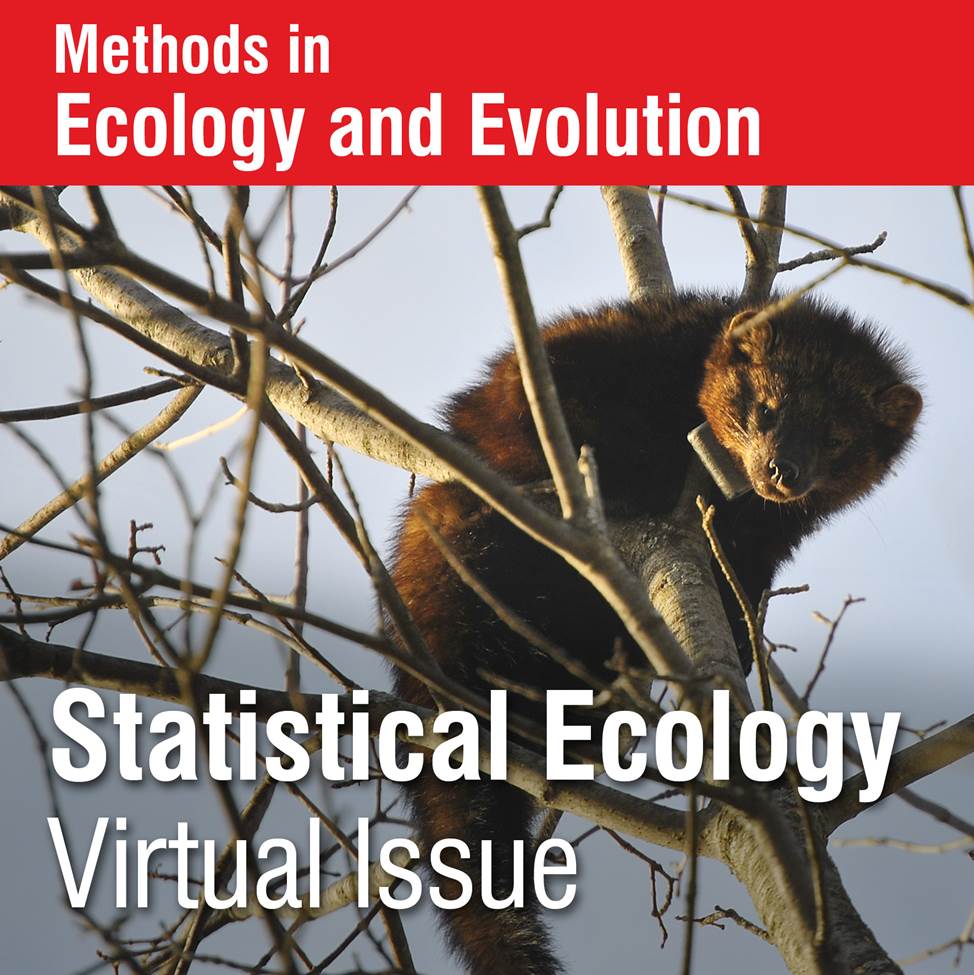
At the last ISEC, in Montpellier in 2014, an informal survey suggested that Methods in Ecology and Evolution was the most cited journal in talks. This reflects the importance of statistical methods in ecology and it is one reason for the success of the journal. For this year’s International Statistcal Ecology Conference in Seattle we have produced a virtual issue that presents some of our best recent papers which cross the divide between statistics and ecology. They range over most of the topics covered at ISEC, from statistical theory to abundance estimation and distance sampling.
We hope that Methods in Ecology and Evolution will be equally well represented in talks in Seattle, and also – just as in Montpellier – some of the work presented will find its way into the pages of the journal in the future.
Our 5th Anniversary Special Feature is a collection of six articles (plus an Editorial from Executive Editor Rob Freckleton) that highlights the breadth and depth of topics covered by the journal so far. It grew out of our 5th Anniversary Symposium – a joint event held in London, UK and Calgary, Canada and live-streamed around the world in April 2015 – and contains papers by Associate Editors, a former Robert May prize winner and regular contributors to the journal.
The six articles are based on talks given at last May’s Symposium. They focus on:
In his Editorial for the Special Feature, Rob Freckleton looks to the future. In his words: “we hope to continue to publish a wide range of papers on as diverse a range of topics as possible, exemplified by the diversity of the papers in this feature”.
If you are attending Evolution, as well as attending the fabulous talks mentioned by Hélène below, do stop by booth 125 to see our BES colleague Simon Hoggart. Simon is the Assistant Editor of Journal of Animal Ecology and would be happy to answer your questions about any of our journals or any of the other work we do here at the BES.
RPANDA: a time machine for evolutionary biologists
Imagine “Doc”, Marty’s friend in Back to the Future, trying to travel back millions of years in an attempt to understand the history of life. Instead of building a time machine from a DeLorean sports car powered by plutonium, he could dig fossils, or more likely, he would use molecular phylogenies.
Molecular phylogenies are family trees of species that can be built from data collected today: the genes (molecules) of present-day species (Fig 1). They are often thought of as trees, in reference to Darwin’s tree of life. The leaves represent the present: species that can be found on Earth today. The branches represent the past: ancestral species, which from time to time split, giving rise to two independent species. The structure of the tree tells us which species descend from which ancestors, and when their divergence happened.
Fig 1: The phylogenetic tree of all birds (adapted from Jetz et al. 2012). Each bird order is represented by a single bird silloutter and a specific colour (the most abundant order of Passeriformes, for example is represented in dark orange). Each terminal leaf represents a present-day bird species, while internal branches represent the evolutionary relationships among these species.




 Methods Blog