Issue 7.1

Issue 7.1 is now online!

The January issue of Methods is now online!

As always, the first issue of the year is our sample issue. You can access all of the articles online free of charge. No subscription or membership is required!

We have two Open Access articles and two Applications papers in our January issue.

Recognizing False Positives: Environmental DNA (eDNA) is increasingly used for surveillance and detection of species of interest in aquatic and soil samples. A significant risk associated with eDNA methods is potential false-positive results due to laboratory contamination. To minimize and quantify this risk, Chris Wilson et al. designed and validated a set of synthetic oligonucleotides for use as species-specific positive PCR controls for several high-profile aquatic invasive species.

BiMat: An open-source MATLAB package for the study of the structure of bipartite ecological networks. BiMat enables both multiscale analysis of the structure of a bipartite ecological network – spanning global (i.e. entire network) to local (i.e. module-level) scales – and meta-analyses of many bipartite networks simultaneously. The authors have chosen to make this Applications article Open Access.

Gemma Murray et al. provide this month’s second Open Access article. In ‘The effect of genetic structure on molecular dating and tests for temporal signal‘ the authors use simulated data to investigate the performance of several tests of temporal signal, including some recently suggested modifications. The article shows that all of the standard tests of temporal signal are seriously misleading for data where temporal and genetic structures are confounded (i.e. where closely related sequences are more likely to have been sampled at similar times). This is not an artifact of genetic structure or tree shape per se, and can arise even when sequences have measurably evolved during the sampling period.

Our January issue also features articles on Monitoring, Population Ecology, Genetics, Evolution, Community Ecology, Diversity and more. Continue reading “Issue 7.1”

Introducing Biodiverse: Phylodiversity Made Easy

Post provided by SHAWN LAFFAN and ANDREW THORNHILL

© Shawn Laffan
© Shawn Laffan

Phylodiversity indices are increasingly used in spatial analyses of biodiversity, driven largely by the increased availability of phylogenetic trees and the tools to analyse them. Such analyses are integral to understanding evolutionary history and deciding where to allocate conservation resources.

Phylogenetic Indices: The Current Favourites

The most commonly used phylogenetic index is Faith’s Phylogenetic Diversity (PD; Faith 1992). PD is the phylogenetic analogue of taxon richness and is expressed as the number of tree units which are found in a sample.

More recently developed phylodiversity indices adapt the calculation of PD by adjusting the branch lengths of a sample using the local lineage range sizes and abundances, for example Phylogenetic Endemism (PE) and Abundance weighted Evolutionary Diversity (AEDt). In PE the length of each branch in a sample is multiplied by the fraction of its total geographic range found in that sample. The AEDt index uses the same general approach, but weights each branch by the fraction of total abundances found in the sample. The weighting process is generic, so one can scale the branch lengths by any relevant factor, for example the threat status (Faith 2015). Continue reading “Introducing Biodiverse: Phylodiversity Made Easy”

From Star Trek to Species Ranks in Space… and Beyond

Post provided by Leonardo Saravia

Algae, Space Travel and Jungles

One of my main areas of study is Periphyton developed in microcosms. For those of you who don’t know, Periphyton is a green biofilm that you may notice in some (not very clean) swimming pools and is composed mainly of algae, bacteria, fungi, meiofauna and detritus. I started studying Periphyton because my Masters thesis involved developing a model in freshwater systems and after that I wanted to look into their spatial distribution.

©Hubble Heritage
©Hubble Heritage

I wanted to find an opportunity to connect my study system with two of my passions: space travel (I used to watch Star Trek and also I thoroughly enjoyed Space: The Final Frontier for Ecological Theory by Peter Kareiva) and tropical rainforests (which I developed a fondness for while watching Tarzan). I thought I could use Periphyton as a model system to test ecological theory, with a complexity similar to tropical forest as suggested by Lowe [1].

The study of the spatial structure of Periphyton was not as easy as space travel in Star Trek (for one thing they have a warp drive and I don’t!). I wanted to compare spatial models and data, but the methods that were available weren’t very well-suited to what I wanted to do, so I was not sure of how to begin. In the end, I decided to launch my first microcosms experiment and in the first photos I took of Periphyton’s spatial structure I saw they were like clouds, algae clouds. Continue reading “From Star Trek to Species Ranks in Space… and Beyond”

Models, Practical Management and Invasive Critters

POST PROVIDED BY NICK BEETON

How Simple Should a Model Be?

Should scientists make simplifying assumptions in complex models? This is a debate as old as the hills, and one that everyone seems to have strong opinions about. Some argue that because even the most simplistic model based on the best available estimates is objective, it is better than relying solely on “gut feelings”. In such a model, estimates based on expert opinion or simplifying assumptions can at least be included in a transparent fashion. Others argue that such an approach can miss important emergent properties as a result of missed complexity, making any results misleading and potentially even worse than not using a model at all.

Models to Support Management: Invasive Horses, Cats and Deer

Wild horses in the Australian alps. © Regina Magierowski
Wild horses in the Australian Alps. © Regina Magierowski

Both sides are right in their own way, of course, but perhaps unusually (as an applied mathematics graduate working in ecology), I’ve found myself leaning towards the former view as my career progresses. During my last postdoc, I was confronted with a large, vexing problem: the incursion of wild horses in the Australian Alps. The species was already impacting bogs and wetlands, overpopulated in some places to the point of starvation, and spreading to previously pristine areas of National Park. The issue was (and still is) highly contentious, with activists applying considerable political pressure against lethal forms of control. Knowledge of population densities across the horses’ range was patchy and ability to predict their likely movements equally unreliable. Even predicting their demographics was difficult, with most values for population growth rates conflicting and spatially variable. Continue reading “Models, Practical Management and Invasive Critters”

Disentangling Ecosystem Functions: Our Imagination is the Limit

Post supplied by Tomas Roslin and Eleanor Slade (SPATIAL FOODWEB ECOLOGY GROUP, UNIVERSITY OF OXFORD & LANCASTER UNIVERSITY)

Studies of Action

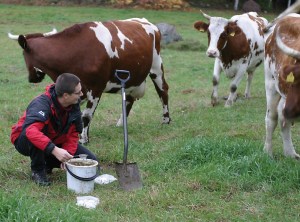
Studies of ecosystem function are studies of action: of insects pollinating flowers, of predators killing pests – and in our case (well, more often than not) of beetles disposing of dung. To isolate the effects of the critters that we think will matter, we need to selectively include or exclude them. If we think a particular species or species group is responsible for a certain function, then we test this by keeping it in or out of enclosures. If we want to look at effects of species diversity, then we create communities of different species richness.

Research on dung beetles is far from boring. © Kari Heliövaara.

Depending on the target organism, this is sometimes easy and sometimes difficult. But it almost invariably proves to be fun! We enjoy the challenge of inventing new techniques for unravelling ecosystem functions sustained by insects. Working on dung beetles – as we tend to do – can be messy, but it’s definitely never boring.

In targeting ecosystem functions, the real trick is to make the experiments relevant. What we want to understand are the effects of changes occurring in the real world. All too often studies of ecosystem functions have been focused on artificial species pools in artificial settings. To see how we have solved this, we’ll give you a quick look at our dungy portfolio of approaches to date. Continue reading “Disentangling Ecosystem Functions: Our Imagination is the Limit”

Methods in Ecology and Evolution 2015: The Year in Review

Happy New Year! We hope that you all had a wonderful Winter Break and that you’re ready to start 2016. We’re beginning the year with a look back at some of our highlights of 2015. Here’s how last year looked at Methods in Ecology and Evolution.

The Articles

We published some amazing articles in 2015, too many to mention them all here. However, we would like to say a massive thank you to all of the authors, reviewers and editors who contributed to the journal last year. Without your hard work, knowledge and generosity, the journal would not be where it is today. We really appreciate all of your time and effort. THANK YOU!

mee312268_CoverOpportunities at the Interface between Ecology and Statistics

There was only one Special Feature in the journal this year, but it was a great one. Arising from the 2013 Eco-Stats Symposium at the University of New South Wales and guest edited by Associate Editor David Warton, Opportunities at the Interface between Ecology and Statistics was one of the highlights of 2015 for us. It consists of seven articles written collaboratively by statisticians and ecologists and highlights the benefits of cross-disciplinary partnerships. Continue reading “Methods in Ecology and Evolution 2015: The Year in Review”
Measuring Survival Selection in Natural Populations: How important is recapture probability?

Post Provided by John Waller

The “Lande-Arnold” Approach

Damselflies marked in the field, which will hopefully be recaptured later. This small insect at our field site had only about 10% recapture probability.

The quantification of survival selection in the field has a long history in evolutionary biology. A considerable milestone in this field was the highly influential publication by Russel Lande and Steve Arnold in the early 1980s.

The practical implementation of Lande and Arnold’s method involved simply fitting a linear model with standardized response (survival) and explanatory (trait) variables values with quadratic terms (multiplied by two). This straightforward method allowed evolutionary biologists to measure selection coefficients using commonly available statistical software and these estimates could be used directly within a quantitative genetic framework.  Continue reading “Measuring Survival Selection in Natural Populations: How important is recapture probability?”

Joint Species Distribution Models to Study Species and their Interactions

David Warton (University of New South Wales) interviews Otso Ovaskainen (University of Helsinki) about his two recent articles in Methods in Ecology and Evolution. David and Otso talk about studying communities of species and their interactions via joint species distribution models, the advances made by Otso’s papers and future developments in this field.

Continue reading “Joint Species Distribution Models to Study Species and their Interactions”

Maximising the Exposure of Your Research: Search Engine Optimisation and why it matters

This post is an outcome of the ‘Maximising the Exposure of Your Research’ Workshop at the BES 2015 Annual Meeting in Edinburgh (UK). If you’re interested in joining us for our 2016 Annual Meeting in Liverpool (UK), you can find some more information and pre-register HERE.

© Got Credit
© Got Credit

In recent years there has been a significant increase in the number of academic articles published. At the same time, readers are changing how they find content, tending towards a point of entry at article level as opposed to journal level. These two factors mean that it is increasingly necessary for authors to make their articles easy for relevant readers to find. Search Engine Optimisation (SEO) is one of the best ways to do this.

While writing your paper, there are a few things that you can do to optimise it for search engines, such as Google Scholar. The tips below focus on three areas that are prioritised by search engines when looking for content. Following these tips will help you to maximise the exposure of your research. Continue reading “Maximising the Exposure of Your Research: Search Engine Optimisation and why it matters”

Issue 6.12

Issue 6.12 is now online!

The December issue of Methods is now online! 

Our final issue of 2015 contains one Applications article and two Open Access articles, all of which are freely available.

stagePOP: A tool for predicting the deterministic dynamics and interactions of stage-structured populations (i.e. where the life cycle consists of distinct stages, for example eggs, juveniles and reproductive adults). The continuous-time formulation enables stagePop to easily simulate time-varying stage durations, overlapping generations and density-dependent vital rates.

Julia Cherry et al. provide one of this month’s Open Access articles. In ‘Testing sea-level rise impacts in tidal wetlands: a novel in situ approach‘ the authors describe the use of experimental weirs that manipulate water levels to test sea-level rise impacts in situ and at larger spatial scales. This new method can provide more robust estimates of sea-level rise impacts on tidal wetland processes. This article was accompanied by a press release when it was published in Early View. You can read more about this article here.

Our September issue also features articles on Biodiversity, Demography, Predator-Prey Interactions, Animal Communication and much more. Continue reading “Issue 6.12”