Tiny Grains, Big Data: The Global Pollen Project

Post Provided by Andrew Martin

A drawer from the Oxford Long-Term Ecology Lab (OxLEL) pollen reference collections, which has been digitised into the Global Pollen Project reference set.

The Global Pollen Project is a new, online, freely available tool developed to help people identify and disseminate palynological resources. Palynology – the study of pollen grains and other spores – is used across many fields of study modern and fossil vegetation dynamics, forensic sciences, pollination, beekeeping, and much more. This platform helps to facilitate cross/multi-disciplinary integration and discussion, outsourcing identifications, expertise and the sharing of knowledge.

Pollen’s Role in Plant Conservation

Successful conservation of rare, threatened, and valuable plants is dependent on an understanding of the threats that they face. Also, conservationists must prioritise species and populations based on their value to humans, which may be cultural, economic, medicinal, etc. The study of fossil pollen (palaeoecology), deposited through time in sediments from lakes and bogs, can help inform the debate over which species to prioritise: which are native, and when did they arrive? How did humans impact species richness? By establishing such biodiversity baselines, policymakers can make more informed value judgements over which habitats and species to conserve, especially where conservation efforts are weighted in favour of native and/or endemic flora. Continue reading “Tiny Grains, Big Data: The Global Pollen Project”

Estimating the Size of Animal Populations from Camera Trap Surveys

Below is a press release about the Methods paper ‘Distance sampling with camera traps‘ taken from the Max Planck Society.

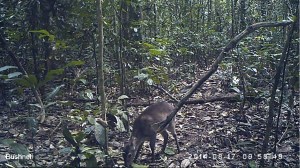
A Maxwell's duiker photographed using a camera trap. Marie-Lyne Després-Einspenner
A Maxwell’s duiker photographed using a camera trap. ©Marie-Lyne Després-Einspenner

Camera traps are a useful means for researchers to observe the behaviour of animal populations in the wild or to assess biodiversity levels of remote locations like the tropical rain forest. Researchers from the University of St Andrews, the Max Planck Institute for Evolutionary Anthropology (MPI-EVA) and the German Centre for Integrative Biodiversity Research (iDiv) recently extended distance sampling analytical methods to accommodate data from camera traps. This new development allows abundances of multiple species to be estimated from camera trapping data collected over relatively short time intervals – information critical to effective wildlife management and conservation.

Remote motion-sensitive photography, or camera trapping, is revolutionising surveys of wild animal populations. Camera traps are an efficient means of detecting rare species, conducting species inventories and biodiversity assessments, estimating site occupancy, and observing behaviour. If individual animals can be identified from the images obtained, camera trapping data can also be used to estimate animal density and population size – information critical to effective wildlife management and conservation. Continue reading “Estimating the Size of Animal Populations from Camera Trap Surveys”

New Associate Editors

Today we are welcoming four new Associate Editors to Methods in Ecology and Evolution. Graziella Iossa (University of Lincoln) and Theoni Photopoulou (Nelson Mandela Metropolitan University) are joining as regular Associate Editors and Simon Jarman (Unversity of Porto) and Daniele Silvestro (University of Gothenburg) will be working on Applications articles. You can find out more about all of our new Associate Editors below. Graziella Iossa “I am … Continue reading New Associate Editors

Digitizing Historical Land-use Maps with HistMapR

Habitat destruction and degradation represent serious threats to biodiversity, and quantification of land-use change over time is important for understanding the consequences of these changes to organisms and ecosystem service provision. Historical land-use maps are important for documenting how habitat cover has changed over time, but digitizing these maps is a time consuming process. HistMapR is an R package designed to speed up the digitization … Continue reading Digitizing Historical Land-use Maps with HistMapR

When Measuring Biodiversity, Do Individuals Matter?

Post provided by Samuel RP-J Ross

Close up of a black-capped babbler (Pellorneum capistratum), one of the species included in our study.
Close up of a black-capped babbler (Pellorneum capistratum), one of the species in our study.

Our newly-developed method simulates intraspecific trait variation when measuring biodiversity. This gives us an understanding of how individual variation affects ecosystem processes and functioning. We were able to show that accounting for within-species variation when measuring functional diversity can reveal details about ecological communities which would otherwise remain unseen. Namely, we found a negative impact of selective-logging on birds in Borneo when accounting for intraspecific variation which we could not detect when ignoring intraspecific variation.

Why Biodiversity Matters

Biodiversity is important for many reasons. One of the main reasons is its contribution to the range of goods and services provided by ecosystems (i.e. ecosystem services) that we can take advantage of, such as natural food resources or climatic regulation. It’s generally believed that biodiversity contributes to these services by increasing and maintaining ‘ecosystem functioning’ – often defined as the rate at which ecosystems are turning input energy (e.g. sunlight) into outputs (e.g. plant biomass). Continue reading “When Measuring Biodiversity, Do Individuals Matter?”

Capturing the Contribution of Rare and Common Species to Turnover: A Multi-Site Version of Generalised Dissimilarity Modelling

Post provided by Guillaume Latombe and Melodie A. McGeoch

Understanding how biodiversity is distributed and its relationship with the environment is crucial for conservation assessment. It also helps us to predict impacts of environmental changes and design appropriate management plans. Biodiversity across a network of local sites is typically described using three components:

  1. alpha (α) diversity, the average number of species in each specific site of the study area
  2. beta (β) diversity, the difference in species composition between sites
  3. gamma (γ) diversity, the total number of species in the study area.
Two tawny frogmouths, a species native to Australia. ©Marie Henriksen.

Despite the many insights provided by the combination of alpha, beta and gamma diversity, the ability to describe species turnover has been limited by the fact that they do not consider more than two sites at a time. For more than two sites, the average beta diversity is typically used (multi-site measures have also been developed, but suffer shortcomings, including difficulties of interpretation). This makes it difficult for researchers to determine the likely environmental drivers of species turnover.

We have developed a new method that combines two pre-existing advances, zeta diversity and generalised dissimilarity modelling (both explained below). Our method allows the differences in the contributions of rare versus common species to be modelled to better understand what drives biodiversity responses to environmental gradients. Continue reading “Capturing the Contribution of Rare and Common Species to Turnover: A Multi-Site Version of Generalised Dissimilarity Modelling”

Decoupling Functional and Phylogenetic Dissimilarity between Organisms

Francesco de Bello describes the main elements of the method he has recently published in Methods in Ecology and Evolution. The method aims at decoupling and combining functional trait and phylogenetic dissimilarities between organisms. This allows for a more effective combination of non-overlapping information between phylogeny and functional traits. Decoupling trait and phylogenetic information can also uncover otherwise hidden signals underlying species coexistence and turnover, … Continue reading Decoupling Functional and Phylogenetic Dissimilarity between Organisms

New Associate Editors

Today we are welcoming two new people to the Methods in Ecology and Evolution Associate Editor Board. Pierre Durand is joining us from the University of the Witwatersrand (South Africa) and Andrew Mahon joins from Central Michigan University (USA). You can find out more about Pierre and Andrew below. Pierre Durand “My research is broadly focussed on the evolution of complexity. Many of my projects are related to the evolutionary … Continue reading New Associate Editors

Progressive Change BACIPS: Estimating the Effects of Environmental Impacts over Time

Post provided by Lauric Thiault BACIPS (Before-After Control-Impact Paired Series) is probably the best-known and most powerful approach to detect and quantify human interventions on ecosystems. In BACIPS designs, Impact and Control sites are sampled simultaneously (or nearly so) multiple times Before and After an intervention. For each sampling survey conducted Before or After, the difference in the sampled response variable (e.g. density) is calculated. … Continue reading Progressive Change BACIPS: Estimating the Effects of Environmental Impacts over Time

The Field Guide to Sequence-Based Identification of Biodiversity: An Interview with Simon Creer

In a new Methods in Ecology and Evolution podcast, Georgina Brennan (Bangor University) interviews Simon Creer (Bangor University) about his article ‘The ecologist’s field guide to sequence-based identification of biodiversity‘. They talk about about where the idea for the paper came from, what it’s aim are and who will benefit from it. We hear how new sequences can improve and enhance current biomonitoring programmes (and make them … Continue reading The Field Guide to Sequence-Based Identification of Biodiversity: An Interview with Simon Creer