Happy Pride Month! Join the British Ecological Society in this annual, global celebration as we share stories from STEM researchers who belong to the LGBTQ+ community. This post is by Nathaniel Wells. About me My name is Nathaniel, and I use he/they pronouns. I’m from Newfoundland and Labrador, Canada, and I’ve just finished my undergraduate degree at Memorial University of Newfoundland with Honours in Psychology. … Continue reading Pride Month 2024: Nathaniel Wells
The Rainbow Research series returns to the British Ecological Society to celebrate Pride month 2022! These special posts promote visibility and share stories from STEM researchers who belong to the LGBTQIA2S+ community. Each post is connected to one of the themes represented by the colours in the Progress Pride flag (Daniel Quasar 2018). In this post, Sara Blunk shares her love of birds and experiences being an LGBTQ+ student.
Tracking the movement of animals is important for informing conservation practices but can present logistical obstacles, especially when attempting to track smaller species with large GPS tags. Using existing technologies in new ways may help overcome these obstacles and provide alternative approaches for accurately tracking large numbers of relatively small sized species. In this blog post, Christine Beardsworth discusses findings from her recent Methods in Ecology and Evolution paper “Validating ATLAS: a regional-scale, high-throughput tracking system”.
Researchers are increasingly interested in how social behaviour influences a range of biological processes. Social data have the interesting mathematical property that the number of potential connections among individuals is typically much larger than the number of individuals (because individuals can interact with every other member of their group). This introduces a huge challenge when it comes to collecting data on social interactions—not only does the amount of data needed increase exponentially with group size, the data can also be more difficult to record.
Larger groups have more simultaneous interactions, making it harder for observers to capture a complete or representative sample. It’s also more difficult for observers to tell individuals apart in larger groups. Coloured markers are often used to distinguish different members of a group – the bigger the group, the more complex the markers are needed.
Group-level properties or behaviours can also emerge or change rapidly over time or depending on the situation. This means that observations have to be made at high temporal resolution. To study social behaviour with group sizes that resemble those occurring in nature, we need new techniques to extract sufficient information from social groups. Continue reading “The Social Life of Birds: A New Technique for Studying Behavioural Ecology”
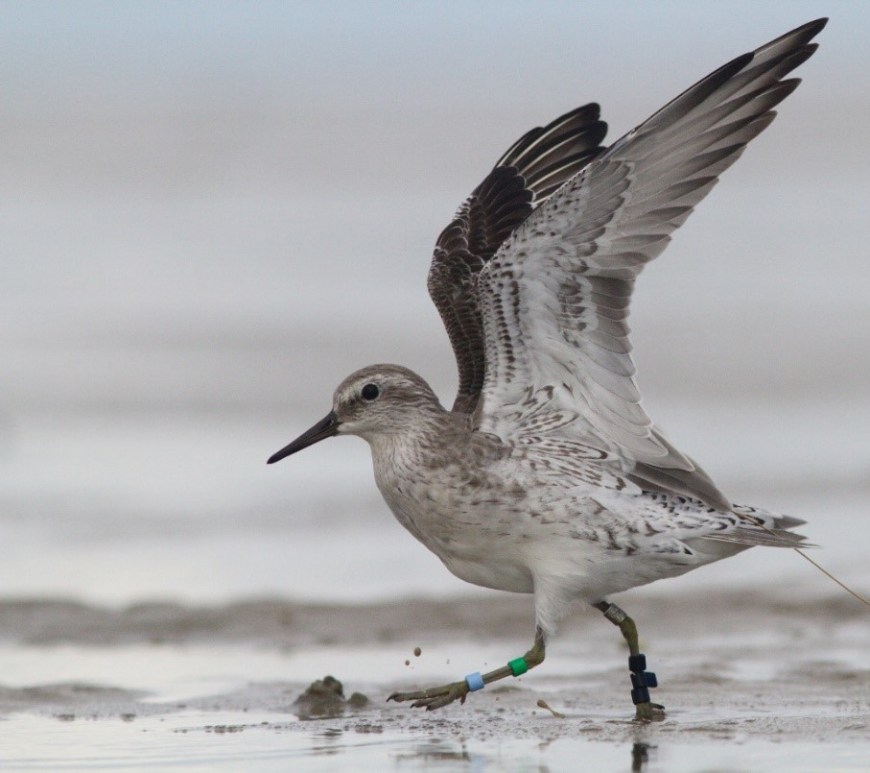
Technological advancements in the past 20 years or so have spurred rapid growth in the study of migratory connectivity (the linkage of individuals and populations between seasons of the annual cycle). A new article in Methods in Ecology and Evolution provides methods to help make quantitative comparisons of migratory connectivity across studies, data types, and taxa to better understand the causes and consequences of the seasonal distributions … Continue reading How Can We Quantify the Strength of Migratory Connectivity?
Measurements of morphological features are important for ecological studies, especially on free-ranging wild animal species. Conventionally, specimens either dead or in captivity are used for morphometric studies, which is difficult in the case of wild species for several reasons.‘In situ measurements of animal morphological features: a non-invasive method’ presents a new way to estimate an individual’s morphometric measurements using metadata from digital photographs. Dr. Mylswamy Mahendiran and … Continue reading In Situ Measurements of Wildlife
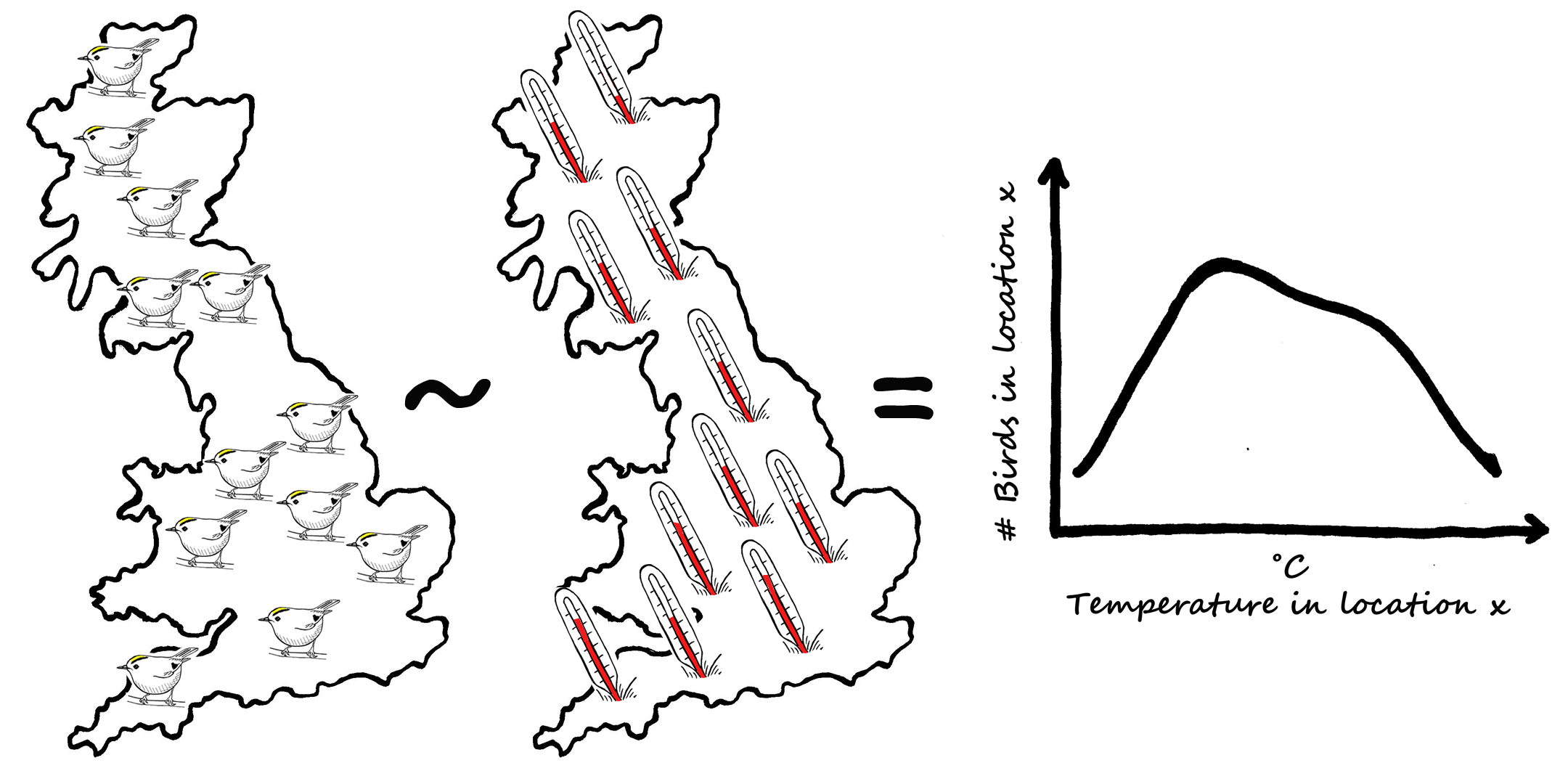
When trying to understand how wildlife, for example a bird species, may react to climate change scientists generally study how species numbers vary in relation to climatic or weather variables (e.g. Renwick et al. 2012, Johnston et al. 2013). The way this tends to be done is by gathering information (data!) about bird numbers as well as the weather variables (for example temperature) in several locations (i.e. in space) and fitting a regression model to these data to detect and illustrate how bird numbers go up or down with temperature.
Data on bird numbers and temperatures in several locations lets researchers see the relationship between the two.
This relationship is then used to forecast how bird numbers may change along with potential temperature changes in the future (i.e. in time), for example due to climate change.
Relationships between bird numbers and temperature in a given location are often used to forecast changes in bird numbers with expected changes in temperatures over time.
To understand the factors shaping vocal communication, we need reliable information about the communicating individuals on different levels. First, vocal behaviour should be recorded from undisturbed animals in meaningful settings. Then we have to separate and assign the individuals’ vocalisations. Finally, the precise timing of vocal events needs to be stored. Microphone backpacks allow researchers to record the vocal behaviour of individual animals in naturalistic settings – even in acoustically challenging … Continue reading Microphone Backpacks for Individual-level Acoustic Recordings
Wetlands tend to accumulate considerable anthropogenic pollution.
All living organisms are dependent on trace elements (TEs), including metals, that are acquired in very small quantities through their environment or diet. Most TEs are essential for growth, development and physiology of the organism, but excessive intake can be detrimental for animals and plants. Some TEs – especially heavy metals such as mercury, cadmium, lead and others – are generally toxic though. This toxicity occurs because species’ natural mechanisms fail to excrete excess TEs quickly enough for their metabolism to cope. TEs are present in the environment at different concentrations, either through natural processes or anthropogenic processes (i.e. pollution).
Some natural environments are more vulnerable to toxic effects of TEs. For instance, wetlands are geochemical endpoints of large river systems that often flow near or through cities, roads, factories, industries, cultivated lands, and/or mines, so they tend to accumulate considerable anthropogenic pollution. Vulnerable habitats like wetlands need to be closely monitored in order to assess the environmental health of these ecosystems. For this kind of monitoring we need reliable methods to measure TEs exposure, intake and bioaccumulation. Continue reading “Biomonitoring Pollution in Wetlands: A New Method for More Reliable Interpretation of Chemical Data”
Post provided by ALISTAIR HOBDAY (senior principal research scientist, CSIRO Australia), Tim Lynch (senior research scientist, CSIRO, Australia) and Rachael Alderman (wildlife biologist, Tasmanian Department of Primary Industry, Parks, Water and Environment, Australia).
Behavioural and ecological research and monitoring of wildlife populations are based on collection of field data. Demographic data, such as breeding frequency, birth rates and juvenile survival, have been critical in understanding population trends for a wide range of species.
Photography has been extensively used by field biologists and ecologists to gather these data and they have been quick to take up improvements in this technology. Many field programmes today use photography either for primary data collection or the communication of results. Advances in digital photography, image storage and transmission, image processing software and web-based dissemination of images have been extremely rapid in recent years, offering ecologists and biologists a range of powerful tools.
Digital imagery has been captured from a wide range of platforms, each of which has various advantages and limitations for biological study. The most remote images are captured from satellite-based sensors, which have been used to assess population abundance of large animals, such as elephant seals, or locate colonies of emperor penguins. Cameras mounted on aircraft can also provide large-scale perspectives but both of these platforms suffer from high cost, operational limitations due to weather, and limited temporal replication. Recent use of drones, while cheaper, still requires a person to be close to the survey location and can only be used in short bursts, typically lasting less than 20 minutes.
Land-based cameras – or those fixed onto animals – can track behaviour closely, but have low sample size as data tends to be collected at the scale of individual or small groups. To improve replication, fleets of remote cameras can be used or multiple images stitched together post hoc to form a montage. However, this increases cost, either for hardware or labour to manually construct panoramas. To date all these camera systems have had limits to their spatial and/or temporal resolution and, therefore, to the number of individuals covered. This restricts biological study at the population level. Continue reading “High-Res Camera Surveys of Wildlife Colonies: The advantages over traditional approaches”








 Methods Blog