The potential and practice of arboreal camera trapping

Post provided by Jennifer Moore

Each year Methods in Ecology and Evolution awards the Robert May Prize to the best paper published in the journal by an author at the start of their career. Ten Early Career Researchers made the shortlist for this year’s prize, including Jennifer Moore who is a post-doctoral associate at the University of Florida in the USA. In this interview, Jennifer shares insights on her paper ‘The potential and practice of arboreal camera trapping’.

Continue reading “The potential and practice of arboreal camera trapping”

How do you measure the movement of tiny insects?

Post provided by Yash Sondhi, Hailey Dansby, Angela Nicoletti, Elina Barredo, and Samuel T. Fabian.

Studying animal behaviour or ecology can involve measuring movement patterns of small animals. Observing behaviours like foraging, pollination, circadian activity or predation is laborious because it involves long periods of waiting for the behaviour and triggering a camera or poring over hours of video footage to find the behaviour. Existing automated motion tracking tools for small animals are expensive and unsuitable for field use, or need specific conditions like bright light to work. In this blog post, Yash Sondhi and co-authors discuss their tool “Portable Locomotion Activity Monitor (pLAM)” which enables automated monitoring small animal motion tracking in a cost-effective manner, suitable for lab or field use and can track motion under any light environment.

Continue reading “How do you measure the movement of tiny insects?”

Searching for snow leopards

Post provided by Ian Durbach and Koustubh Sharma

Snow leopard captured via camera trap in Mongolia. Picture credit: Snow Leopard Conservation Foundation/Snow Leopard Trust/Panthera (OR SLCF/SLT/PF).

Snow leopards are notoriously elusive creatures and monitoring their population status within the remote, inhospitable habitats they call home, can be challenging.  In this post, co-authors Ian Durbach and Koustubh Sharma discuss the applications of their Methods in Ecology and Evolution article, ‘Fast, flexible alternatives to regular grid designs for spatial capture–recapture’, for monitoring snow leopard populations.

Continue reading “Searching for snow leopards”

Just snap it! Using Digital Cameras to Discover What Birds Eat

Post provided by Davide Gaglio and Richard Sherley

Digital photography has revolutionised the way we view ourselves, each other and our environment. The use of automated cameras (including camera traps) in particular has provided remarkable opportunities for biological research. Although mostly used for recreational purposes, the development of user-friendly, versatile auto-focus digital single lens reflex (DSLR) cameras allows researchers to collect large numbers of high quality images at relatively little cost.

These cameras can help to answer questions such as ‘What does that species feed its young?’ or ‘How big is this population?’, and can provide researchers with glimpses of rare events or previously unknown behaviours. We used these powerful research tools to develop a non-invasive method to assess the diets of birds that bring visible prey (e.g. prey carried in the bill or feet) back to their chicks. Continue reading “Just snap it! Using Digital Cameras to Discover What Birds Eat”

Automatic Camera Monitoring: A Window into the Daily Life of Pollinators

Post provided by Ronny Steen

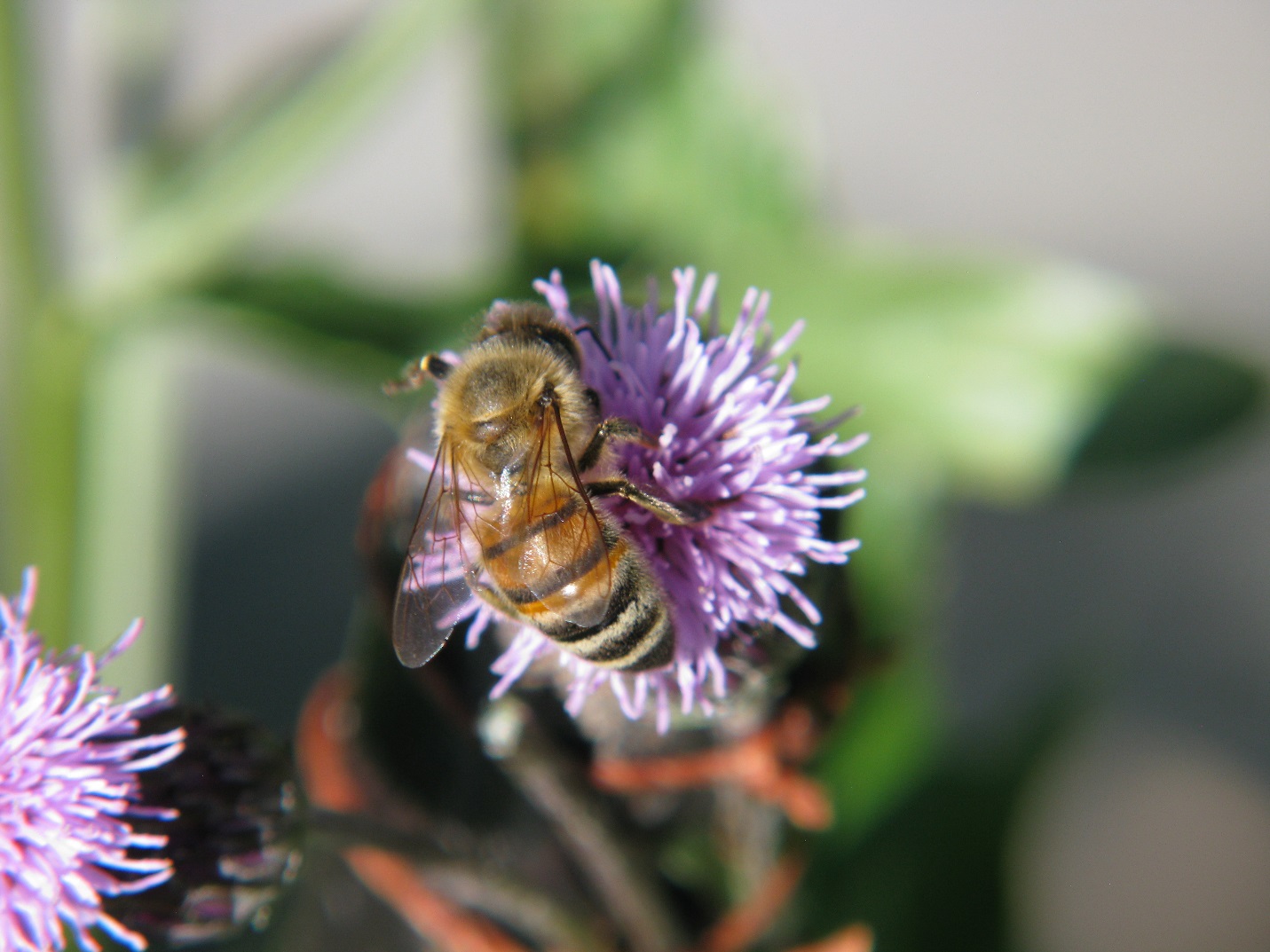
Image from the Canon PowerShot camera with CHDK script ‘Motion Detect Plus’. The thistle flower being visited by ♀ honeybee Apis mellifera L.

Pollinators have fascinated ecologists for decades, and they have traditionally been monitored by on-site human observations. This can be a time-consuming enterprise and – more importantly – species identification and recordings of behaviour have to be registered at the time of observation. This has two complications:

  1. While writing notes, or recording them electronically, the observer cannot continue focusing on the animal or behaviour in question.
  2. Such data then have to be transcribed, with the risk of making transcription errors.

Bringing Monitoring into the 21st Century

Although on-site human observations have predominated, today’s widespread availability of digital monitoring equipment has enabled unique data on flower visitors to be collected. In my research, I have used a time-efficient automated procedure for monitoring flower-visiting animals – namely foraging bumblebees visiting focal white clovers and honeybees visiting thistles.

Continue reading “Automatic Camera Monitoring: A Window into the Daily Life of Pollinators”

The Smart Nest Box: Stepping into the World of Cavity-Dwelling Animals

Post provided by MARKÉTA ZÁRYBNICKÁ

The SNBox in the field

Seeing is better than being told, isn’t it? In recent years, video recording and analysis has become a successful non-invasive method for collecting biological data on many species. At Project Smart Nestbox (a collaborative project between the Czech University of Life Science Prague and the Czech Technical University in Prague) we decided to push these methods forward to allow for the long term surveillance of cavity or box-nesting species. We developed and tested the Smart Nest Box (SNBox) – a system that overcomes some of the usual limitations found in video recording fieldwork: data storage capacity, power source and insufficient light. As it’s National Nest Box Week in the UK, Methods in Ecology and Evolution have asked me to write a blog post about it. Continue reading “The Smart Nest Box: Stepping into the World of Cavity-Dwelling Animals”

National Wildlife Day 2015

Happy National Wildlife Day everyone!

Today is 10th National Wildlife Day. As we have done for a few awareness days this year (Bats, Biodiversity and Bees so far) we are marking the day by highlighting some of our favourite Methods in Ecology and Evolution articles on the subject. Obviously ‘wildlife’ is a pretty big topic, so we have narrowed our focus (slightly) to monitoring wildlife (with one or two additional papers that we didn’t want to leave out).

This list is certainly not exhaustive and there are many more wonderful articles on these topics in the journal. You can see more of them on the Wiley Online Library.

If you would like to learn more about National Wildlife Day, you may wish to visit the organisation’s website, follow them on Twitter and Facebook or check out today’s hashtag: #NationalWildlifeDay.

Without further ado though, please enjoy our selection of Methods articles for National Wildlife Day:
Integrating Demographic Data

Our National Wildlife Day celebration begins with an article from our EURING Special Feature. Robert Robinson et al. present an approach which allows important demographic parameters to be identified, even if they are not measured directly, in ‘Integrating demographic data: towards a framework for monitoring wildlife populations at large spatial scales‘. Using their approach they were able to retrieve known demographic signals both within and across species and identify the demographic causes of population decline in Song Thrush and Lawping.


Continue reading “National Wildlife Day 2015”