RSS Meeting on Model Averaging: Elephants, Oscars and Spiky Data

Post provided by Dr Eleni Matechou

Eleni is a Lecturer in Statistics and a member of the Statistical Ecology @ Kent (SE@K) group at the University of Kent. She develops statistical models motivated by ecological applications to study populations of birds, insects and, more recently, humans.

On September 15th 2016, a half-day meeting on Model Averaging – organised by the Environmental Statistics section and the East Kent local group of the Royal Statistical Society (RSS) – took place at the University of Kent in Canterbury .

There were three invited speakers: Professor Richard Chandler, from University College London, Professor Jonty Rougier, from the University of Bristol and Dr Kate Searle, from the Centre for Ecology and Hydrology, who presented via Skype.

All three talks included interesting motivating data, clever modelling and great insight.

Taming the Pachyderm

elephant-in-the-roomProfessor Richard Chandler presented joint work with Marianna Demetriou on “The interpretation of climate model ensembles”. Projecting future global temperatures is clearly a timely topic and Richard’s talk highlighted the challenges of doing this reliably. And they’re certainly not minor challenges, in his own words, this is a problem he has spent 10 years thinking about! Continue reading “RSS Meeting on Model Averaging: Elephants, Oscars and Spiky Data”

Creating Bigger, Better and More Joined-up Habitat Networks

Below is a press release about the Methods paper ‘How to manipulate landscapes to improve the potential for range expansion‘ taken from the University of Liverpool.

©Bidgee
©Bidgee

Scientists at the University of Liverpool have developed a new ‘route planner’ tool that could help conservationists aid the movement of species as they adapt to a changing climate.

The environmental ranges of many animal and plant species are starting to alter with climate change, as temperatures change and force species to migrate to more suitable climes.

To be able to do this successfully, they will need sufficient habitat in their existing range, their future range, and any intermediate areas to enable populations to survive and thrive. Many conservation initiatives to restore habitats and increase connectivity are trying to address this issue. However, existing modelling tools mainly treat the landscape as static, and it is difficult to use these to plan restoration. Continue reading “Creating Bigger, Better and More Joined-up Habitat Networks”

Estimating Shifts in Species Distribution: An Interview with James Thorson

David Warton (University of New South Wales) interviews James Thorson (NOAA) about his paper Model-based inference for estimating shifts in species distribution, area occupied and centre of gravity. The article is included in the August 2016 issue of Methods in Ecology and Evolution.  They discuss how to estimate changes in distribution shifts accounting for changes in the spatial distribution of sampling intensity, James’ current workplace NOAA, his academic background and what trouble he is planning to get up to next.

Continue reading “Estimating Shifts in Species Distribution: An Interview with James Thorson”

Planning Habitat for Very Long-Distance Connectivity under Climate Change

Post provided by JENNY HODGSON

Climate change and habitat fragmentation are interacting threats: it is likely that many species cannot reach newly suitable areas at the cool edge of their range because there is not enough habitat, in the right places, to support range expansion over multiple generations. Conservation efforts are already underway to restore large areas of habitat, and to improve the “connectivity” within networks of habitat. However, there are multiple ways of measuring connectivity and few of them address the scale of shifts that are likely to be needed under climate change. This could be a problem if it leads to inefficient conservation prioritisation.

The Conductance Metric

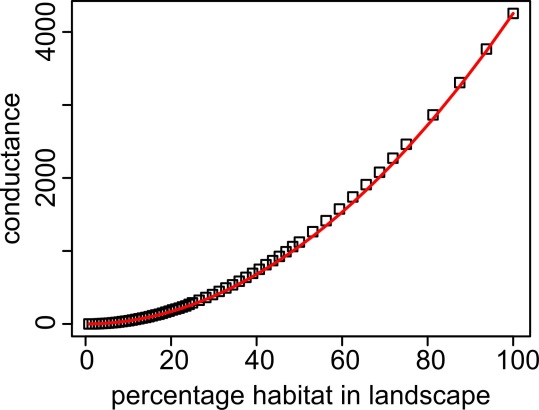
How conductance generally depends on the amount of habitat in the landscape. Squares show the conductance of landscapes with a random selection of cells chosen to be habitat. The red line is based only on the 100% point and the expectation that conductance is proportional to amount of habitat squared.

We first developed the conductance metric in 2012 and we found that it is correlated to the speed with which a species can spread through a landscape, from a specified source location to a specified target. A key difference between this and most other connectivity metrics is that it incorporates both reproduction within habitat patches and dispersal between habitat patches, over multiple generations (further explanation here). Sometimes there could be many very well-connected patches in a network, and yet no easy way for a species to cross the landscape from end to end. This could be a problem for the species’ survival, if staying within its current regions of occupancy is unsustainable, for example if it is being pushed northwards by climate change. Continue reading “Planning Habitat for Very Long-Distance Connectivity under Climate Change”

State-and-Transition Models: An Interview with Marie-Josee Fortin

David Warton (University of New South Wales) interviews Marie-Josee Fortin (University of Toronto) about a recent article on state-and-transition models from her group in Methods in Ecology and Evolution. David and Marie-Josee also discuss what motivated her career to date in spatial ecology, and what she sees as the main advances in this area and current challenges in the field.

Continue reading “State-and-Transition Models: An Interview with Marie-Josee Fortin”

Predicting Disease Outbreaks Using Environmental Changes

Below is a press release about the Methods paper ‘Environmental-mechanistic modelling of the impact of global change on human zoonotic disease emergence: a case study of Lassa fever‘ taken from the University College London.

The multimammate rat (Mastomys natalensis) transmits Lassa virus to humans. ©Kelly, et al.
The multimammate rat transmits Lassa virus to humans. ©Kelly, et al.

A model that predicts outbreaks of zoonotic diseases – those originating in livestock or wildlife such as Ebola and Zika – based on changes in climate, population growth and land use has been developed by a UCL-led team of researchers.

“This model is a major improvement in our understanding of the spread of diseases from animals to people. We hope it can be used to help communities prepare and respond to disease outbreaks, as well as to make decisions about environmental change factors that may be within their control,” said lead author Professor Kate Jones, UCL Genetics, Evolution & Environment and the Zoological Society of London. Continue reading “Predicting Disease Outbreaks Using Environmental Changes”

CO2 Efflux Rates from Dead Organic Matter: Get It Right

Post provided by GBADAMASSI DOSSA

Anthropocene and Climate Change at Glance

As a consequence of human activities the global climate is changing at a rate that is unprecedented in at least the past few centuries, leading to the suggestion that this era should be referred to as the “Anthropocene”. While climate hind-casting and pollen histories in sediments are advancing our understanding of how past ecological ecosystems responded to previous climate changes, forecasting power really depends on how accurately we can predict ecosystem functions that are likely to change in the future.

Despite substantial recent advances in our ability to predict climate change, considerable uncertainty remains – especially in our understanding of how ecosystem functioning could be influenced by climate change and how this may feed back to affect greenhouse-gas fluxes. The decomposition of organic matter in leaf litter and soils accounts for a global flux that is approximately 7 times as large as global anthropogenic emissions. Understanding how climate change will affect carbon held in dead organic matter pools – including leaf litter, woody debris and soil organic carbon – is essential.

Decomposition and Why it Matters

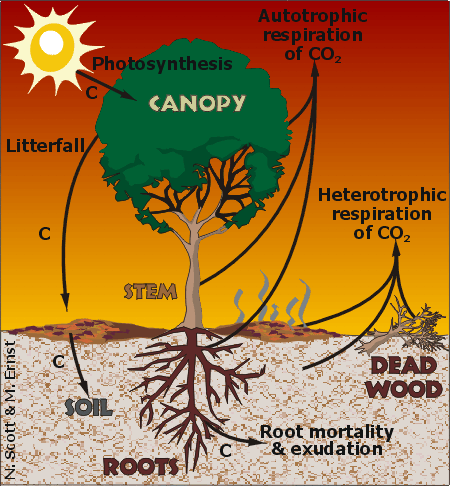
Carbon cycle summary. Note this focuses only in forested or terrestrial ecosystem.

Decomposition is defined as the “physical, chemical and biological mechanisms that transform organic matter into increasingly stable forms” in plant detritus. However, only small part of carbon goes through this process. Most of dead organic matter becomes CO2. Decomposition of organic matter is important because of its link to the global carbon cycle. Simply stated, the carbon cycle consists of carbon inputs via photosynthesis and outputs via respiration. However, while photosynthesis is relatively well studied and understood, respiration – including that of living organisms (autotrophy) and of dead ones (heterotrophy) – is understudied. As a consequence, our understanding of decomposition is much less sophisticated. A substantial amount of greenhouse-gas (CO2, CH4, N2O) production occurs either directly or indirectly from organic matter decomposition, including woody debris. Similar amounts of CO2 efflux exist between fluxes from woody debris decomposition (8.6 Pg yr-1) and fossil fuel burning (9.6 Pg yr-1). So we desperately need a reliable technique to quantify CO2 from decomposition. Continue reading “CO2 Efflux Rates from Dead Organic Matter: Get It Right”

A New Modelling Strategy for Conservation Practice? Ensembles of Small Models (ESMS) for Modelling Rare Species

Post provided by FRANK BREINER, ARIEL BERGAMINI, MICHAEL NOBIS and ANTOINE GUISAN

Rare Species and their Protection

Erythronium dens-canis L. – a rare and threatened species used for modelling in Switzerland. ©Michael Nobis

Rare species can be important for ecosystem functioning and there is also a high intrinsic interest to protect them as they are often the most original and unique components of local biodiversity. However, rare species are usually those most threatened with extinction.

In order to help prioritizing conservation efforts, the International Union for Conservation of Nature (IUCN) has published criteria to categorize the status of threatened species, which are then published in Red Lists. Changes in a species’ geographical distribution is one of the several criteria used to assign a threat status. For rare species, however, the exact distribution is often inadequately known. In conservation science, Species Distribution Models (SDMs) have recurrently been used to estimate the potential distribution of rare or insufficiently sampled species. Continue reading “A New Modelling Strategy for Conservation Practice? Ensembles of Small Models (ESMS) for Modelling Rare Species”

From Tree of Life to Web of Life: How Google Images Can Help Ecologists Study Evolution

Below is a press release about the Methods paper ‘Just Google it: assessing the use of Google Images to describe geographical variation in visible traits of organisms‘ taken from the British Ecological Society.

Black sparrowhawks are either completely dark or have a white breast. ©Oggmus

Animals caught on camera by amateur photographers and posted on the web could become an important new tool for studying evolution and other ecological questions, researchers from South Africa have found. Their study – the first of its kind – is published today in Methods in Ecology and Evolution.

Colour polymorphism – when a species has two or more colour types – has fascinated biologists since Darwin. The occurrence of these different colour types often varies geographically, providing a useful way of studying how different colour morphs – or phenotypes – evolve.

But the fieldwork needed to collect these data is time consuming and expensive, so Dr Arjun Amar and his student Gabriella Leighton from the University of Cape Town wondered if ecologists could use the thousands of animal images posted on the internet instead. Continue reading “From Tree of Life to Web of Life: How Google Images Can Help Ecologists Study Evolution”

Space-time continuum and conservation planning: Helping Species Adapt to Climate Change

Post provided by Diogo André Alagador

The world’s most threatened felid (Iberian lynx) is endemic in a region predicted to be severely impacted by climate change: the Iberian Peninsula. ©lynxexsitu.es
The world’s most threatened felid (Iberian lynx) is from a region predicted to be severely impacted by climate change: the Iberian Peninsula. ©lynxexsitu.es

Climate change is driving many species to alter their geographic distributions. The ranges of some species contract, expand or shift as individuals track favorable climate conditions. In some cases, threatened species are moving out of protected areas. These trends are expected to intensify in the coming years.

To increase conservation effectiveness within protected areas in the future, researchers at the Research Center on Biodiversity and Genetic Resources at the University of Évora and the Department of Mathematics of the Faculty of Sciences and Technology from the NOVA University in Lisbon, Portugal, have come up with a set of modelling tools to optimize the scheduling of conservation area allocation as the climate changes. These take into account restrictions of conservation area expansion derived from the prevailing socio-economic activities. “The objective is to select the best dispersal corridors for each species considering a budget restriction or competition with other socioeconomic activities” said Diogo Alagador. “These selections are complex and non-trivial as they incorporate decisions on the spatial and temporal trends of large sets of species.”

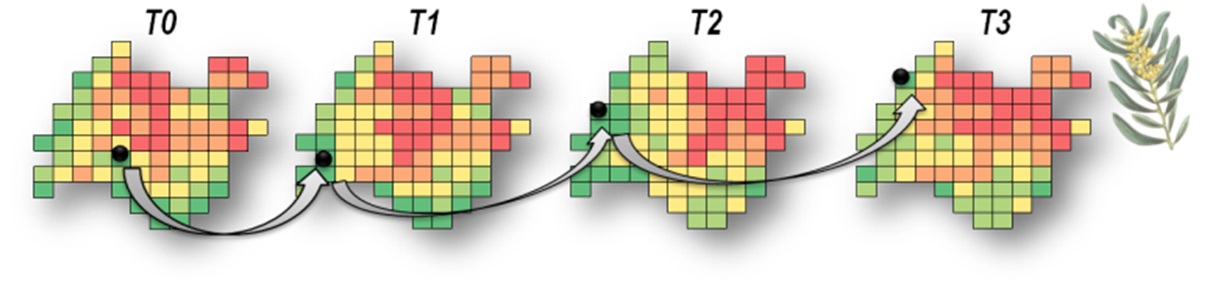
The concept of a spatio-temporal corridor for a species in an environmental heterogeneous region.

Continue reading “Space-time continuum and conservation planning: Helping Species Adapt to Climate Change”