Issue 8.6: How to Measure Natural Selection

Issue 8.6 is now online!

The April issue of Methods, which includes our latest Special Feature – ‘How to Measure Natural Selection – is now online!

Understanding how and why some individuals survive and reproduce better than others, the traits that allow them to do so, the genetic basis of those traits, and the signatures of past and present selection in patterns of variation in the genome remain at the top of the research agenda for evolutionary biology. This Special Feature – Guest Edited by Jeff Conner, John Stinchcombe and Joanna Kelley – draws together a collection of seven papers that highlight new methodological and conceptual approaches to meeting this agenda.

Three of the ‘How to Measure Natural Selection’ papers – Franklin and Morrissey, Thomson and Hadfield, and Hadfield and Thomson – clarify unresolved aspects of the literature in meaningful and important ways. Following on from this Hermisson and Pennings; Lotterhos et al.; and Villanueva‐Cañas et al. tackle the genomic results of evolution by natural selection: namely, how we can detect natural selection from genomic data? Finally, Wadgymar et al. address the issue of how much we know about the underlying loci or agents of selection.

To use the Editors’ own words, the articles in this issue “deal with how we can detect selection in a way that can be used to predict evolutionary responses, how selection affects the genome, and how selection and genetics underlie adaptive differentiation.”

All of the articles in the ‘How to Measure Natural Selection‘ Special Feature will be freely available for a limited time.
Continue reading “Issue 8.6: How to Measure Natural Selection”

Editor Recommendation – HistMapR: Rapid Digitization of Historical Land-Use Maps in R

Post provided by Sarah Goslee For an ecologist interested in long-term dynamics, one of the most thrilling experiences is discovering a legacy dataset stashed away somewhere. For an ecologist interested in long-term dynamics, one of the most daunting experiences is figuring how to turn that box full of paper into usable data. The new tool HistMapR, described in ’HistMapR: Rapid digitization of historical land-use maps in … Continue reading Editor Recommendation – HistMapR: Rapid Digitization of Historical Land-Use Maps in R

New Associate Editors

Today we are welcoming four new Associate Editors to Methods in Ecology and Evolution. Graziella Iossa (University of Lincoln) and Theoni Photopoulou (Nelson Mandela Metropolitan University) are joining as regular Associate Editors and Simon Jarman (Unversity of Porto) and Daniele Silvestro (University of Gothenburg) will be working on Applications articles. You can find out more about all of our new Associate Editors below. Graziella Iossa “I am … Continue reading New Associate Editors

Issue 8.5

Issue 8.5 is now online!

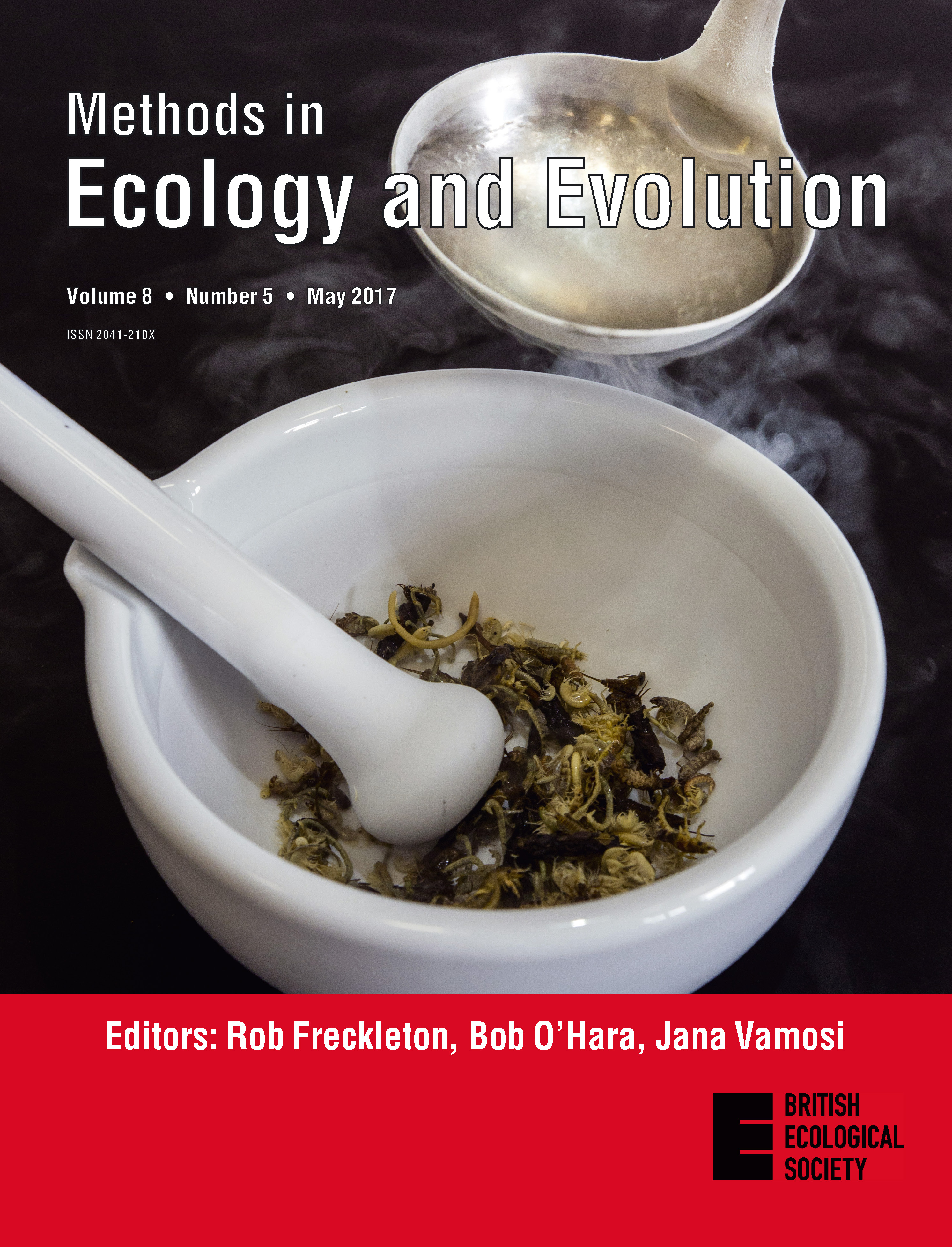
The May issue of Methods is now online!

This issue contains three Applications articles and two Open Access articles. These five papers are freely available to everyone, no subscription required.

MatlabHTK: A software interface to a popular speech recognition system making it possible for non-experts to implement hidden Markov models for bioacoustic signal processing.

 PrimerMiner: The R package PrimerMiner batch downloads DNA barcode gene sequences from BOLD and NCBI databases for specified target taxonomic groups and then applies sequence clustering into operational taxonomic units to reduce biases introduced by the different number of available sequences per species.

 BarcodingR: An integrated software package that provides a comprehensive implementation of species identification methods, including artificial intelligence, fuzzy-set, Bayesian and kmer-based methods, that are not readily available in other packages.

Continue reading “Issue 8.5”

What Can Penguins Tell Us About Mitochondria? And Vice-Versa!

Post provided by Antoine Stier

Why on earth would someone try to combine field ornithology and mitochondrial biology? They’re so different! However, as I have a general background in both ecology and physiology, I am deeply convinced that physiology can help us to better understand ecology. I also see ways that ecology can help us to better understand physiological processes.

Admittedly, my memories from lectures on the mitochondrial electron transport chain are a little fuzzy – many ecologists and evolutionary biologists might feel the same way. Yet, I discovered the importance of getting over this first negative feeling when realizing the importance of mitochondrial function in shaping both ecological and evolutionary processes. Continue reading “What Can Penguins Tell Us About Mitochondria? And Vice-Versa!”

Generating New Ideas in a Conference Setting

Post provided by David Warton

This guy had his eureka moment in the bath (although I have had more success in the shower). ©Dun.can

A few leading reasons for going to a conference are: to present your work and get feedback on it, to find out what others are doing, to meet collaborators and to network. But a conference can also be a great setting for generating completely new ideas. I find that conferences are one of my most likely places for a “eureka moment”.

Surrounded by researchers working on a range of different problems in interesting and often original ways, I’m encouraged to think about things from a different angle. Idea generation is perhaps one of the main benefits of going to a conference – but is the typical conference format is the best way to facilitate that? Or does it focus too much on giving researchers a platform to report on previous research ideas? Continue reading “Generating New Ideas in a Conference Setting”

Issue 8.4: Technological Advances at the Interface of Ecology and Statistics

Issue 8.4 is now online!

The April issue of Methods, which includes our latest Special Feature – “Technological Advances at the Interface of Ecology and Statistics” – is now online!

This new Special Feature is a collection of five articles (plus an Editorial from Guest Editor David Warton) inspired by the December 2015 Eco-Stats conference at the University of New South Wales in Australia. It shows how interdisciplinary collaboration help to solve problems around estimating biodiversity and how it changes over space and time.

The five articles are based on joint talks given at the conference. They focus on:

As David Warton states in his Editorial, “interdisciplinary collaboration and the opportunities offered by recent technological advances have potential to lead to interesting and sometimes surprising findings, and will continue to be fertile ground for scientists in the foreseeable future”. Meetings like Eco-Stats 15 and Special Features like this one will, hopefully, help to encourage these sorts of collaborative research projects.

All of the articles in the ‘Technological Advances at the Interface of Ecology and Statistics‘ Special Feature will be freely available for a limited time.
Continue reading “Issue 8.4: Technological Advances at the Interface of Ecology and Statistics”

piecewiseSEM: Exploring Nature’s Complexity through Statistics

Post provided by Jonathan S. Lefcheck

Nature is complicated. As a scientist, you might say, “Well, duh,” but as students of nature, this complexity is probably the single greatest challenge we must face in trying to dissect the hows and whys of the natural world.

History is a Set of Lies Agreed Upon: Moving beyond ANOVA

For a long time, we tried to strip this complexity away by conducting very controlled experiments adhering to rigid designs. The ‘two-way fully-crossed analysis of variance’ will be familiar to anyone who has taken even the most basic stats class, because, for many decades, it was the gold standard for any experiment.

It might be tough to manipulate this whole reef.

The problem is: the real world doesn’t adhere to an ANOVA design. By this, I mean that by their very nature, manipulative experiments are artificial. It’s hard—if not impossible—to manipulate an entire forest or a coral reef, and as such, we retreat to more tractable, smaller investigations. There is certainly a lot of value in determining whether the phenomenon can occur, but these tightly regulated designs say nothing about whether they are likely to occur, particularly at the scales most relevant to humanity.

To get at the latter point, we must leave the safety of the greenhouse. However, our trusty ANOVA toolbox isn’t very useful anymore, because real-world data often violate the most basic statistical assumptions, not to mention the presence of numerous additional influences that may drive spurious relationships. Continue reading “piecewiseSEM: Exploring Nature’s Complexity through Statistics”

Googling for Ecological Answers: Using the Morphic Web Application

Post provided by Gabriella Leighton

Online Images: A Treasure Trove of Ecological Data

In the proclaimed ‘information age’, where answers are available at the click of a button or a swipe of a finger, we have become accustomed to the ability to get an almost instant grasp of any topic. Other fields are already making use of this wealth of easily accessible online data, but biologists and ecologists tend to let it slip by. However, this attitude is slowly beginning to change. Some ecological and evolutionary studies are emerging that have used the internet to gather data – through online citizen science projects (e.g. Evolution MegaLab) or databases (e.g. using Google Trends) – but few have used existing data, particularly publicly available data from image repositories.

We were curious to apply the concept of using existing images on the internet to a fascinating visual biological phenomenon: colour polymorphism (or the occurrence of multiple discrete colour phenotypes). To do this, we planned to exploit an existing penchant people have for uploading photographs of animals to the Internet.

Our search phrases included the common and scientific name of the species, as well as a location-specific term

Continue reading “Googling for Ecological Answers: Using the Morphic Web Application”

2016 Robert May Prize Winner: Gabriella Leighton

The Robert May Prize is awarded annually for the best paper published in Methods in Ecology and Evolution by an Early Career Researcher. We’re delighted to announce that the 2016 winner is Gabriella Leighton, for her article ‘Just Google it: assessing the use of Google Images to describe geographical variation in visible traits of organisms.

‘Just Google it’ marks an important step in converting ecology to an armchair science. Many species (e.g. owls, hawks, bears) are difficult, time-consuming, expensive and even dangerous to observe. It would be a lot easier if we didn’t have to spend time, energy and risk lives having to observe organisms in the field! Continue reading “2016 Robert May Prize Winner: Gabriella Leighton”