Predicting the effects of ocean warming is vital for understanding the likely impacts of climate change on marine ecosystems. In this post, Chi-Yun Kuo shares insights from his recent publication in Methods in Ecology and Evolution which develops a framework for estimating the effects of warming water on communities of marine fishes, and discusses the implications for conservation, food security, and other ecosystem services.
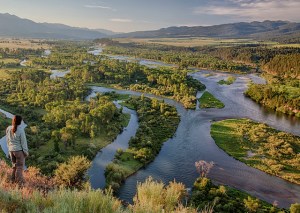
It’s the 22nd of September and that means it’s this year’s UN World Rivers Day! In over 60 countries around the globe events are going on today to bring attention to the many values of our waterways. And we, the Aquatic Ecology Special Interest Group of the BES, are joining in with the celebrations! We’re highlighting recent methodological advancements that will help us to manage and conserve our rivers in the future. So let’s get started…
Multiple Stressors and Molecular Tools
Today, human activities across the world are impacting rivers to varying degrees. As scientists, we frequently see the interaction of multiple different stressors such as flow regulations, pollution or climate change affecting our rivers. The combined impact of stressors like these may be worse than any of their individual impacts. To understand and manage the effect of them, we need cost-effective and reliable analytical tools that can capture site-specific and ecosystem-wide effects.
Recent methodological advances that will help us to achieve these goals often rely on the application of new or improved molecular tools. Emerging techniques include environmental DNA (eDNA) based applications to monitor endangered and invasive species as well as stable isotope ecology, which provides us with new insights into animal diets and energy flows through aquatic food webs. We’d like to take the opportunity to introduce some of the novel developments in both of these exciting fields. Continue reading “A Celebration of World Rivers Day”
It’s estimated that a person sheds between 30,000 to 40,000 skin cells per day. These cells and their associated DNA leave genetic traces of ourselves in showers, dust — pretty much everywhere we go.
Other organisms shed cells, too, leaving traces throughout their habitats. This leftover genetic material is known as environmental DNA, or eDNA. Research using eDNA began about a decade ago, but was largely limited to a small cadre of biologists who were also experts in computers and big data. However, a new tool from UCLA could be about to make the field accessible and useful to many more scientists.
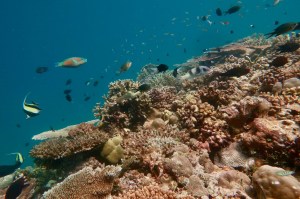
There are an estimated 830,000 species on coral reefs worldwide. At some stage in their lives, nearly all of these species are consumed as prey items. In this super diverse buffet of fishes, corals, crabs, worms, and other critters, the number of possible interactions between predators and prey is nearly inexhaustible.
The extreme diversity of coral reefs has fascinated naturalists for centuries. Pinpointing predator-prey dynamics is essential to fully understand coral reef ecosystem dynamics, and visual analysis of gut contents has been a staple technique of coral reef ecologists. While the joy of spending copious hours looking through a microscope at half-digested marine mush is undeniable, this type of visual inspection has limitations. Even so, visual gut content analysis (along with stable isotope analysis and behavioural observations) has showcased a highly complex dietary network.
To digest this extreme complexity and surmount the hurdle of dietary unknowns, researchers frequently lump fishes into broad trophic categories, such as ‘mobile herbivores’. Broad generalisations are pragmatic and may be help us detect broad ecological trends, but they oversimplify species’ actual dietary preferences. As coral reefs are changing due to anthropogenic disturbances, it’s critical to thoroughly examine how well trophic groupings capture dietary linkages among reef organisms. Continue reading “Using Molecular Power to Reconstruct Hyperdiverse Food Webs”
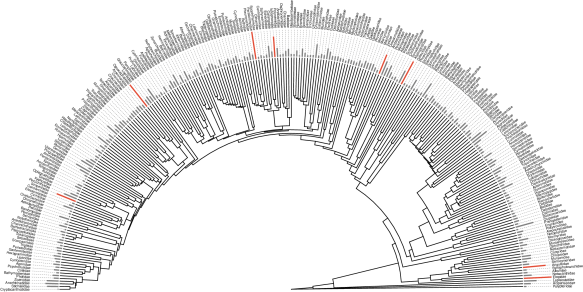
In our recent publication (Rabosky et al. 2018) we assembled a huge phylogeny of ray-finned fishes: the most comprehensive to date! While all of our data are accessible via Dryad, we felt like we could go the extra mile to make it easy to repurpose and reuse our work. I’m pleased to report that this effort has resulted in two resources for the community: the Fish Tree of Life website, and the fishtree R package. The package is available on CRAN now, and you can install it with:
install.packages("fishtree")
The source is on GitHub in the repository jonchang/fishtree. The manuscript describing these resources has been published in Methods in Ecology and Evolution (Chang et al. 2019).
Scientists at the University of Southampton have developed maps of chemicals found in jellyfish which could offer a new tool for conservation in British waters and fisheries. The maps will also be able to detect fraudulently labelled food in retail outlets by helping to trace the origins of seafood.
Rather than conduct an aquatic roll call with nets to know which fish reside in a particular body of water, scientists can now use DNA fragments suspended in water to catalog invasive or native species.
“We’ve sharpened the environmental DNA (eDNA) tool, so that if a river or a lake has threatened, endangered or invasive species, we can ascertain genetic detail of the species there,” said senior author David Lodge, the Francis J. DiSalvo Director of the Atkinson Center for a Sustainable Future at Cornell, and professor of ecology and evolutionary biology. “Using eDNA, scientists can better design management options for eradicating invasive species, or saving and restoring endangered species.” Continue reading “Refined DNA Tool Tracks Native and Invasive Fish”
Most people assume that research equipment is expensive and complicated. But, it doesn’t need to be and the noise egg is a perfect example of this. It consists of a watertight container (as used by scuba divers) and the buzzer from a cellphone and does exactly what it says: it produces low frequency noise. This allows researchers to test the effect of noise on underwater life. It is a small, simple and cheap device that anyone can build.
Underwater noise is rapidly increasing due to, for example, boat traffic and offshore wind farms. This can lead to stress for animals and difficulties in communication. Just as people have a hard time communicating in a noisy pub, animals may struggle to get their messages across when background noise is high. A nice description of how animals use sound and how noise may affect this can be found at www.dosits.org
While there is some knowledge on the effect of noise on large aquatic animals, we still know very little about how fish and other small aquatic animals are affected. Such knowledge is vital for management of protected areas. It’s also important to know whether wind farms and boat traffic can affect reproduction in populations of underwater resources such as fish and mussels. The answers to these questions are likely to be species specific, so we’ll need data on a large number of species in different habitats. Continue reading “Testing the Effects of Underwater Noise on Aquatic Animals”
Fish and invertebrates predominantly or exclusively detect particle motion.
A growing number of studies on the behaviour of aquatic animals are revealing the importance of underwater sound, yet these studies typically overlook the component of sound sensed by most species: particle motion. In response, researchers from the Universities of Bristol, Exeter and Leiden and CEFAS have developed a user-friendly introduction to particle motion, explaining how and when it ought to be measured, and provide open-access analytical tools to maximise its uptake. Continue reading “The Overlooked Commotion of Particle Motion in the Ocean”




 Methods Blog