Smart genetic analysis made fast and easy

Post provided by: Salvador Herrando-Pérez

If you use genetics to differentiate populations, the new package smartsnp might be your new best friend. Written in R language and available from GitHub and CRAN, this package performs principal component analysis with control for genetic drift, projects ancient samples onto modern genetic space, and tests for population differences in genotypes. The package can load big datasets and run complex stats in the blink of an eye.

In this post, Salvador Herrando-Pérez discusses the features of this new package which is fully described in the new paper “smartsnp, an R package for fast multivariate analyses of big genomic data” recently published in Methods in Ecology & Evolution.

Continue reading “Smart genetic analysis made fast and easy”

A new evolutionary simulation R package sheds light on the metaphor of genomic islands of divergence

Robert May Prize Shortlisted Article

Post provided by Claudio S. Quilodrán and Ashley T. Sendell-Price

Nesting eggs of silvereyes (Zosterops lateralis). Heron Island, Australia. Picture: Erik Sandvik.

Each year Methods in Ecology and Evolution awards the Robert May Prize to the best paper in the journal by an author at the start of their career. Claudio S. Quilodrán has been shortlisted for his article ‘The multiple population genetic and demographic routes to islands of genomic divergence’. In this blog, Claudio and co-author Ashley T. Sendell-Price discuss how their paper came to be and how their individual‐based simulation can be used to explore the dynamics of diverging genomes.

Continue reading “A new evolutionary simulation R package sheds light on the metaphor of genomic islands of divergence”

Uma breve história sobre o pacote R ‘metan’

Post ESCRITO POR Tiago Olivoto

This post is also available in English

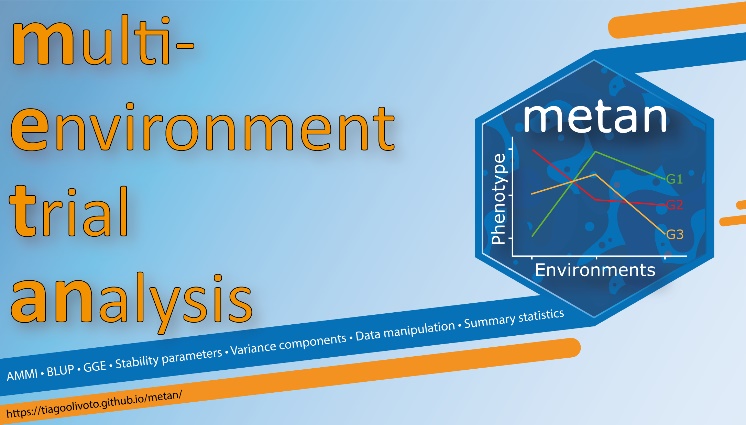
Em nosso recente artigo na Methods in Ecology and Evolution, Alessandro D. Lúcio e eu descrevemos um novo pacote R para análise de ensaios multi-ambientes chamado metan. Ensaios multi-ambientes são um tipo de ensaio em programas de melhoramento de plantas, onde vários genótipos são avaliados em um conjunto de ambientes. A análise desses dados requer a combinação de várias abordagens, incluindo manipulação, visualização e modelagem de dados. A versão estável mais recente do metan (v1.5.1) está disponível agora no repositório CRAN. Então, pensei em compartilhar a história da minha primeira incursão no uso do R criando um pacote e submetendo um artigo para uma revista que nunca havia submetido antes.

Continue reading “Uma breve história sobre o pacote R ‘metan’”

A brief history about the R package ‘metan’

Post provided by Tiago Olivoto

Este post também pode ser lido em Português

In our recent paper in Methods in Ecology and Evolution, Alessandro Lúcio and I describe a new R package, metan, for multi-environment trial analysis. Multi-environment trials are a kind of trial in plant breeding programs where several genotypes are evaluated in a set of environments. Analyzing such data requires the combination of several approaches including data manipulation, visualization and modelling. The latest stable version of metan (v1.5.1) is now on CRAN. So, I want to share the history about my first foray into using R, creating an R package, and submitting a paper to a journal that I’ve never had submitted before.

Continue reading “A brief history about the R package ‘metan’”

Gaining Genetic and Epigenetic Data from a Single Established Next-Generation Sequencing Approach

Post provided by Marco Crotti

How organisms adapt to the environment they live in is a key question in evolutionary biology. Genetic variation, i.e. how individuals within populations differ from each other in terms of their DNA, is an essential element in the process of adaptation. It can arise through different mechanisms, including DNA mutations, genetic drift, and recombination.

Example of how genetic drift can occur over generations via random sampling (i.e. random mating) in a population. (Picture credit: Gringer).

Differences in DNA sequences between individuals can results in differences in the expression of genes. This can therefore determine the organism’s capacity to grow, develop, and react to environmental stimuli. However, a growing body of literature reveals that there are other ways organisms can change the way they interact with the world without mutations in the DNA sequence.

Continue reading “Gaining Genetic and Epigenetic Data from a Single Established Next-Generation Sequencing Approach”

Issue 7.8

Issue 7.8 is now online!

The August issue of Methods is now online!

This month’s issue contains two Applications articles and two Open Access articles, all of which are freely available.

Plant-O-Matic: A free iOS application that combines the species distribution models with the location services built into a mobile device to provide users with a list of all plant species expected to occur in the 100 × 100 km geographic grid cell corresponding to the user’s location.

RClone: An R package built upon genclone software which includes functions to handle clonal data sets, allowing:

  • Checking for data set reliability to discriminate multilocus genotypes (MLGs)
  • Ascertainment of MLG and semi-automatic determination of clonal lineages (MLL)
  • Genotypic richness and evenness indices calculation based on MLGs or MLLs
  • Describing several spatial components of clonality

Continue reading “Issue 7.8”