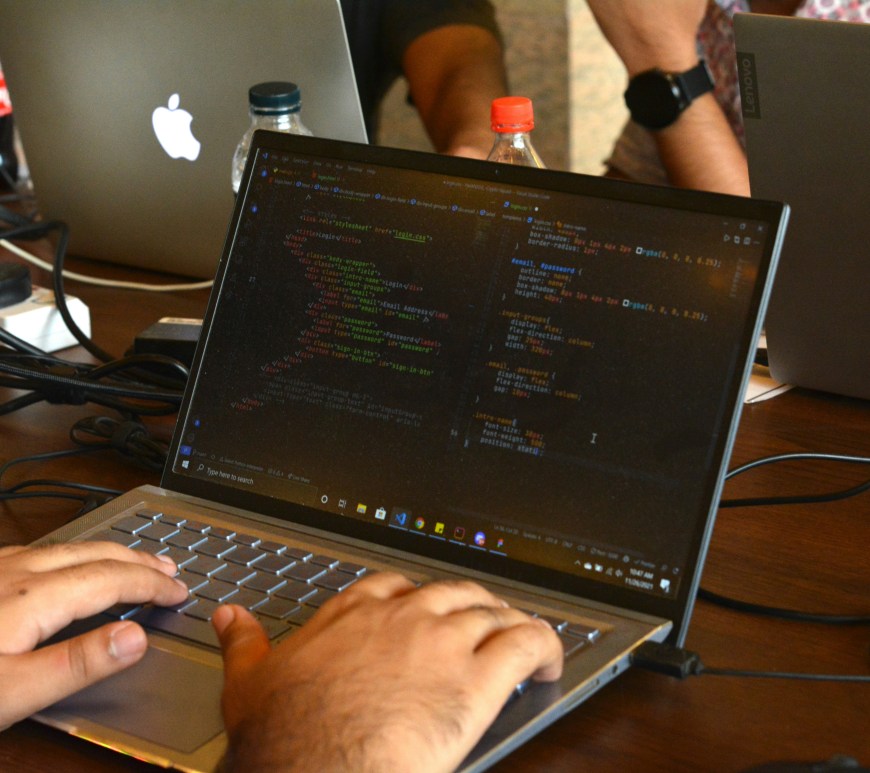
Post provided by Natalie Cooper, MEE Senior Editor In my last blog post I wrote generally about why and how to organise a hackathon. To help make those instructions a little clearer, below I provide an example from the BES Data and Code Hackathon we ran 29th-30th September 2025. Note that technically this was really a datathon rather than a hackathon! We followed the outline … Continue reading Organising the BES Data and Code Hackathon
Post provided by Natalie Cooper, MEE Senior Editor In September 2025 we ran a hackathon to collect data for a paper on data- and code-sharing across the BES journals. After the event, we thought it might be nice to share what we learned about hackathons here on the MEE blog. Massive thanks to all the participants of the BES Data and Code Hackathon for their … Continue reading The What, Why and How of Hackathons
Hackathons have become a regular feature in the data-science world. Get a group of people with a shared interest together, give them data, food, and a limited amount of time and see what they can produce (often with prizes to be won). Translated into the world of academia as research hackathons, these events are a fantastic way to foster collaboration, interdisciplinary working and skills sharing.
The Quantitative Ecology hackathon was an intense day of coding resulting in creative and innovative research ideas using social and ecological data. Teams worked through the day to develop their ideas with support from experts in R, open science and statistics. We ended up with five projects addressing questions from, ‘Who has the least access to nature?’ to ‘Where should citizen scientists go to collect new data?’.
Last year, I introduced R to petrified first-year biology students in a set of tutorials. I quickly realised that students were getting bogged down in error messages (even on very simple tasks), so most of my time was spent jumping between students like a wayward Markov chain. I would often find a desperate face at the end of a raised hand looking hopelessly towards their R console muttering some version of “What the $%# does this mean?”. I instantly morphed from teacher to translator and our class progress was slower than a for-loop caught in the second Circle.
Imagine an ecologist. Now imagine a programmer. Did you imagine the same person? If you were at the Ecology Hackathon on the day before the Ecology Across Borders (#EAB2017) conference in Ghent, Belgium (a joint conference between the BES, GFÖ, NecoV and EEF), you probably did (or at least we hope you did!).
Ecology is becoming increasingly quantitative and, as a result, we can add one more item on our daily to do lists as scientists:
Think of questions
Go on fieldwork / run simulations
Supervise students
Meet with our own supervisors
Teach
Write articles and review manuscripts
Answer emails
And now code as well
A Coding Community
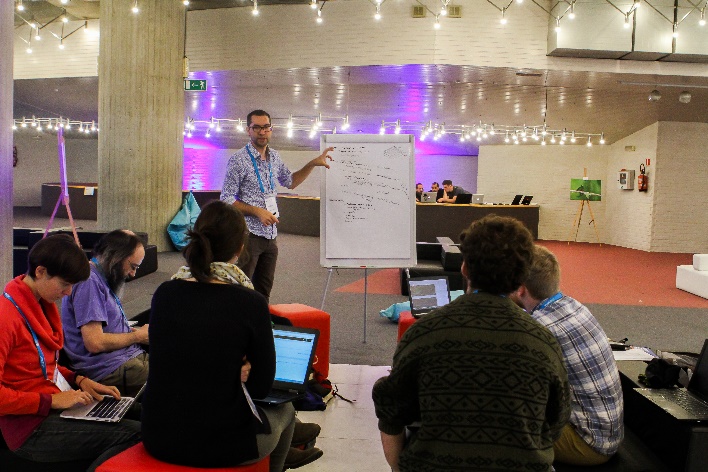
Coding doesn’t need to be a lonely activity – one of the areas where it truly shines is collaborative coding. This can take us across borders and bring us together to figure out the best way to answer our research questions. That is exactly what the EAB Ecology Hackathon set out to do. Continue reading “Ecology Hackathon at Ecology Across Borders 2017”
Scientific software is an increasingly important part of scientific research, and ecologists have been at the forefront of developing open source tools for ecological research. Much of this software is distributed via R packages – there are over 200 R packages for ecology and evolution on CRAN alone. Methods regularly publishes Application articles introducing R packages (and other software) that enable ecological research, and we’re … Continue reading Solving YOUR Ecology Challenges with R: Ecology Hackathon in Ghent