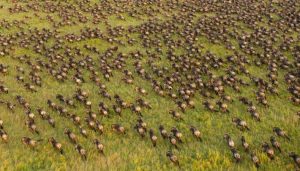
Mathematicians and conservationists from the UK, Africa and the United States have used machine-learning and citizen science techniques to accurately count wildebeest in the Serengeti National Park in Tanzania more rapidly than is possible using traditional methods.
Evaluating wildebeest abundance is currently extremely costly and time-intensive, requiring manual counts of animals in thousands of aerial photographs of their habitats. From those counts, which can take months to complete, wildlife researchers use statistical estimates to determine the size of the population. Detecting changes in the population helps wildlife managers make more informed decisions about how best to keep herds healthy and sustainable. Continue reading “New Technologies Could Help Conservationists Keep Better Track of Serengeti Wildebeest Herds”
For more than a decade, citizen science projects have helped researchers use the power of thousands of volunteers who help sort through datasets that are too large for a small research team. Previously, this data generally couldn’t be processed by computers because the work required skills that only humans could accomplish.
Now, computer machine learning techniques that teach the computer specific image recognition skills can be used in crowdsourcing projects to deal with massively increasing amounts of data—making computers a surprising new partner in citizen science projects.
A search of almost any topic on Google Scholar promises to return tens of thousands of hits in less than a second. The first step in any research endeavour is to wade through the titanic amounts of articles available to become acquainted with the existing knowledge. For many people it’s one of the most dreadful and tedious parts of the scientific process.
But what if we could streamline/facilitate this step by automatizing parts of it? Automated content analysis (ACA) gives us the opportunity to do just that. ACA – a text-mining method that uses text-parsing and machine learning – is able to classify vast amounts of text into categories of named concepts. It can then quantify the frequency of those concepts and the relationships among them. Continue reading “How to Synthesize 100 Articles in Under 10 Minutes: Reviewing Big Literature Using ACA”
To understand how species survive in nature, demographers pair field-collected life history data on survival, growth and reproduction with statistical inference. Demographic approaches have significantly contributed to our understanding of population biology, invasive species dynamics, community ecology, evolutionary biology and much more.
As ecologists begin to ask questions about demography at broader spatial and temporal scales and collect data at higher resolutions, demographic analyses and new statistical methods are likely to shed even more light on important ecological mechanisms.
Traditionally, demographers collect life history data on species in the field under one or more environmental conditions. This approach has significantly improved our understanding of basic biological processes. For example, rosette size is a significant predictor of survival for plants like wild teasel (Werner 1975 – links to all articles are at the end of the post), and desert annual plants hedge their bets against poor years by optimizing germination strategies (Gremer & Venable 2014).
Demographers also include temporal and spatial variability in their models to help make realistic predictions of population dynamics. We now know that temporal variability in carrying capacity dramatically improves population growth rates for perennial grasses and provides a better fit to data than models with varying growth rates because of this (Fowler & Pease 2010). Moreover, spatial heterogeneity and environmental stochasticity have similar consequences for plant populations (Crone 2016). Continue reading “Demography and Big Data”
Today (17 April) is Bat Appreciation Day! Yes I know, a whole day to appreciate bats. Although my biodiversity modelling research group at University College London would argue that 24 hours is just not enough time to appreciate these cool, yet misunderstood animals, we wanted to mark the day by giving MEE a round-up of the latest methodological advances in bat monitoring and what we hope to see in the next few years.
Bat Detectives and Machine Learning
Oisin Mac Aodha PostDoc – If you have ever tried to spot bats flying around at night you will know that it can be very difficult. However, bats leak information about themselves into the environment in the form of the sounds they make while navigating and feeding. These calls are often too high for us to hear, but we can use devices known as bat detectors to transform them into a form that we can record and listen to. Monitoring bat populations over wide areas or long periods can result in huge amounts of data which is difficult to analyse though. To address this problem, our group, along with Zooniverse, have setup a citizen science project called Bat Detective which asks members of the public help us find bat calls in audio recordings that have been collected from all over Europe (the infographic below gives a bit more information on this). We have had an amazing response to date and our detectives have already located several thousand bat calls. However, to scale up monitoring, we need more automated methods of detecting calls. Using the analysis provided by our Bat Detectives, we are currently working on building algorithms that can automatically tell us if a recording contains a bat call.
In this video we see a visual representation of an audio signal called a spectrogram that features several bat calls. On top you see the result of an automated method we have developed for detecting bat calls. The larger the value, the more certain the algorithm is that there is a bat call at that point in time.Continue reading “Bat Appreciation Day: The Latest Methodological Advances”