Best practices for taxonomic harmonization, an overlooked yet crucial step in biodiversity analyses

Post provided by Matthias Grenié, Emilio Berti, Juan Carvajal-Quintero, Gala Mona Louise Dädlow, Alban Sagouis and Marten Winter.

Merging taxonomic datasets from diverse sources for use in macroecological studies can prove challenging, as there is no standardised methodology, taxonomic names often change over time, and even close colleagues can format the exact same data using different approaches. Researchers at iDiv, the German Centre for Integrative Biodiversity, held a workshop to discuss strategies for harmonizing taxonomy which led to a review of best practice being published in Methods in Ecology and Evolution. In this post, Matthias Grenié and co-authors share insight on this process.    

Continue reading “Best practices for taxonomic harmonization, an overlooked yet crucial step in biodiversity analyses”
The BES Macroecology (& Macroevolution) SIG: Who We Are, What We Do and What to Look Out for at #BES2018

Post provided by Natalie Cooper

Defining macroecology should be easy; it’s just ecology at large spatial scales, right? In reality though, it’s a little more complex than that. No-one agrees on exactly how large the spatial scale should be, and many studies that could be macroecology may also be defined as biogeography, landscape ecology, community ecology etc. Working at large spatial scales can also mean working at large temporal scales, often in deep-time. So there’s a lot of overlap with studies of macroevolution both on living and extinct species too.

This breadth of definitions means the BES Macroecology Special Interest Group (or BES Macro as we usually call it) has members with interests across ecology, evolution and palaeontology. Probably the most common statement at any of our events is “I’m not a macroecologist but…”. So, if you’re interested in broad-scale ecology and evolution, in a living or palaeo context, the SIG is for you, even if you don’t identify as a macroecologist! Continue reading “The BES Macroecology (& Macroevolution) SIG: Who We Are, What We Do and What to Look Out for at #BES2018”

New Associate Editors

Today we are welcoming two new Associate Editors to Methods in Ecology and Evolution: Huijie Qiao (Chinese Academy of Sciences, China) and Veronica Zamora-Gutierrez (Unidad Durango, Mexico and University of Southampton, UK). They have both joined on a three-year term and you can find out more about them below. Huijie Qiao “My research is focused broadly on macroecology. I work to clarify the theory and methodology behind ecological niche modelling … Continue reading New Associate Editors

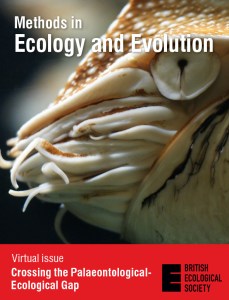
Crossing the Palaeontological-Ecological Gap

Today is the first day of the Crossing the Palaeontological-Ecological Gap (CPEG) conference. The aim of the conference is to open a dialogue between palaeontologists and ecologists who work on similar questions but across vastly different timescales. This splitting of temporal scales tends to make communication, data integration and synthesis in ecology harder. A lot of this comes from the fact that palaeontologists and ecologists tend to publish in different journals and attend different meetings.

Methods in Ecology and Evolution is one of few ecological journals that attracts submissions from both ecologists and palaeontologists. To highlight this, we’ve released a Virtual Issue, also called Crossing the Palaeontological-Ecological Gap. Continue reading “Crossing the Palaeontological-Ecological Gap”

BES Macroecology 2018: Macroecology and Data

Post provided by Faith Jones

© Matthew Leonard
© Matthew Leonard

The annual BES Macroecology Special Interest Group conference took place on the 10th and 11th of July. This year the meeting was in St Andrews, Scotland. Over 100 delegates came together in this old University town to discuss the latest research and concepts in macroecology and macroevolution.

Remote Sensing, Funky Koalas and a Science Ceilidh

The conference opened with a plenary by Journal of Applied Ecology Senior Editor Nathalie Pettorelli from ZSL. She talked about how remote sensing can be used in ecological and conservation studies. In the other plenary talks, we heard from:

  • Methods in Ecology and Evolution Senior Editor Bob O’Hara from NTNU on, among other things, how useful occupancy models are when “occupancy” is such a broad term
  • Anne Magurran from the University of St Andrews discussing turnover and biodiversity change
  • Brian McGill from the University of Maine talking about the data-driven approach to the “biodiversity orthodoxy” and challenging the conventional wisdom about macroecological change

We also hosted a student plenary speaker, Alex Skeels, who gave a lively talk about diversification and geographical modelling using some pretty funky disco koalas. In addition to these talks, there were 60 short 5 minutes talks and 20 posters. Continue reading “BES Macroecology 2018: Macroecology and Data”

HistMapR: 12 Months from Coffee Break Musings to a Debut R Package

Post provided by Alistair Auffret

I was really happy to hear that our paper, ‘HistMapR: Rapid digitization of historical land‐use maps in R’ was shortlisted for the 2017 Robert May Prize, and to be asked to write a blog to mark the occasion. The paper was already recommended in an earlier blog post by Sarah Goslee (the Associate Editor who took care of our submission), and described by me in an instructional video, so I thought that I would write the story of our first foray into making an R package, and submitting a paper to a journal that I never thought I would ever get published in.

Background: Changing Land-Use and Digitizing Maps

Land-use change in Europe is often typified by land-drainage to create arable fields.

Land-use change is largely accepted to be one of the major threats to biodiversity worldwide at the moment. At the same time, a warming climate means that species’ ranges need to move poleward – something that can be hampered by changing land use. Quantifying how land use has changed in the past can help us to understand how species diversity and distributions respond to environmental change.

Unfortunately, quantifying this change by digitizing historical maps is a pretty tedious business. It involves a lot of clicking around various landscape features in a desktop GIS program. So, in many cases, historical land use is only analyzed in a relatively small number of selected landscapes for each particular study. In our group at Stockholm University, we thought that it would be useful to digitize maps over much larger areas, making it possible to assess change in all types of landscape and assess biodiversity responses to land-use change at macroecological scales. The question was, how could we do this? Continue reading “HistMapR: 12 Months from Coffee Break Musings to a Debut R Package”

Editor Recommendation: A Multi-State Species Distribution Modelling Framework for Species Using Distinct Habitats

Post provided by Jana McPherson

© Amélie Augé
© Amélie Augé

Correlative distribution models have become essential tools in conservation, macroecology and ecology more generally. They help turn limited occurrence records into predictive maps that help us get a better sense of where species might be found, which areas might be critical for their protection, how large their range currently is, and how it might change with climate change, urban encroachment or other forms of habitat conversion.

It can be frustrating, however, when species distribution models (and the predictive maps they produce) don’t adequately capture what we already know about the habitat needs of a species. A major challenge to date has been to represent the environmental needs of species that require distinct habitats during different life stages or behavioural states. Rainbow parrotfish (Scarus guacamaia), for example, spend their youth sheltered from predators in mangrove areas before moving onto coral reefs, and European nightjars (Caprimulgus europaeus) breed in heathland but require access to grazed grassland for foraging. Correlative distribution models confronted with occurrence records from both life stages or behavioural modes tend to produce poor predictive maps because they confound these distinct requirements. Continue reading “Editor Recommendation: A Multi-State Species Distribution Modelling Framework for Species Using Distinct Habitats”

The Field Guide to Sequence-Based Identification of Biodiversity: An Interview with Simon Creer

In a new Methods in Ecology and Evolution podcast, Georgina Brennan (Bangor University) interviews Simon Creer (Bangor University) about his article ‘The ecologist’s field guide to sequence-based identification of biodiversity‘. They talk about about where the idea for the paper came from, what it’s aim are and who will benefit from it. We hear how new sequences can improve and enhance current biomonitoring programmes (and make them … Continue reading The Field Guide to Sequence-Based Identification of Biodiversity: An Interview with Simon Creer

Achieving Reproducibility in Research

Earlier this month Leila Walker attended a panel discussion imparting ‘Practical Tips for Reproducible Research’, as part of the Annual Meeting of the Macroecology Special Interest Group (for an overview of the meeting as a whole check out this Storify). The session and subsequent drinks reception was sponsored by Methods in Ecology and Evolution. Here, Leila reports back on the advice offered by the panel members.

For anyone interested in viewing further resources from the session, please see here. Also, you may like to consider attending the best practice for code archiving workshop at the 2016 BES Annual Meeting. Do you have any tips for making your research reproducible? Comment on this post or email us and let us know!

This year’s Annual Meeting of the Macroecology SIG was the biggest yet, with around 75 attendees and even representation across the PhD, post-doc and faculty spectrum. The panel discussion aimed to consider what reproducibility means to different people, identify the reproducibility issues people struggle with, and ultimately provide practical tips and tools for how to achieve reproducible research. Each of the participants delivered a short piece offering their perspective on reproducibility, with plenty of opportunity for discussion during the session itself and in the poster and wine reception that followed.

Attendees enjoy a wine reception (sponsored by MEE) whilst viewing posters and reflecting on the Reproducible Research panel discussion. Photo credit: Leila Walker

Continue reading “Achieving Reproducibility in Research”

New Associate Editors

Over the next few weeks we will be welcoming three new Associate Editors to Methods in Ecology and Evolution. Susan Johnston (University of Edinburgh, UK) became a member of the Associate Editor Board on Monday 5 October. She will be joined on 19 October by Natalie Cooper (Natural History Museum, London, UK) and finally by Luísa Carvalheiro (University of Brasília, Brazil) on 2 November. You can find out … Continue reading New Associate Editors