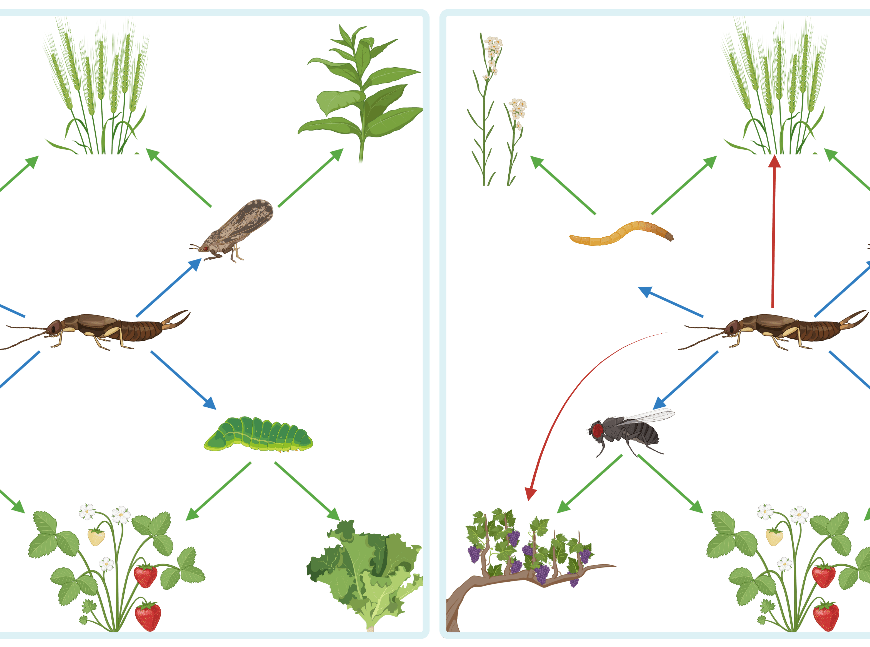
Do you spend your days incapacitated by the agony of not knowing how to combine your field-based observational data with your dietary metabarcoding results? Perhaps every time you go to merge them, the horror of conflicting data types and biases causes you to run and hide from the mere thought of analysis. Or maybe the thought of such problems hadn’t even crossed your mind!In this post, Jordan Cuff and co-authors share insight from their recent publication on using dietary metabarcoding in network ecology and how to merge metabarcoding with traditional data types.
Imagine that you want to catalogue all of the biodiversity (all of the living organisms) from a particular location; how many trained experts would that require? How many person hours would it take to collect and identify all of the rare, well-disguised, and microscopic organisms? How many of these organisms would have to be removed from the environment and taken back to a lab for taxonomic analysis.
Although there is no substitute for human expertise, we have begun using the traces of DNA that organisms leave behind (e.g. excretions, skin and hair cells) in the environment to catalogue biodiversity. These traces of DNA, referred to as environmental DNA, can persist in the environment for minutes or can persist for centuries depending on where they end up. This field of environmental DNA (eDNA) is rapidly becoming an effective tool to complement surveys of biodiversity, both past and present.
Aurora Borealis in the polar north. Photo: Noel Bauza, Pixabay
For those of us in the Northern Hemisphere, the coldest months of the year are upon us. A combination of post-holiday ‘blues’ and the cold, dark mornings make the daily trudge to work all that less inspiring. Recent snow storms in locations such as Newfoundland (Canada), have made it nearly impossible for many people to leave their homes, let alone commute to work. Now cast your mind to a little over 2,000 km north of Newfoundland and imagine the challenges faced with carrying out a job during the coldest, darkest months of the year.
As with every other biome on the planet, polar biomes contain a variety of different species, from bugs to baleen whales. To better understand the different species at our poles, scientists need to collect ecological data, but this is far from a walk in the park.
Iceberg in the Gerlache Strait, Antarctica. Photo: Liam Quinn, flikr.
We’re starting 2020 with a great issue – and ALL of the articles are completely free. And they’ll remain free for the whole year. No subscription required.
You can find out more about our Featured Articles (selected by the Senior Editor) below. We also discuss this month’s Open Access, Practical Tools and Applications articles. There are also articles on species distributions, biotic interactions, taxonomic units and much more.
There’s more information below on the Featured Articles selected by the Senior Editor. We also give you a taste of the Open Access and freely available papers (Applications articles are always free to access for everyone upon publication, whether you have a subscription or not) we’ve published in our November issue. Continue reading “Issue 10.11: Demography, Image Analysis, eDNA and More”
Wild grey seals. By Philip Newman, Natural Resources Wales
A brand new method has been developed by scientists at Plymouth Marine Laboratory (PML) and the University of Exeter, in collaboration with Abertay University and Greenpeace Research Laboratories, to investigate links between top predator diets and the amount of microplastic they consume through their prey. It offers potential insights into the exposure of animals in the ocean and on land to microplastics.
An estimated 9.6-25.4 million tonnes of plastic will enter the sea annually by 2025. Microplastics in particular have been found on the highest mountains and in the deepest seas. New techniques are needed to trace, investigate and analyse this growing concern. Continue reading “Finding the Links between Prey and Microplastics”
With the extra long issue, comes more free articles. There are ELEVEN papers in our August issue that are free to access for absolutely anyone. You can find out about the four Practical Tools papers and seven Applications articles below.
It’s estimated that a person sheds between 30,000 to 40,000 skin cells per day. These cells and their associated DNA leave genetic traces of ourselves in showers, dust — pretty much everywhere we go.
Other organisms shed cells, too, leaving traces throughout their habitats. This leftover genetic material is known as environmental DNA, or eDNA. Research using eDNA began about a decade ago, but was largely limited to a small cadre of biologists who were also experts in computers and big data. However, a new tool from UCLA could be about to make the field accessible and useful to many more scientists.
“…if all the matter in the universe except the nematodes were swept away, our world would still be dimly recognizable, and if, as disembodied spirits, we could then investigate it, we should find its mountains, hills, vales, rivers, lakes, and oceans represented by a film of nematodes…” (Cobb 1914)
He may have said it more than a century ago but we now, more than ever, realise that Nathan Augustus Cobb was right. Nematodes are by far the most abundant animals soil, freshwater and marine ecosystems. These tiny worms are barely visible to the human eye (if they’re visible at all), hundreds can inhabit a single gram of soil . Their similar shape might lead you to think that they’re all alike, but that’s not the case. More than 25,000 species have been identified and estimates put their entire species diversity in the 100,000s.
This taxonomic and functional diversity has boosted nematodes to become useful bioindicators for soil quality. Nematodes perform many different functions in both terrestrial and aquatic ecosystems. These are mainly defined by what they eat:
Bacteria/Fungi: Many nematode groups eat bacteria and fungi. They control the population of these organisms and keep them active.
Plants: Plant feeders are the unwanted guests in agricultural systems as well as in our gardens. They can destroy entire harvests by piercing into or infiltrating roots.
Omnivores/Predators: Many nematode species prey on other smaller organisms including smaller nematodes and control their abundances.
Parasites: These species inhabit other larger organisms and can act as biocontrol agents.




 Methods Blog