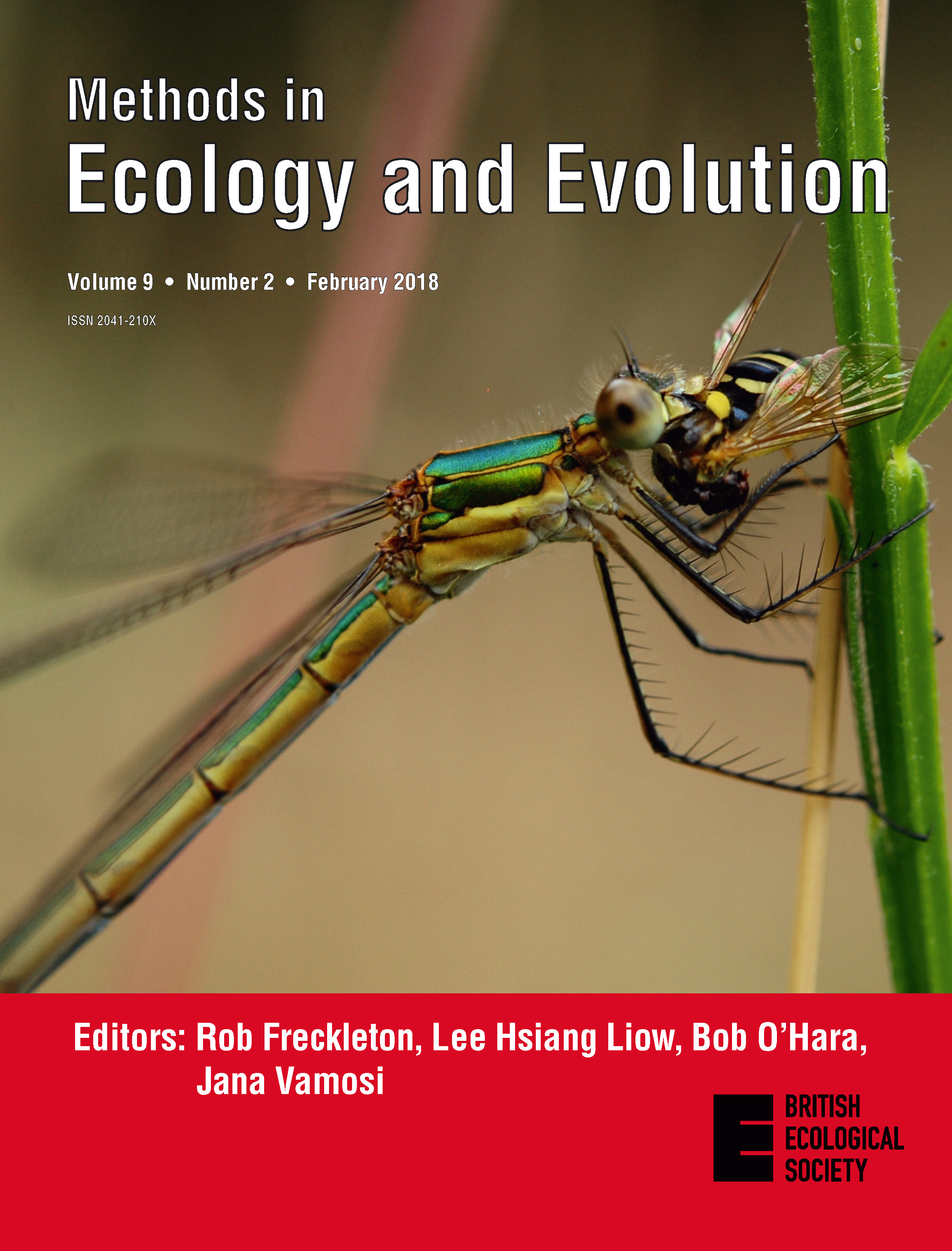
February Issue Out Now

Our February issue is now online! Our second issue of the year contains 22 high-quality articles about the latest methods in ecology and evolution. This month we have methods for visualising the tree of life, estimating arthropod abundance and diversity, disentangling effects of climate and land use on biodiversity and much more! This issue also contains four Applications and two Practical Tools articles that are free to … Continue reading February Issue Out Now

October Issue Out Now!

Our October Issue is out now! It’s a bumper issue, with 26 articles presenting the latest methods in ecology and evolution. We have methods for measuring temporal change in alpha diversity, aerial imaging of field plots, analysing 3D morphology images and more, plus four Applications and five Practical Tools articles for your reading. Find out more below! Featured Articles The potential and practice of arboreal … Continue reading October Issue Out Now!

An interview with the editors of “Population Ecology in Practice”: Part II

Post provided by Daniel Caetano

Today we bring the second part of an interview with Dennis Murray and Brett Sandercock about their brand new book in population ecology methods: “Population Ecology in Practice.” This time we talked about their experience as editors, including some useful advice for new editors.

If you missed the first part of the interview, check it out here.

Population Ecology in Practice introduces a synthesis of analytical and modelling approaches currently used in demographic, genetic, and spatial analyses. Chapters provide examples based on real datasets together with a companion website with study cases and exercises implemented in the R statistical programming language.

Continue reading “An interview with the editors of “Population Ecology in Practice”: Part II”

An interview with the editors of “Population Ecology in Practice”: Part I

Post provided by Daniel Caetano

Today we bring the first part of an interview with Dennis Murray and Brett Sandercock about their brand new book in population ecology methods: “Population Ecology in Practice.” The editors were kind enough to share some interesting backstage information with us.

Snowshoe hare in winter

Population Ecology in Practice introduces a synthesis of analytical and modelling approaches currently used in demographic, genetic, and spatial analyses. Chapters provide examples based on real datasets together with a companion website with study cases and exercises implemented in the R statistical programming language.

Stay tuned for the second part of this interview, where we talk about some of the challenges of editing a large book and the editors share essential advice for anyone looking into leading such a project!

Continue reading “An interview with the editors of “Population Ecology in Practice”: Part I”

Issue 9.2

Issue 9.2 is now online!
The February issue of Methods is now online!

This double-size issue contains six Applications articles (one of which is Open Access) and two Open Access research articles. These eight papers are freely available to everyone, no subscription required.

 Temperature Manipulation: Welshofer et al. present a modified International Tundra Experiment (ITEX) chamber design for year-round outdoor use in warming taller-stature plant communities up to 1.5 m tall.This design is a valuable tool for examining the effects of in situ warming on understudied taller-stature plant communities

 ZoonThe disjointed nature of the current species distribution modelling (SDM) research environment hinders evaluation of new methods, synthesis of current knowledge and the dissemination of new methods to SDM users. The zoon R package aims to overcome these problems by providing a modular framework for constructing reproducible SDM workflows.

 BEIN R Package: The Botanical Information and Ecology Network (BIEN) database comprises an unprecedented wealth of cleaned and standardised botanical data. The bien r package allows users to access the multiple types of data in the BIEN database. This represents a significant achievement in biological data integration, cleaning and standardisation.

Continue reading “Issue 9.2”

Issue 8.4: Technological Advances at the Interface of Ecology and Statistics

Issue 8.4 is now online!

The April issue of Methods, which includes our latest Special Feature – “Technological Advances at the Interface of Ecology and Statistics” – is now online!

This new Special Feature is a collection of five articles (plus an Editorial from Guest Editor David Warton) inspired by the December 2015 Eco-Stats conference at the University of New South Wales in Australia. It shows how interdisciplinary collaboration help to solve problems around estimating biodiversity and how it changes over space and time.

The five articles are based on joint talks given at the conference. They focus on:

As David Warton states in his Editorial, “interdisciplinary collaboration and the opportunities offered by recent technological advances have potential to lead to interesting and sometimes surprising findings, and will continue to be fertile ground for scientists in the foreseeable future”. Meetings like Eco-Stats 15 and Special Features like this one will, hopefully, help to encourage these sorts of collaborative research projects.

All of the articles in the ‘Technological Advances at the Interface of Ecology and Statistics‘ Special Feature will be freely available for a limited time.
Continue reading “Issue 8.4: Technological Advances at the Interface of Ecology and Statistics”

What is Methods in Ecology and Evolution?

In a new Methods in Ecology and Evolution podcast, the Senior Editors – Rob Freckleton, Bob O’Hara and Jana Vamosi – discuss the past, present and future of the journal. They talk about what sets it apart from other journals, their favourite articles and the kinds of papers that they would like to see more of. If you’re thinking about submitting to Methods in Ecology and … Continue reading What is Methods in Ecology and Evolution?

Issue 7.9

Issue 7.9 is now online!

The September issue of Methods is now online!

This month’s issue contains two Applications articles and three Open Access articles, all of which are freely available.

– Arborist Throw-Line Launcher: A cost-effective and simple alternative for collecting leaves and seeds from tall trees. The authors have also provided some tutorial videos on YouTube.

– ctmm: An R package which implements all of the continuous-time stochastic processes currently in use in the ecological literature and couples them with powerful statistical methods for autocorrelated data adapted from geostatistics and signal processing.

Continue reading “Issue 7.9”

Issue 7.8

Issue 7.8 is now online!

The August issue of Methods is now online!

This month’s issue contains two Applications articles and two Open Access articles, all of which are freely available.

Plant-O-Matic: A free iOS application that combines the species distribution models with the location services built into a mobile device to provide users with a list of all plant species expected to occur in the 100 × 100 km geographic grid cell corresponding to the user’s location.

RClone: An R package built upon genclone software which includes functions to handle clonal data sets, allowing:

  • Checking for data set reliability to discriminate multilocus genotypes (MLGs)
  • Ascertainment of MLG and semi-automatic determination of clonal lineages (MLL)
  • Genotypic richness and evenness indices calculation based on MLGs or MLLs
  • Describing several spatial components of clonality

Continue reading “Issue 7.8”

Issue 7.7

Issue 7.7 is now online!

The July issue of Methods is now online!

This month’s issue contains two Applications articles and two Open Access articles, all of which are freely available.

– MO-Phylogenetics: A software tool to infer phylogenetic trees optimising two reconstruction criteria simultaneously and integrating a framework for multi-objective optimisation with two phylogenetic software packages.

– PHYLOMETRICS: An efficient algorithm to construct the null distributions (by generating phylogenies under a trait state-dependent speciation and extinction model) and a pipeline for estimating the false-positive rate and the statistical power of tests on phylogenetic metrics..

Continue reading “Issue 7.7”