Can We Really Measure Habitat Condition From Space?

Post provided by Tom Harwood, Randall Donohue, Simon Ferrier, Tim McVicar, Graeme Newell, Matt White and Kristen Williams
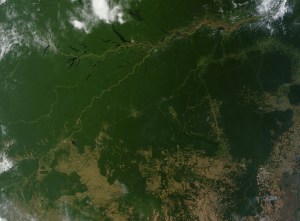
Remotely sensing can see patterns of land cover, but how do we use this information to quantify human impact on biodiversity?
Remotely sensing can see patterns of land cover, but how do we use this information to quantify human impact on biodiversity? ©NASA/GSFC/Jeff Schmaltz/MODIS Land Rapid Response Team

It’s very hard to make sensible choices without sensible information. When it comes to actions around changing land use and its ecological impact though, this is often what we are forced to do. If we want to reduce the impact of human activities on natural ecosystems, we need to know how much change has already occurred and how altered an ecosystem might be from its “natural” state.

Working out which parts of the landscape have been changed and mapping the absence of natural vegetation is an achievable (though onerous) task. However, moving beyond this binary view of the world is a huge challenge. Pretty much all habitat has been modified by human influences to some extent – by, for example, wood extraction, the introduction of invasive species or livestock grazing. This means that a lot of the apparently native habitat is no longer capable of supporting its full complement of native biodiversity. Continue reading “Can We Really Measure Habitat Condition From Space?”

The Delphi Technique: Unleashing the Power of Structured Collaboration in Anonymity

Post provided by Nibedita Mukherjee (author of The Delphi technique in ecology and biological conservation)

The quirky nature of decision making

Two heads are often better than one in decision making. Several heads might have an even higher probability of being better than one. However, people in a group often have different modes of thinking or problem solving, alternate reference frames, subjective biases and varying levels or domains of expertise. How do we harness these messy thought processes and channel them for effective decision-making for biodiversity management?

© Henry Martin (The New Yorker Collection/The Cartoon Bank)

Continue reading “The Delphi Technique: Unleashing the Power of Structured Collaboration in Anonymity”

Latest issue and other articles

Issue 3.4 Our latest issue covers an impressive array of subjects: from metabarcoding (with associated presentation), to population genetics and population monitoring (with video explaining a microphone array system). Modelling and monitoring dispersal also features heavily with four articles, one of which is accompanied by a video for a novel telemetry system to track wild animals. Articles also include topics such as transient dynamics, a review … Continue reading Latest issue and other articles

Issue 3.3

About the issue Issue 3.3 contains an amazing number of extra features: three videos, one podcast and one Powerpoint presentation. The topics in the issue range from DNA barcoding, surveys, measuring diversity, population and movement modelling and includes five free applications. About the cover Recently developed light-weighed tracking devices for positioning through light intensity pattern (‘geolocation’) have begun to greatly improve our knowledge of animal … Continue reading Issue 3.3

Why Simpler Models are Better

(this is the first in a possibly irregular series of posts about papers that catch my eye. I don’t intend to only cover MEE papers, but I had to start somewhere)

ResearchBlogging.orgA perennial worry for anyone building models for the real world is whether they actually represent the real world. If the whole process of finding and fitting a model has been done well, the model will represent the data. But the data is only part of the real world. How can we be sure our model will extrapolated beyond the data?
Continue reading “Why Simpler Models are Better”

Issue 3.2

About the issue With topics ranging from phylogenetic analysis to statistics and distribution modelling, conservation, citizen science, surveys, genetic and demographic models to avian biology, our issue 3.2 should be of interest to most ecologists and evolutionary biologists. The issue also contains 5 free applications. About the cover This very high-resolution image of a beech-dominated forest in central Germany was taken by an unmanned aerial … Continue reading Issue 3.2

Recently accepted articles

We have been very busy in the past couple of weeks and we have a whole range of recently accepted articles: A novel digital telemetry system for tracking wild animals: a field test for studying mate choice in a lekking tropical bird Dan Mennill, Stéphanie Doucet, Kara-Anne Ward, Dugan Maynard, Brian Otis and John Burt A general theory of multimetric indices and their properties Donald … Continue reading Recently accepted articles

Latest papers online

In the past week, MEE has been at the ITN Speciation conference in Jyväskylä. As a result, journal updates have been slower than usual. So here is a quick overview of the new papers available online during the past week: Research papers: Movement ecology of human resource users: using net squared displacement, biased random bridges and resource utilization functions to quantify hunter and gatherer behaviour … Continue reading Latest papers online

Volume 3 Issue 1: Now online

It seems that from the number of submissions we receive at the journal, Methods in Ecology and Evolution has filled an important niche. As our editor-in-chief, Rob Freckleton, wrote to introduce our second volume: “those doing science need to be kept up to date on new approaches, and those developing new methods need a place to publish, as well as be supported in getting their … Continue reading Volume 3 Issue 1: Now online

2011 top cited papers – part 2

Today we look at part 2 of our most cited papers in Methods in Ecology and Evolution in 2011. Plant monitoring and modelling Comparison of seedling emergence and seed extraction techniques for estimating the composition of soil seed banks Jodi N. Price, Boyd R. Wright, Caroline L. Gross, Wal R. D. B. Whalley Stable isotope ecology Sensitivity of stable isotope mixing models to variation in … Continue reading 2011 top cited papers – part 2