A Surgical Approach to Dissection of an Exotic Animal

Post provided by Aaron T Irving, Justin HJ Ng and Lin-fa Wang
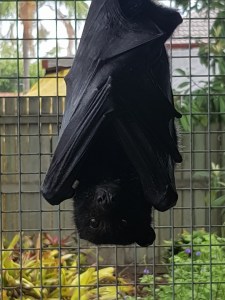
An Australian black flying fox – missing an ear, but fit for release.

Bats. They’re amazing creatures. Long-lived (with relevance to their body size), echolocating (for microbats and some megabats), metabolically-resilient (apparently resilient to most virus infections) flying mammals (with heart beats up to 1200 bpm for hours during flight). There are 1,411 species of this incredible creature. But very little is known about their physiology and unique biological traits. And detailed evolutionary analysis has only just begun.

The problem is, they’re an ‘exotic’ animal (wildlife that most people do not come into contact with). Being a long-lived animal producing minimal offspring (most only have one baby per year), they’re not suited to the kind of experimental studies we do with other animals like mice. Unavoidably, some aspects of biology require the use of tissues and cells. These samples can be used for sequencing, genomics, molecular evolution studies, detailed transcriptomic analysis, functional experiments with specific cell types and much more. Some methodology is beginning to be published – such as capture techniques and wing punch/genomic isolation – but there’s been an absence of protocols for the processing of bats. This is essential for the field to maximise the potential application of each individual and for minimising non-essential specimen collection.

Continue reading “A Surgical Approach to Dissection of an Exotic Animal”

Associate Editor Profile: LOUISE JOHNSON

Dr Louise Johnson, a population geneticist working on the evolution of genetic systems, has been an Associate Editor for Methods in Ecology and Evolution since October 2013. In that time she has handled a range of manuscripts falling within her areas of expertise (primarily molecular evolution, population genetics and genomes).

Louise Johnson
Dr Louise Johnson

Louise began her academic career with a degree in Genetics at the University of Edinburgh. She then moved south to complete her PhD on the evolution of mating systems in yeast at Imperial College London under the supervision of Professor Austin Burt. Following her successful time in London, she took up post-doctorate positions at the University of Nottingham (working on transposable elements with Professor John Brookfield) and across the Atlantic at the University of Virginia (looking at genome defences with Professor Janis Antonovics and Professor Michael Hood). Louise returned to the UK in 2006 to take up an RCUK Fellowship at the University of Reading and has been there ever since.

As part of our series of Editor Profiles, we asked Louise to tell us about some of her current research:

There are three projects which I am currently working on that I would like to outline. I’ll be discussing the cancer project – or at least the story so far – at the Methods in Ecology and Evolution 5th Anniversary Symposium later this month. Do check out the programme, and I hope to see you there! The whole point of a methods journal is to help each other do our research as well and easily as possible, so there’s a built-in community spirit about MEE, which bodes well for a fun and useful meeting. Before I start I should also say that I’m lucky to have amazing collaborators at Reading and beyond: for the projects below, credit is particularly due to my colleagues Rob Jackson and Tiffany Taylor, who had a huge input, and to Mike Brockhurst at York. Continue reading “Associate Editor Profile: LOUISE JOHNSON”

New associate editor

Methods is pleased to announce that Matthew Spencer has become the newest member of its editorial board, taking up the role of Associate Editor. Matt is a quantitative biologist at the University of Liverpool and is interested in using stochastic models to understand community dynamics and molecular evolution: In particular, I want to work with models that are simple, flexible, and can be applied to … Continue reading New associate editor

Methods digest – update

A round up of recent methods-relevant research published recently: it is ages since we did this, largely because the journal has been so busy with papers coming in and being published. Do send through links to any new methods papers to me or to the journal, or post a comment below. In Evolution, Werthelm & Sanderson look at how estimates of diversification rates are influenced … Continue reading Methods digest – update