Smart genetic analysis made fast and easy

Post provided by: Salvador Herrando-Pérez

If you use genetics to differentiate populations, the new package smartsnp might be your new best friend. Written in R language and available from GitHub and CRAN, this package performs principal component analysis with control for genetic drift, projects ancient samples onto modern genetic space, and tests for population differences in genotypes. The package can load big datasets and run complex stats in the blink of an eye.

In this post, Salvador Herrando-Pérez discusses the features of this new package which is fully described in the new paper “smartsnp, an R package for fast multivariate analyses of big genomic data” recently published in Methods in Ecology & Evolution.

Continue reading “Smart genetic analysis made fast and easy”

A new evolutionary simulation R package sheds light on the metaphor of genomic islands of divergence

Robert May Prize Shortlisted Article

Post provided by Claudio S. Quilodrán and Ashley T. Sendell-Price

Nesting eggs of silvereyes (Zosterops lateralis). Heron Island, Australia. Picture: Erik Sandvik.

Each year Methods in Ecology and Evolution awards the Robert May Prize to the best paper in the journal by an author at the start of their career. Claudio S. Quilodrán has been shortlisted for his article ‘The multiple population genetic and demographic routes to islands of genomic divergence’. In this blog, Claudio and co-author Ashley T. Sendell-Price discuss how their paper came to be and how their individual‐based simulation can be used to explore the dynamics of diverging genomes.

Continue reading “A new evolutionary simulation R package sheds light on the metaphor of genomic islands of divergence”

10th Anniversary Volume 10: Evidence synthesis technology and automating systematic reviews

Post provided by Eliza M. grames

To celebrate the 10th Anniversary of the launch of Methods in Ecology and Evolution, we are highlighting an article from each volume to feature on the Methods.blog. For Volume 10, we have selected ‘An automated approach to identifying search terms for systematic reviews using keyword co‐occurrence networks’ by Grames et al. (2019).

In this post, Eliza Grames shares the motivation behind the litsearchr search approach, and developments since the article’s publication.

Continue reading “10th Anniversary Volume 10: Evidence synthesis technology and automating systematic reviews”

10th Anniversary Volume 3: paleotree: A Retrospective

Post provided by David bapst

To celebrate the 10th Anniversary of the launch of Methods in Ecology and Evolution, we are highlighting an article from each volume to feature on the Methods.blog. For Volume 3, we have selected ‘paleotree: an R package for paleontological and phylogenetic analyses of evolution‘ by David W. Bapst (2012). In this post, David discusses the background to the Application he wrote as a graduate student, and how the field has changed since.

I was a fourth year graduate student when I first had the idea to make an R package. Quite a few people thought it was a bit silly, or a bit of a time-waste, but I thought it was the right thing to do at the time, and I think it has proven to be the right decision in hindsight.

Continue reading “10th Anniversary Volume 3: paleotree: A Retrospective”

MInOSSE: all you need to reconstruct past species geographic range is in the fossil record!

Post provided by Francesco Carotenuto

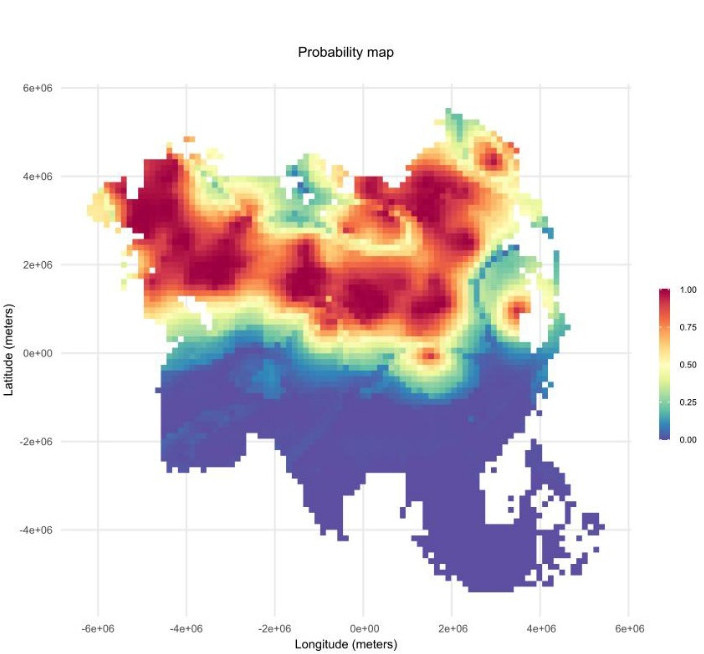
A very important ecological feature of a species is its geographic range, which can be described by its size, position and shape. Studying the geographic range can be useful to understand the ecological needs of a species and, thereby, to plan conservation strategies. In ecological studies, mathematical models are the new standard to reconstruct the distribution of living species on Earth because of their accuracy in predicting a species presence or absence at unsampled locations. These methods are able to reconstruct the climatic niche of a species and to project it onto a geographic domain in order to predict the species’ spatial distribution. To do this, besides the occurrences of a species, the models necessarily require the spatial maps of environmental variables, like temperature and precipitation, for all the study area.

Continue reading “MInOSSE: all you need to reconstruct past species geographic range is in the fossil record!”

A brief history about the R package ‘metan’

Post provided by Tiago Olivoto

Este post também pode ser lido em Português

In our recent paper in Methods in Ecology and Evolution, Alessandro Lúcio and I describe a new R package, metan, for multi-environment trial analysis. Multi-environment trials are a kind of trial in plant breeding programs where several genotypes are evaluated in a set of environments. Analyzing such data requires the combination of several approaches including data manipulation, visualization and modelling. The latest stable version of metan (v1.5.1) is now on CRAN. So, I want to share the history about my first foray into using R, creating an R package, and submitting a paper to a journal that I’ve never had submitted before.

Continue reading “A brief history about the R package ‘metan’”

Uma breve história sobre o pacote R ‘metan’

Post ESCRITO POR Tiago Olivoto

This post is also available in English

Em nosso recente artigo na Methods in Ecology and Evolution, Alessandro D. Lúcio e eu descrevemos um novo pacote R para análise de ensaios multi-ambientes chamado metan. Ensaios multi-ambientes são um tipo de ensaio em programas de melhoramento de plantas, onde vários genótipos são avaliados em um conjunto de ambientes. A análise desses dados requer a combinação de várias abordagens, incluindo manipulação, visualização e modelagem de dados. A versão estável mais recente do metan (v1.5.1) está disponível agora no repositório CRAN. Então, pensei em compartilhar a história da minha primeira incursão no uso do R criando um pacote e submetendo um artigo para uma revista que nunca havia submetido antes.

Continue reading “Uma breve história sobre o pacote R ‘metan’”

Issue 10.12: Statistical Ecology, UAVs, Invasive Species and More

The December issue of Methods is now online!

The final 2019 issue of Methods in Ecology and Evolution is online now.

To close out another brilliant year, we’ve got papers on invasive species, convolutional neural networks, rapid spatial risk modelling, species distribution models and much more.

You can find out more about our Featured Articles (selected by the Senior Editor) below. We also discuss this month’s Open Access and freely available papers we’ve published in our latest issue (Practical Tools and Applications articles are always free to access, whether you have a subscription or not) .

Continue reading “Issue 10.12: Statistical Ecology, UAVs, Invasive Species and More”

‘Tis the Season for Modelling Mortalities

Post provided by ELIE GURARIE

A warning: Halloween is nigh, and the following post contains graphic real-life imagery of maggot-eaten eye-sockets and deadly pianos. Read on… if you dare!

A Death in the Woods 

In the vast and often frozen boreal forest of northern Canada there is a slow-burning forensic investigation into a death. The victim: a woodland caribou, an iconic species that is threatened or endangered throughout its range.

Kyle Joly

The scene is very much made for TV neo-Scandinavian neo-noir. From a not-too-luxurious regional office in the town of Fort Smith, just north of the Alberta border, over a steaming cup of coffee, world-weary biologist Allicia Kelly – who’s seen it all and then some – is monitoring the movements of collared animals on her computer screen. It’s the middle of May. The females, nearly all pregnant, are scattering to higher ground to find suitably cozy and secluded sites to calve. All is as peaceful and idyllic as a bunch of blips on a computer screen can be.

But then (cue slightly unsettling dissonance in the soundtrack) one of the little blips seems to have stopped moving. Kelly raises her eyebrow, tells herself to keep an eye out. A moment later she makes the call: “Team, we’ve got another ringer … let’s roll!Continue reading “‘Tis the Season for Modelling Mortalities”

Meaningful Monitoring or Monitoring for the Sake of Monitoring? epower Helps You Tell the Difference

Post provided by REBECCA FISHER and GLENN R SHIELL

As environmental managers, we’re frequently asked to make judgements about the relative health of the environment. This is often difficult because, by its nature, the environment is highly variable in space and time. Ideally, such judgements should be informed by robust scientific investigation, or more precisely, the reliable interpretation of the resulting data.

Type I and Type II Errors

Even with robust investigations and good data, our interpretations can sometimes be wrong. In general, this happens when:

  • the investigation concludes that an impact has occurred, when in fact it hasn’t (Type I error)
  • fails to detect an impact, when an impact has actually occurred (Type II error).

Understanding the circumstances that lead to these errors is unfortunately complicated, and difficult unless you have a strong statistical background. Continue reading “Meaningful Monitoring or Monitoring for the Sake of Monitoring? epower Helps You Tell the Difference”