Like all living things, plant species must reproduce to persist. Key stages in successful plant reproduction must be carefully timed to make sure resources are available and conditions are optimal. There will be little success if flowers mature in bad weather conditions for their insect pollinators or if fruits ripen but the seed dispersers have migrated elsewhere.
The Global Pollen Project is an online, freely available tool and data source developed to help people identify and disseminate palynological resources. Palynology – the study of pollen grains and other spores – is used across many fields of study including modern and fossil vegetation dynamics, forensic sciences, pollination, and beekeeping. To help make pollen identification quicker and more transparent, we developed the Global Pollen Project (GPP) – an open, peer-reviewed database of global pollen morphology, where content and expertise is crowdsourced from across the world. Our approach to developing this tool was open: open code, open data, open access. It connects to other data services, including the Global Biodiversity Information Facility and Neotoma Palaeoecology Database, to provide occurrence data for each taxon, alongside pollen images and metadata. Continue reading “The Global Pollen Project: An Update for Methods Readers”
Some individuals survive and reproduce better than others. Traits that help them do so may be passed on to the next generation, leading to evolutionary change. Because of this, evolutionary biologists are interested in what differentiates the winners from the losers – how do their traits differ, and by how much? These differences are known as natural selection.
Linear and Nonlinear Selection
Traditionally, natural selection is separated into linear selection (differences in average trait values) and nonlinear selection (any other differences in trait distributions between winners and the rest). For example, successful individuals might be unusually close to average: this is known as stabilizing selection. Alternatively, winners might split into two camps, some with unusually high trait values, and others with unusually low trait values. This is disruptive selection (famously thought to explain the ur-origin of sperm and eggs). Stabilizing and disruptive selection are important types of nonlinear selection. In general, though, the trait distribution of successful individuals can differ from the general population in arbitrarily complicated ways.
When individuals with larger trait values have higher fitness on average (left panel), the trait distribution of successful individuals is shifted towards the right (right panel, orange curve). The difference in mean trait values between the winners and the general population is called linear selection.
The standard approach to quantifying natural selection, developed by Lande and Arnold, does not allow for comparable metrics between linear (i.e. selection on the mean phenotype) and nonlinear (i.e. selection on all other aspects of the phenotypic distribution, including variance and the number of modes) selection gradients. Jonathan Henshaw’s winning submission provides the first integrated measure of the strength of selection that applies across qualitatively different selection regimes (e.g. directional, stabilizing or disruptive selection). Continue reading “2017 Robert May Prize Winner: Jonathan Henshaw”
I was really happy to hear that our paper, ‘HistMapR: Rapid digitization of historical land‐use maps in R’ was shortlisted for the 2017 Robert May Prize, and to be asked to write a blog to mark the occasion. The paper was already recommended in an earlier blog post by Sarah Goslee (the Associate Editor who took care of our submission), and described by me in an instructional video, so I thought that I would write the story of our first foray into making an R package, and submitting a paper to a journal that I never thought I would ever get published in.
Background: Changing Land-Use and Digitizing Maps
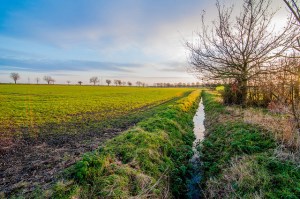
Land-use change in Europe is often typified by land-drainage to create arable fields.
Land-use change is largely accepted to be one of the major threats to biodiversity worldwide at the moment. At the same time, a warming climate means that species’ ranges need to move poleward – something that can be hampered by changing land use. Quantifying how land use has changed in the past can help us to understand how species diversity and distributions respond to environmental change.
Unfortunately, quantifying this change by digitizing historical maps is a pretty tedious business. It involves a lot of clicking around various landscape features in a desktop GIS program. So, in many cases, historical land use is only analyzed in a relatively small number of selected landscapes for each particular study. In our group at Stockholm University, we thought that it would be useful to digitize maps over much larger areas, making it possible to assess change in all types of landscape and assess biodiversity responses to land-use change at macroecological scales. The question was, how could we do this? Continue reading “HistMapR: 12 Months from Coffee Break Musings to a Debut R Package”
Ecologists have long been fascinated by animal sounds and in recent decades there’s been growing interest in the field of ‘bioacoustics’. This has partially been driven by the availability of high-definition digital audio recorders that can withstand harsh field conditions, as well as improvements in software technology that can automate sound analysis.
Each year an uncountable number of airborne organisms, mainly birds and insects, venture out on long journeys across the globe. In particular, the mass movements of birds have fascinated humankind for hundreds of years and inspired a wealth of increasingly sophisticated studies. The development and improvement of individual tracking devices in animal research and has provided amazing insights into such extensive journeys. Study of mass movements of biological organisms is still a challenge on continent-wide or cross-continental scales.
One tool that can effectively track and/or monitor large numbers of birds is radar technology. Radars offer many advantages over other methods such as visual counts or ringing. They’re less expensive, need less effort, offer better visibility and detectability, and are more applicable for large-scale monitoring. Networks of meteorological radars (as opposed to individual radars) seem particularly promising for large-scale studies. Continue reading “Radar Wind Profilers: A Widespread but Unused Remote Sensing Tool for Migration Ornithologists”
Quantitative syntheses of primary research studies (meta-analysis) are being used more and more in ecological and evolutionary research. So knowing the basics of how meta-analysis works is important for every researcher. Meta-analytical thinking also encourages us scientists to see each single primary research study as a substantial contribution to a larger picture.
To be included in a meta-analysis, relevant primary research studies must be easy to find and basic information about the methods and results must be thoroughly, clearly and transparently reported. Moreover, papers with accessible data are the most useful for meta-analyses. Many published papers provide this information, but it’s not unusual for essential data to be omitted. Studies that are missing these details can’t be used in meta-analyses, which limits their reach. Continue reading “Meta-Analysis: How to Increase the Reach of Your Research and Make it Longer Lasting”
Happy New Year! We hope that you all had a wonderful Winter Break and that you’re ready to start 2018. We’re beginning the year with a look back at some of our highlights of 2017. Here’s how last year looked at Methods in Ecology and Evolution.
The Articles
We published some amazing articles in 2017, too many to mention them all here. However, we would like to take a moment to thank all of the Authors, Reviewers and Editors who contributed to the journal last year. Your time and effort make the journal what it is and we are incredibly grateful. THANK YOU for all of your hard work!
Technological Advances at the Interface between Ecology and Statistics
Our first Special Feature of the year came in the April issue of the journal. The idea forTechnological Advances at the Interface between Ecology and Statistics came from the 2015 Eco-Stats Symposium at the University of New South Wales and the feature was guest edited by Associate Editor David Warton. It consists of five articles based on talks from that conference and shows how interdisciplinary collaboration help to solve problems around estimating biodiversity and how it changes over space and time.
Online Images: A Treasure Trove of Ecological Data
In the proclaimed ‘information age’, where answers are available at the click of a button or a swipe of a finger, we have become accustomed to the ability to get an almost instant grasp of any topic. Other fields are already making use of this wealth of easily accessible online data, but biologists and ecologists tend to let it slip by. However, this attitude is slowly beginning to change. Some ecological and evolutionary studies are emerging that have used the internet to gather data – through online citizen science projects (e.g. Evolution MegaLab) or databases (e.g. using Google Trends) – but few have used existing data, particularly publicly available data from image repositories.
We were curious to apply the concept of using existing images on the internet to a fascinating visual biological phenomenon: colour polymorphism (or the occurrence of multiple discrete colour phenotypes). To do this, we planned to exploit an existing penchant people have for uploading photographs of animals to the Internet.
Our search phrases included the common and scientific name of the species, as well as a location-specific term






 Methods Blog