Issue 7.9

Issue 7.9 is now online!
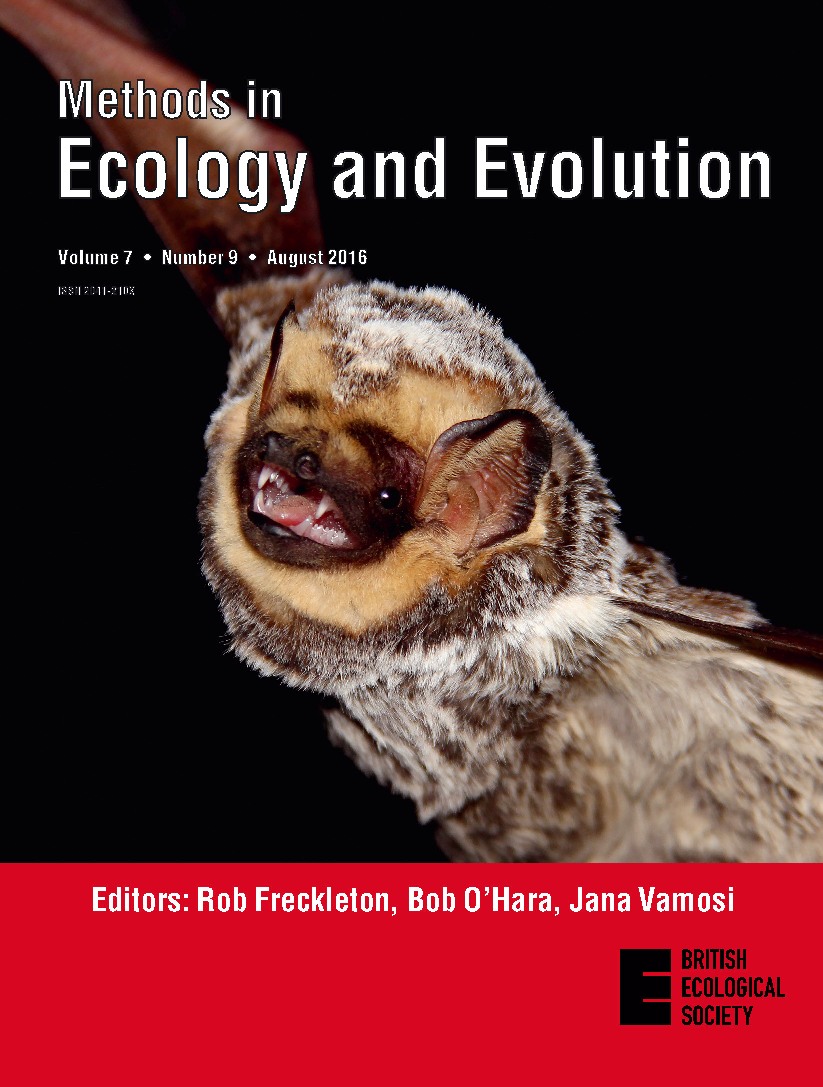
The September issue of Methods is now online!

This month’s issue contains two Applications articles and three Open Access articles, all of which are freely available.

– Arborist Throw-Line Launcher: A cost-effective and simple alternative for collecting leaves and seeds from tall trees. The authors have also provided some tutorial videos on YouTube.

– ctmm: An R package which implements all of the continuous-time stochastic processes currently in use in the ecological literature and couples them with powerful statistical methods for autocorrelated data adapted from geostatistics and signal processing.

Continue reading “Issue 7.9”

New Associate Editor: Marie Auger-Méthé

Today, we are pleased to be welcoming a new member of the Methods in Ecology and Evolution Associate Editor Board. Marie Auger-Méthé joins us from Dalhousie University in Canada and you can find out a little more about her below.

Marie Auger-Méthé

Marie Auger-Méthé

“I am broadly interested in developing and applying statistical tools to infer behavioural and population processes from empirical data. My work tends to focus on marine and polar mammals, but the methods I develop are often applicable to a wide range of species and ecosystems. My recent work has centred on modelling animal behaviour using movement data and I generally analyse data with spatial and/or temporal structure.”

Marie has been reviewing for Methods in Ecology and Evolution for a few years and has contributed articles to some of the other journals of the British Ecological Society too. Earlier this month, her article titled ‘Evaluating random search strategies in three mammals from distinct feeding guilds‘ was published in the Journal of Animal Ecology. Continue reading “New Associate Editor: Marie Auger-Méthé”

moveHMM: An Interview with Théo Michelot

David Warton (University of New South Wales) interviews Théo Michelot (University of Sheffield) about an article on his recent R package moveHMM in Methods in Ecology and Evolution. David and Théo also discuss the case study in the paper – on the understudied wild haggis – and what advances could be made to the package in future.

Continue reading “moveHMM: An Interview with Théo Michelot”

New Associate Editor: Michael Morrissey

Today, we are pleased to be welcoming a new member of the Methods in Ecology and Evolution Associate Editor Board. Michael Morrissey joins us from the University of St Andrews in Scotland and you can find out a little more about him below.

Michael Morrissey

“I am an evolutionary quantitative geneticist. I am interested in the selection, genetics, and evolutionary trajectories of traits in natural populations. I typically work at the interface of statistics, evolutionary theory, and empirical problems.”

Michael has been an active reviewer for Methods for the past few years and has provided excellent comments and recommendations on a number of papers. He also had an article – ‘In search of the best methods for multivariate selection analysis‘ – published in the journal in 2014 (which will become freely available in October this year).
Continue reading “New Associate Editor: Michael Morrissey”

Estimating Shifts in Species Distribution: An Interview with James Thorson

David Warton (University of New South Wales) interviews James Thorson (NOAA) about his paper Model-based inference for estimating shifts in species distribution, area occupied and centre of gravity. The article is included in the August 2016 issue of Methods in Ecology and Evolution.  They discuss how to estimate changes in distribution shifts accounting for changes in the spatial distribution of sampling intensity, James’ current workplace NOAA, his academic background and what trouble he is planning to get up to next.

Continue reading “Estimating Shifts in Species Distribution: An Interview with James Thorson”

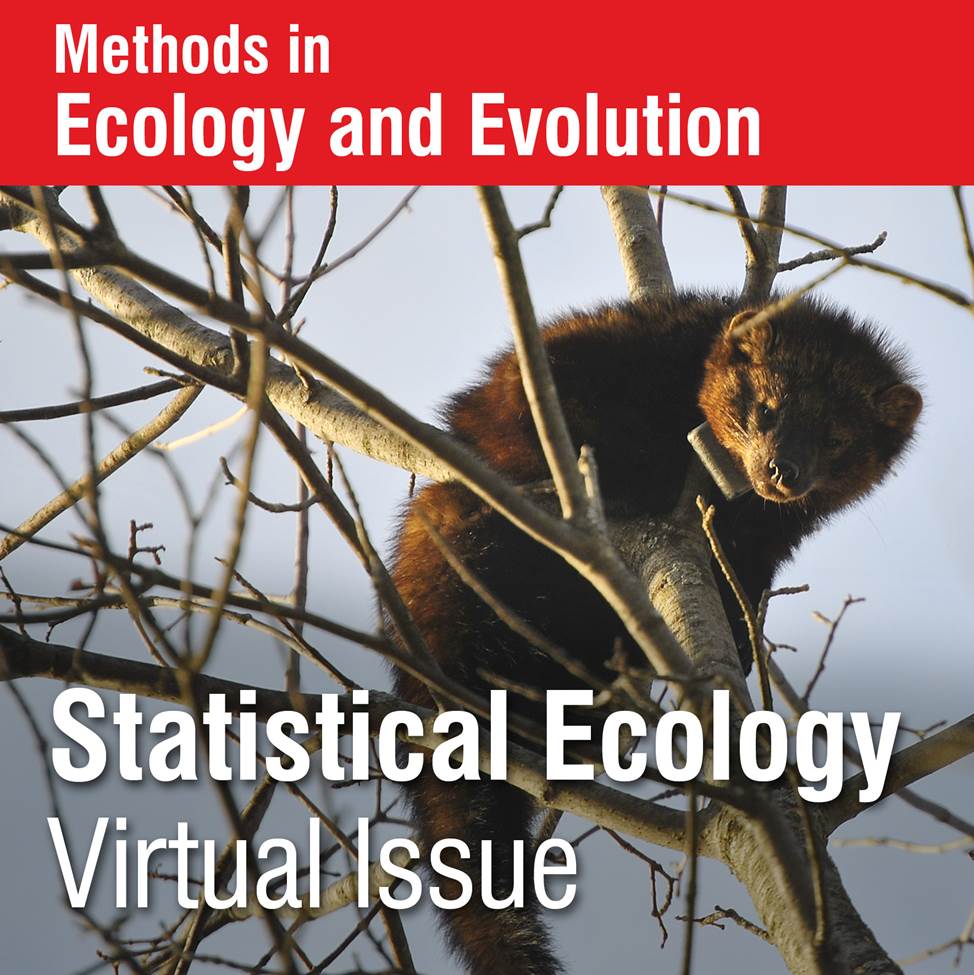
Statistical Ecology Virtual Issue

StatEcolVI_WebAdAt the last ISEC, in Montpellier in 2014, an informal survey suggested that Methods in Ecology and Evolution was the most cited journal in talks. This reflects the importance of statistical methods in ecology and it is one reason for the success of the journal. For this year’s International Statistcal Ecology Conference in Seattle we have produced a virtual issue that presents some of our best recent papers which cross the divide between statistics and ecology. They range over most of the topics covered at ISEC, from statistical theory to abundance estimation and distance sampling.

We hope that Methods in Ecology and Evolution will be equally well represented in talks in Seattle, and also – just as in Montpellier – some of the work presented will find its way into the pages of the journal in the future.

Without further ado though, here is a brief overview of the articles in our Statistical Ecology Virtual Issue: Continue reading “Statistical Ecology Virtual Issue”

Issue 7.6: Methods in Ecology and Evolution 5th Anniversary Special Feature

Issue 7.6 is now online!

The June issue of Methods, which includes our latest Special Feature – “5th Anniversary of Methods in Ecology and Evolution” – is now online!

Our 5th Anniversary Special Feature is a collection of six articles (plus an Editorial from Executive Editor Rob Freckleton) that highlights the breadth and depth of topics covered by the journal so far. It grew out of our 5th Anniversary Symposium – a joint event held in London, UK and Calgary, Canada and live-streamed around the world in April 2015 – and contains papers by Associate Editors, a former Robert May prize winner and regular contributors to the journal.

The six articles are based on talks given at last May’s Symposium. They focus on:

In his Editorial for the Special Feature, Rob Freckleton looks to the future. In his words: “we hope to continue to publish a wide range of papers on as diverse a range of topics as possible, exemplified by the diversity of the papers in this feature”.

All of the articles in the Special Feature will be freely available for a limited time. In addition to this, two of the articles (Shedding light on the ‘dark side’ of phylogenetic comparative methods and Perturbation analysis of transient population dynamics using matrix projection models) are Open Access.
Continue reading “Issue 7.6: Methods in Ecology and Evolution 5th Anniversary Special Feature”

Bringing Ecologists and Statisticians Together for the Conservation of Endangered Species

Post provided by Cecilia Pinto and Luigi Spezia

The Benefits of High Frequency Data

One of the tagged flapper skates showing the three different kinds of tags. ©Cecilia Pinto

High frequency data, like those obtained from individual electronic tags, carries the potential of giving us detailed information on the behaviour of species at the individual level. Such data are particularly useful for marine species, as we can’t observe them directly for long periods of time.

Understanding how individuals use water columns – both at daily and seasonal scales – can help define conservation measures such as restricting fishing activity to reduce by-catch or defining protected areas to help recovering populations or protect spawning and nursery areas. High frequency data have become popular as they give insight to detailed individual foraging behaviour and therefore the specific energetic needs that are linked to reproduction and fitness. Continue reading “Bringing Ecologists and Statisticians Together for the Conservation of Endangered Species”

New Associate Editor: Will Pearse

Today, we are pleased to be welcoming a new member of the Methods in Ecology and Evolution Associate Editor Board. Will Pearse joins us from McGill University in Canada and you can find out a little more about him below. Will Pearse “I am an evolutionary ecologist and use phylogeny to link the evolution of species’ traits with their ecological community assembly. I’m interested in phylogenetic methods, macro-evolution of species’ traits, community assembly … Continue reading New Associate Editor: Will Pearse

Spatially-explicit Power Analysis: A First Step for Occupancy-Based Monitoring

Post provided by Martha Ellis and Jody Tucker

Where’s Waldo? Trying to find this fisher somewhere in a giant landscape is going to be tricky! ©Mike Schwartz
Where’s Waldo? Trying to find this little guy somewhere in a giant landscape is going to be tricky! © Mike Schwartz

The seemingly basic question of whether a population is increasing, decreasing, or stable can be one of the most difficult to answer. Collecting data on rare and elusive species is hard. Imagine trying to detect a handful of fisher or wolverine across hundreds of thousands of acres – it is physically demanding, time consuming and logistically complicated. And that’s just to do it once! To monitor a population for changes, you have to repeat these surveys regularly over many years. The long-term monitoring that is necessary for conservation requires careful planning and a substantial commitment of resources and funding. So before we spend these valuable resources, it’s critical to know whether the data we are collecting can help us to answer our questions. Continue reading “Spatially-explicit Power Analysis: A First Step for Occupancy-Based Monitoring”