Demography and Big Data

Post provided by BRITTANY TELLER, KRISTIN HULVEY and ELISE GORNISH

Follow Brittany (@BRITTZINATOR) and Elise (@RESTORECAL) on Twitter

To understand how species survive in nature, demographers pair field-collected life history data on survival, growth and reproduction with statistical inference. Demographic approaches have significantly contributed to our understanding of population biology, invasive species dynamics, community ecology, evolutionary biology and much more.

As ecologists begin to ask questions about demography at broader spatial and temporal scales and collect data at higher resolutions, demographic analyses and new statistical methods are likely to shed even more light on important ecological mechanisms.

Population Processes

Midsummer Opuntia cactus in eastern Idaho, USA. © B. Teller.

Traditionally, demographers collect life history data on species in the field under one or more environmental conditions. This approach has significantly improved our understanding of basic biological processes. For example, rosette size is a significant predictor of survival for plants like wild teasel (Werner 1975 – links to all articles are at the end of the post), and desert annual plants hedge their bets against poor years by optimizing germination strategies (Gremer & Venable 2014).

Demographers also include temporal and spatial variability in their models to help make realistic predictions of population dynamics. We now know that temporal variability in carrying capacity dramatically improves population growth rates for perennial grasses and provides a better fit to data than models with varying growth rates because of this (Fowler & Pease 2010). Moreover, spatial heterogeneity and environmental stochasticity have similar consequences for plant populations (Crone 2016). Continue reading “Demography and Big Data”

My Entropy ‘Pearl’: Using Turing’s Insight to Find an Optimal Estimator for Shannon Entropy

Post provided by Anne Chao (National Tsing Hua University, Taiwan)

Shannon Entropy

Not quite as precious as my entropy pearl
Not quite as precious as my entropy pearl ©Amboo Who

Ludwig Boltzmann (1844-1906) introduced the modern formula for entropy in statistical mechanics in 1870s. Since its generalization by Claude E. Shannon in his pioneering 1948 paper A Mathematical Theory of Communication, this entropy became known as ‘Shannon entropy’.

Shannon entropy and its exponential have been extensively used to characterize uncertainty, diversity and information-related quantities in ecology, genetics, information theory, computer science and many other fields. Its mathematical expression is given in the figure below.

In the 1950s Shannon entropy was adopted by ecologists as a diversity measure. It’s interpreted as a measure of the uncertainty in the species identity of an individual randomly selected from a community. A higher degree of uncertainty means greater diversity in the community.

Unlike species richness which gives equal weight to all species, or the Gini-Simpson index that gives more weight to individuals of abundant species, Shannon entropy and its exponential (“the effective number of common species” or diversity of order one) are the only standard frequency-sensitive complexity measures that weigh species in proportion to their population abundances. To put it simply: it treats all individuals equally. This is the most natural weighing for many applications. Continue reading “My Entropy ‘Pearl’: Using Turing’s Insight to Find an Optimal Estimator for Shannon Entropy”

Issue 7.2: Demography Beyond the Population

Issue 7.2 is now online!

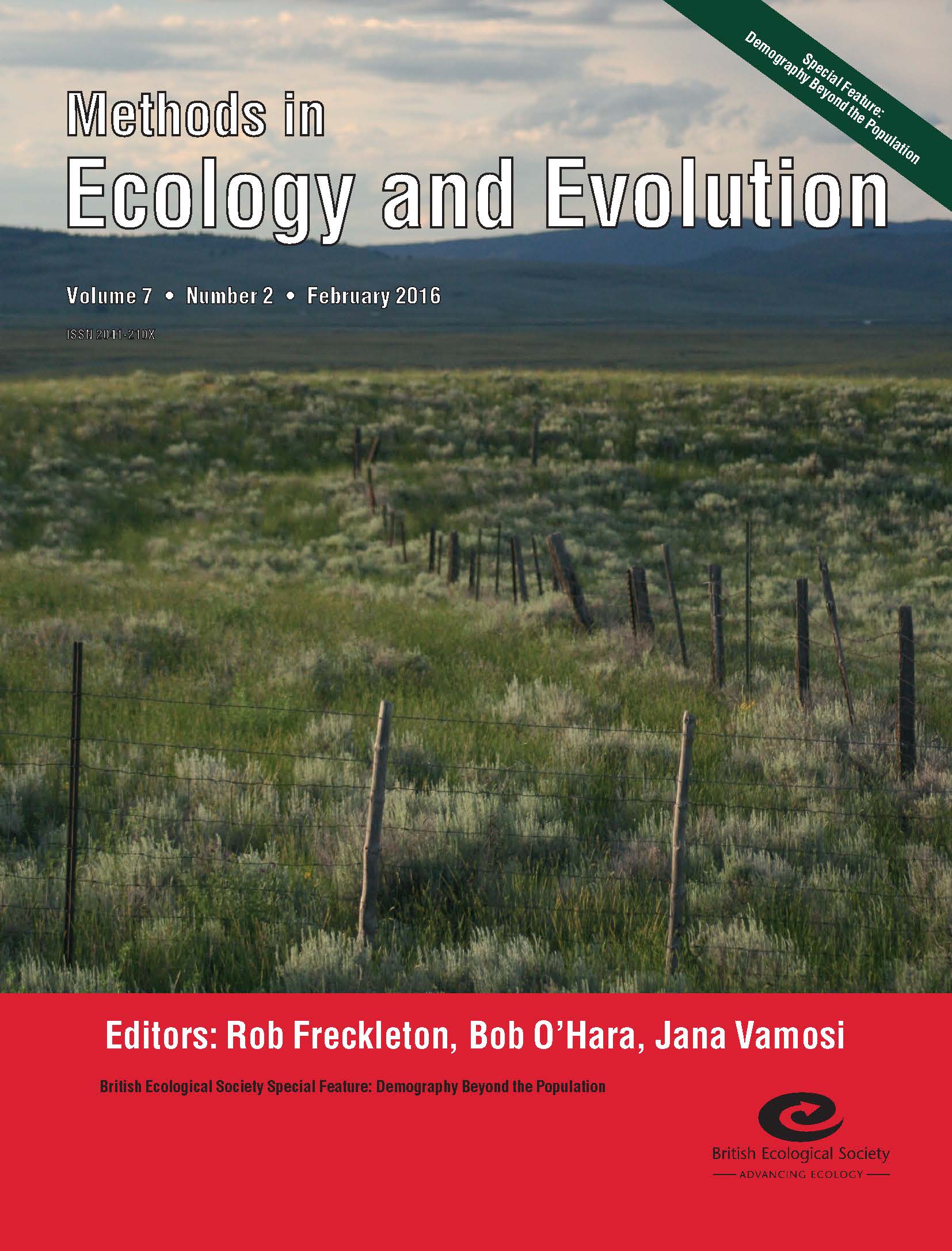
Sagebrush steppe in eastern Idaho, USA
© Brittany J. Teller

The February issue of Methods is now online! As you may have seen already, it includes the BES cross-journal Special Feature: “Demography Beyond the Population“. There are also eight other wonderful articles to read.

We have four articles in the Demography Beyond the Symposium Special Feature. You can read an overview of them by two of the Feature’s Guest Editor Sean McMahon and Jessica Metcalf here (Sean and Jessica are also Associate Editors of Methods).

If you’d like to find out more about each of the individual papers before downloading them, we have blog posts about each one. Daniel Falster and Rich Fitzjohn discuss the development of plant and provide some advice on creating simulation models in Key Technologies Used to Build the plant Package (and Maybe Soon Some Other Big Simulation Models in R). There is a look back at the evolution of Integral Projection Models from Mark Rees and Steve Ellner in How Did We Get Here From There? A Brief History of Evolving Integral Projection Models. In Inverse Modelling and IPMs: Estimating Processes from Incomplete Information Edgar González explains how you can estimate process that you can’t observe. And keep an eye out for Brittany Teller’s blog post coming next week!

Don’t wait too long to get the Demography Beyond the Population Special Feature papers though, they’re freely available for a limited time only

Continue reading “Issue 7.2: Demography Beyond the Population”

Methods in Ecology and Evolution 2015: The Year in Review

Happy New Year! We hope that you all had a wonderful Winter Break and that you’re ready to start 2016. We’re beginning the year with a look back at some of our highlights of 2015. Here’s how last year looked at Methods in Ecology and Evolution.

The Articles

We published some amazing articles in 2015, too many to mention them all here. However, we would like to say a massive thank you to all of the authors, reviewers and editors who contributed to the journal last year. Without your hard work, knowledge and generosity, the journal would not be where it is today. We really appreciate all of your time and effort. THANK YOU!

mee312268_CoverOpportunities at the Interface between Ecology and Statistics

There was only one Special Feature in the journal this year, but it was a great one. Arising from the 2013 Eco-Stats Symposium at the University of New South Wales and guest edited by Associate Editor David Warton, Opportunities at the Interface between Ecology and Statistics was one of the highlights of 2015 for us. It consists of seven articles written collaboratively by statisticians and ecologists and highlights the benefits of cross-disciplinary partnerships. Continue reading “Methods in Ecology and Evolution 2015: The Year in Review”
There’s Madness in our Methods: Improving inference in ecology and evolution

Post provided by JARROD HADFIELD

Last week the Center for Open Science held a meeting with the aim of improving inference in ecology and evolution. The organisers (Tim Parker, Jessica Gurevitch & Shinichi Nakagawa) brought together the Editors-in-chief of many journals to try to build a consensus on how improvements could be made. I was brought in due to my interest in statistics and type I errors – be warned, my summary of the meeting is unlikely to be 100% objective.

True Positives and False Positives

The majority of findings in psychology and cancer biology cannot be replicated in repeat experiments. As evolutionary ecologists we might be tempted to dismiss this because psychology is often seen as a “soft science” that lacks rigour and cancer biologists are competitive and unscrupulous. Luckily, we as evolutionary biologists and ecologists have that perfect blend of intellect and integrity. This argument is wrong for an obvious reason and a not so obvious reason.

We tend to concentrate on significant findings, and with good reason: a true positive is usually more informative than a true negative. However, of all the published positives what fraction are true positives rather than false positives? The knee-jerk response to this question is 95%. However, the probability of a false positive (the significance threshold, alpha) is usually set to 0.05, and the probability of a true positive (the power, beta) in ecological studies is generally less than 0.5 for moderate sized effects. The probability that a published positive is true is therefore 0.5/(0.5+0.05) =91%. Not so bad. But, this assumes that the hypotheses and the null hypothesis are equally likely. If that were true, rejecting the null would give us very little information about the world (a single bit actually) and is unlikely to be published in a widely read journal. A hypothesis that had a plausibility of 1 in 25 prior to testing would, if true, be more informative, but then the true positive rate would be down to (1/25)*0.5/((1/25)*0.5+(24/25)*0.05) =29%. So we can see that high false positive rates aren’t always the result of sloppiness or misplaced ambition, but an inevitable consequence of doing interesting science with a rather lenient significance threshold. Continue reading “There’s Madness in our Methods: Improving inference in ecology and evolution”

Issue 6.7

Issue 6.7 is now online!

The July issue of Methods is now online!

This month’s issue contains two Applications article and one Open Access article, all of which are freely available.

fuzzySim: Binary similarity indices are widely used in ecology. This study proposes fuzzy versions of the binary similarity indices most commonly used in ecology, so that they can be directly applied to continuous (fuzzy) rather than binary occurrence values, producing more realistic similarity assessments. fuzzySim is an open source software package which is also available for R.

 Actave.net: A freely accessible, web-based analysis tool for complex activity data, actave.net provides cloud-based and automatic computation of daily aggregates of various activity parameters based on recorded immersion data. It provides maps and graphs for data exploration, download of processed data for modelling and statistical analysis, and tools for sharing results with other users.

Anna Sturrock et al. provide this month’s Open Access article. In ‘Quantifying physiological influences on otolith microchemistry‘ the authors test relationships between otolith chemistry and environmental and physiological variables. The influence of physiological factors on otolith composition was particularly evident in Sr/Ca ratios, the most widely used elemental marker in applied otolith microchemistry studies. This paper was reported on in the media recently. You can read more about it here.

Our July issue also features articles on Monitoring, Remote Sensing, Conservation, Genetics and three papers on Statistics. Continue reading “Issue 6.7”

Statistics in Ecology and Environmental Monitoring: A Look Back at the SEEM 2015 Conference

Post provided by Dr Matt Schofield

Matt is an Associate Editor for Methods in Ecology and Evolution. He was the principle organiser of this year’s SEEM conference. His research interests include Bayesian inference and hierarchical modelling, computational methodology, ecological statistics and much more. Matt is based at the University of Otago.

A photo taken during a lunch break at the conference

The Statistics in Ecology and Environmental Monitoring (SEEM) conference was held in Queenstown, New Zealand on June 22-26, 2015. Queenstown is a resort town in the Southern Alps of New Zealand that looks out on Lake Wakatipu, surrounded by snow-capped mountains. The venue gave a chance to explore some of the natural beauty of New Zealand, with excursions to local ski fields, wineries and various hiking trails.

SEEM conferences have been organized by members of the Statistics group at the University of Otago since 1993. The first SEEM conference was held in Dunedin, New Zealand and conferences were then held regularly (every 3 years) until 2002. The last SEEM conference, in 2007, also served as the EURING (European Union for Bird Ringing) technical meeting. With nearly ten years passing since 2007, we had a smaller conference of around 50 attendees this year. There was an engaging atmosphere during the meeting and productive discussion followed each of the 40 talks. The SEEM 2015 meeting maintained the tradition of previous SEEM conferences with delegates from across a broad spectrum of statistical ecology coming together to discuss research. Continue reading “Statistics in Ecology and Environmental Monitoring: A Look Back at the SEEM 2015 Conference”

Ten Top Tips for Reviewing Statistics: A Guide for Ecologists

post provided by Dr Mark Brewer.

Mark is a statistician with Biomathematics & Statistics Scotland, based in Aberdeen. His main statistical research interests are Species Distribution Modelling, Compositional Data Analysis, Bayesian Mixture Modelling and Bayesian Ordinal Regression. Mark was one of the presenters at the UK half of the Methods in Ecology and Evolution 5th Anniversary Symposium in April. You can watch his talk, ‘Model Selection and the Cult of AIC’ here.

The level of statistical analysis in ecology journals is far higher than in most other disciplines. Ecological journals lead the way in the development of statistical methodology, necessitated by challenging practical problems involving complex data sets. As a statistician, publishing also in hydrology, soil science, social science and forensic science journals, I’ve found papers in those areas are much more likely to only use well-established methods than papers in ecology.

Here’s the big question though: why then do I have the most difficulty with ecological journals when it comes to statistical analyses? Let’s be clear here: when I say “difficulty”, I mean I receive reviews which are just plain wrong. Most statisticians I’ve spoken to who work in ecology have anecdotes from reviews which demonstrate a lack of understanding by the non-statistician reviewer (including the all-too-frequent “perhaps you should consult a statistician”). So, why the apparent disconnect?

The difference seems to be in how non-statisticians in different disciplines treat the statistics in a paper. In many subject areas, reviewers are almost deferential to the statistical analysis; in ecology, reviewers can be forthright in their condemnation, often without justification. Reviewers have every right to question the statistical analysis in a paper, but the authors have the exact same right to expect a high quality review from a genuine expert in the field. Has ecology become blasé about statistics? Continue reading “Ten Top Tips for Reviewing Statistics: A Guide for Ecologists”

Issue 6.4: Opportunities at the Interface Between Ecology and Statistics

Issue 6.4 is now online!

© Chun-Huo Chiu and Ching-Wen Cheng

The April issue of Methods, which includes our latest Special Feature: “Opportunities at the Interface Between Ecology and Statistics” is now online!

Opportunities ar the Interface Between Ecology and Statistics is a collection of eight articles which arose from the Eco-Stats Symposium at the University of New South Wales (Australia) in July 2013.This Symposium was designed to be a collaborative forum for researchers with interests in ecology and statistics. It brought together internationally recognised leaders in these two fields (such as Jane Elith, Trevor Hastie, Anne Chao and Shirley Pledger) – many of whom have contributed articles to this Special Feature.

The Eco-Stats Symposium was arranged around five special topics, all of which are represented in this issue of Methods. Those five topics are:

In his Editorial for the Special Feature, Guest Editor David Warton suggests that one of the reasons for the success of Methods in Ecology and Evolution may be that it provides a forum for statisticians and ecologists to interact. The articles in this issue, and the conference that gave rise to them, show that these interactions can provide significant benefits for both groups.

There will be another Eco-Stats Symposium at the University of New South Wales in December of this year (8-10 December, 2015).
For more details on this, please click here.
Continue reading “Issue 6.4: Opportunities at the Interface Between Ecology and Statistics”

Understanding and Presenting YOUR Data

A Beginner’s Guide to Data Exploration and Visualisation with R
by Elena N. Ieno and Alain F. Zuur

A Beginner's Guide to Data ExplorationIn 2010 Alain Zuur, Elena Ieno and Chris Elphick published a paper in Methods in Ecology and Evolution entitled ‘A protocol for data exploration to avoid common statistical problems‘ (Volume 1, Issue 1). Little did they know at the time that this paper would become one of the journal’s all-time top downloaded and top cited papers, with a total of 22,472 downloads between 2010 and 2014.

Based on this success they decided to extend the material in the paper into a book.

Zuur and his colleagues at Highland Statistics ltd. give about 25 five-day statistics courses per year. Their typical audience consists of biological scientists at the post-graduate and post-doctoral levels. Early on in each course they have the following conversation with the participants:

Speaker: “Do you review submitted manuscripts for journals?”
Audience: “Yes.”
Speaker: “Do you like the statistical part of these manuscripts?”
Audience: “No!”
Speaker: “Do you understand the statistical part?”
Audience: “Not always.”

What if there were ways you could make reviewing your paper easier and more enjoyable for reviewers? What if making your manuscript easier to understand and nicer to read would increase the likelihood of your work being published?

A Beginner’s Guide to Data Exploration and Visualisation with R explains how you can do exactly that! Alain Zuur and Elena Ieno use ecological datasets to discuss the data exploration and visualisation tools you can use to make your paper simpler for readers and reviewers to understand. The authors also explain how to visualise the results of statistical models, an important aspect of scientific papers. Continue reading “Understanding and Presenting YOUR Data”