Post provide Chinmay Keshava Lalgudi. Drone imagery offers an efficient way to gather data on mobile animals. Drones are used for population surveys, creating 3D models of habitat, and even studying how animals move and behave in their environment. While collecting this data is relatively easy, manually annotating it is painstaking and slow. Analysing drone imagery can often mean spending hours in front of a … Continue reading No training necessary: Shark tracking simplified
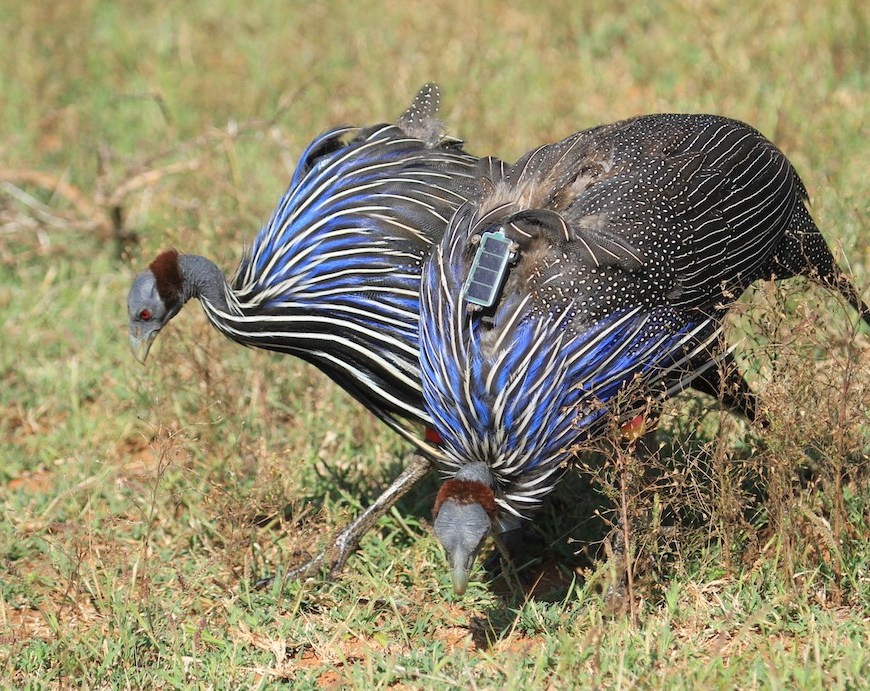
Miniaturisation of technology has made GPS tags increasingly accessible for studying animal behaviour. However, limitations in battery life introduces challenging trade-offs in data collection. In this blog post, Charlotte Christensen and Damien Farine discuss how these sampling trade-offs can impact studies that use GPS tags to study social animals.
It’s more important than ever for us to have accurate information to help marine conservation efforts. Jordan Goetze and his colleagues have provided the first comprehensive guide for researchers using diver operated stereo-video methods (or stereo-DOVs) to survey fish assemblages and their associated habitat. But what is Stereo DOV? What makes it a better method than the traditional UVC (Underwater Visual Census) method? And when … Continue reading Stereo DOV: A Non-Invasive, Non-Destructive Way to Study Fish Populations
Quantifying animal movement is central to research spanning a variety of topics. It’s an important area of study for behavioural ecologists, evolutionary biologists, ecotoxicologists and many more. There are a lot of ways to track animals, but they’re often difficult, especially for people who don’t have a strong background in programming. Vivek Hari Sridhar, Dominique G. Roche and Simon Gingins have developed a new, simple software to … Continue reading Quantifying Animal Movement from Videos
Detecting the movements and interactions of elusive, nocturnal wildlife is a perpetual challenge for wildlife biologists. But, with security tracking technology, more commonly used to protect museum artwork, new Oxford University research has revealed fresh insights into the social behaviour of badgers, with implications for disease transmission.
Previous studies have assumed that badgers are territorial and, at times, anti-social, living in tight-knit and exclusive family groups in dens termed ‘setts’. This led to the perception that badgers actively defend territorial borders and consequently rarely travel beyond their social-group boundaries.
This picture of the badger social system is so widely accepted that some badger culling and vaccination programmes rely on it – considering badger society as being divided up into discrete units, with badgers rarely venturing beyond their exclusive social-groups. But, the findings, newly published in Methods in Ecology and Evolution, have revealed that badgers travel more frequently beyond these notional boundaries than first thought, and appear to at least tolerate their neighbours. Continue reading “Oxford Research Sheds Light on the Secret Life of Badgers”




 Methods Blog