
Post provided by Elena Baños Lara
I am currently completing my PhD at the Centre for Advanced Studies of Blanes (CEAB-CSIC) in Spain, where I use environmental and sedimentary ancient DNA to explore past marine ecosystems. As part of my PhD, I had the opportunity to spend three months at the Globe Institute in Copenhagen, joining Kristine Bohmann’s group and working side by side with assistant professor Luke E. Holman.
The sediment samples were part of the SeaChange project and had already been analysed using metabarcoding by the team. Among the millions of DNA reads recovered from these ancient marine sediments, they had detected traces of Atlantic cod (Gadus morhua) and Atlantic herring (Clupea harengus), but fish DNA represented only a tiny fraction of the overall dataset.
During my stay, Luke and I worked closely together to explore whether we could extract more information from these rare fish detections. In particular, we became interested in a simple question: could the number of PCR replicates in which a species was detected tell us something about how much DNA was actually present in the sample?
To test this, we turned to droplet digital PCR (ddPCR), using it to independently quantify cod and herring DNA in the same sedimentary ancient DNA (sedaDNA) extracts and comparing those concentrations with their detection frequency across the eight metabarcoding PCR replicates.
And that is where the story behind our paper really began.

Looking for fish DNA in the past
One of the things I find fascinating about sedaDNA is that a small amount of sediment can contain traces of organisms that lived in an ecosystem hundreds or even thousands of years ago. But working with those traces also comes with a challenge: ancient DNA is often degraded, scarce and difficult to detect.
This is particularly challenging for rare targets such as fish. In our dataset, fish represented only a very small proportion of the DNA recovered from sediments spanning roughly the last 3,000 years.
So rather than asking only whether cod or herring DNA was detected, we wanted to know whether the way these species appeared across PCR replicates could tell us something more.
Eight PCRs and an interesting pattern
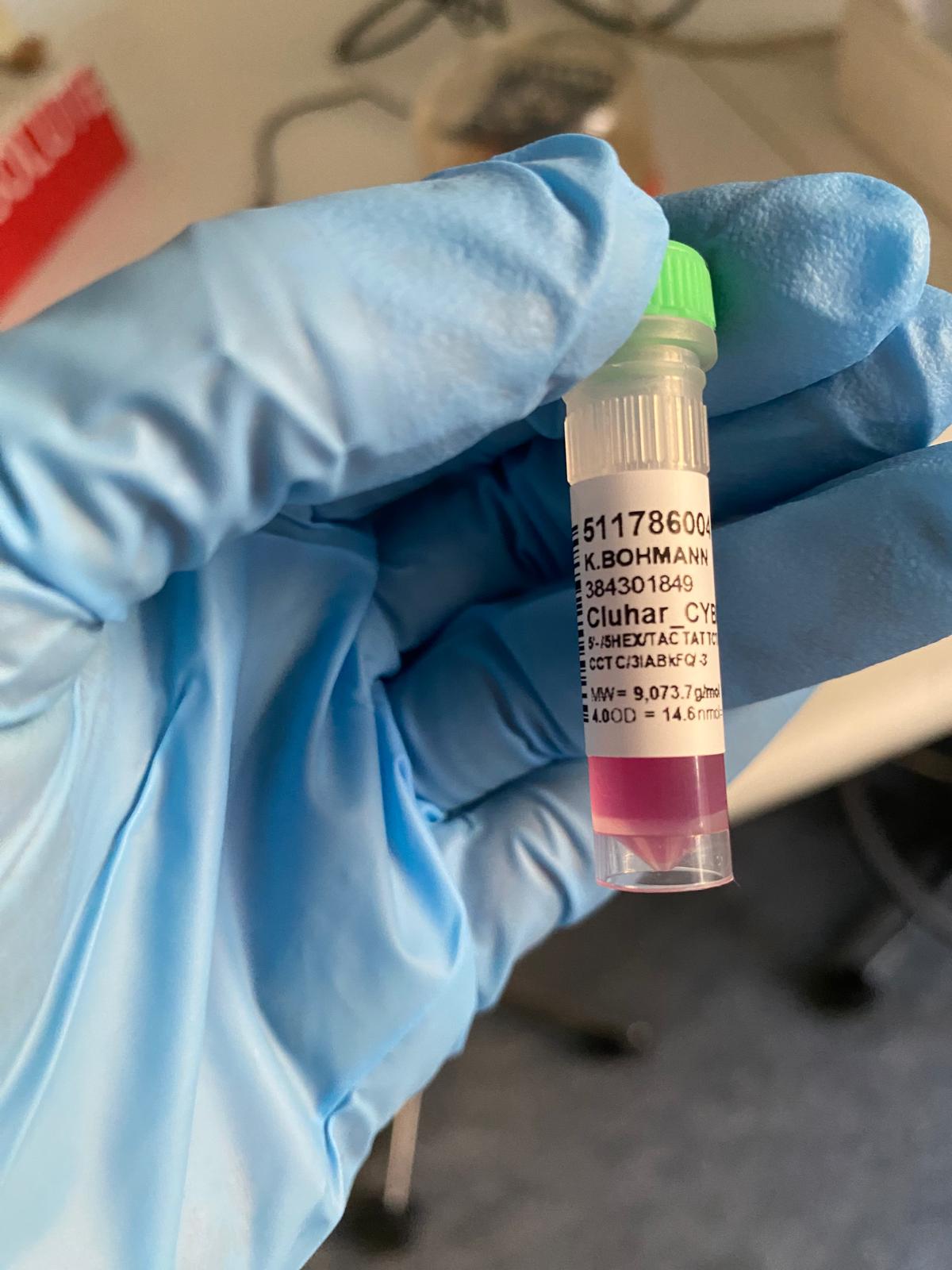
In metabarcoding studies, it is common to run several PCR replicates from the same DNA extract. A species might appear in all of them, in only a few, or not at all.
Usually, we think of these replicates primarily as a way of making detection more reliable. If a species repeatedly appears across independent PCRs, we can be more confident that the signal is real.
But we wondered whether the number of positive PCR replicates might tell us something else too.
If fish DNA is more abundant in one sediment sample than another, should it also be more likely to amplify repeatedly? In other words, could detection frequency across PCR replicates provide some information about the amount of target DNA present?
Metabarcoding is generally not considered a straightforward quantitative method. Read counts are affected by many stages of the laboratory and sequencing process, so twice as many reads does not simply mean twice as much DNA. We therefore needed an independent way to measure the fish DNA in the same samples.
That is where droplet digital PCR came in.
Counting DNA molecules independently
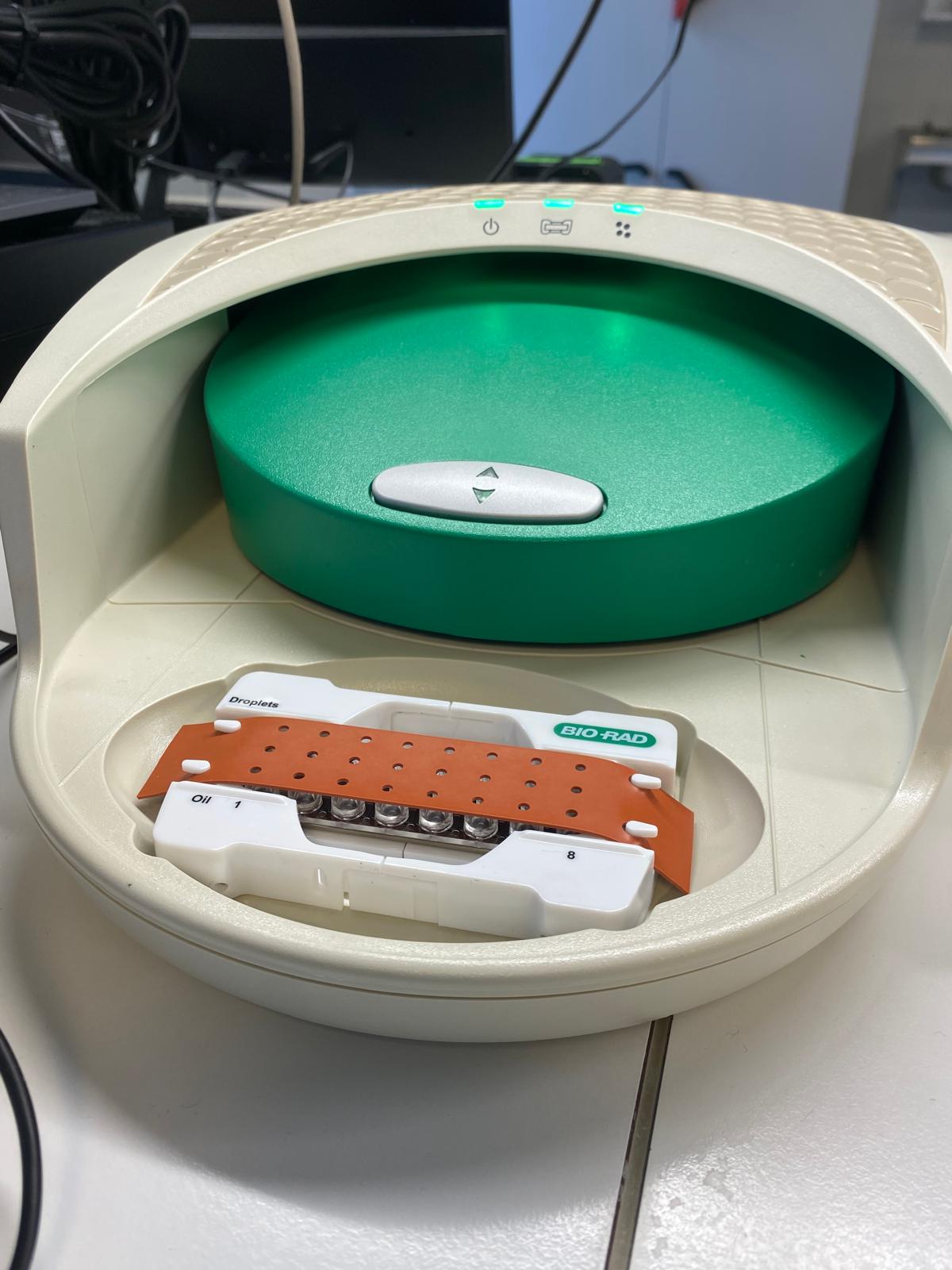
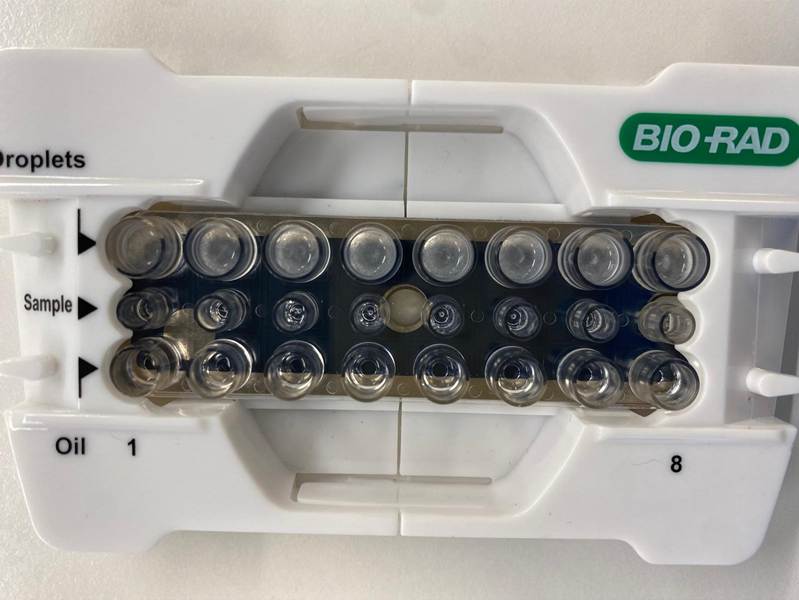
Unlike metabarcoding, ddPCR targets a particular DNA sequence and allows us to estimate its concentration. We designed assays targeting Atlantic cod and Atlantic herring and applied them to 136 ancient DNA extracts from the Icelandic sediment cores.
We could then compare two very different measurements from the same extracts: the DNA concentration estimated by ddPCR and the number of metabarcoding PCR replicates in which each fish was detected.
And we found a clear pattern.
For both cod and herring, samples with higher DNA concentrations measured by ddPCR tended to be detected in more metabarcoding PCR replicates. In other words, those repeated detections were not simply random successes and failures – they contained information about the underlying amount of fish DNA in the sample.
Importantly, we are not suggesting that PCR replicate detection frequency provides an exact measure of DNA concentration. The relationship is most informative when DNA is rare, when stochastic amplification means that a target may appear in some PCRs but not others. Once a target becomes abundant enough to be detected in every replicate, that information naturally reaches a ceiling.
For low-abundance targets, however, replicate detection frequency can provide a useful semi-quantitative signal.
Why does this matter?
Ancient environmental DNA studies often deal with exactly these kinds of weak signals. The DNA we want to detect may have spent centuries or millennia degrading in the environment and can represent only a tiny fraction of all the DNA recovered from a sample.
Our results suggest that information we already generate during replicated metabarcoding experiments may be more useful than we sometimes assume.
This does not make metabarcoding fully quantitative, nor does it replace targeted approaches such as ddPCR. Instead, the two methods provide complementary information. Metabarcoding is extremely powerful for exploring biological communities without deciding in advance which species to target, while ddPCR provides sensitive, targeted quantification once a particular species is of interest.
Perhaps most importantly, our study reminded us that sometimes useful information is hiding in a very simple part of an experiment. In our case, it was not only whether cod or herring DNA was detected, but how consistently it appeared when we repeated the same PCR.
For researchers working with rare eDNA or sedaDNA targets, paying attention to that replication pattern may provide another window into changes in DNA abundance through time.
And when your signal consists of a few ancient fish DNA molecules buried in thousands of years of marine sediment, every bit of information counts.
Read the paper: Metabarcoding replicate detection frequency tracks ddPCR copy number for cod and herring eDNA in ancient marine sediments, published in Methods in Ecology and Evolution.

