Post provided by Renske Jongen The Rainbow Research series returns to the British Ecological Society to celebrate Pride month 2022! These special posts promote visibility and share stories from STEM researchers who belong to the LGBTQIA2S+ community. Each post is connected to one of the themes represented by the colours in the Progress Pride flag (Daniel Quasar 2018). In this post, Renske Jongen shares her … Continue reading Rainbow Research – Harmony
Post provided by Mateusz Iskrzyński Would you like to quickly get a clear picture of the food web you are modelling or analysing? Have you thought about including its visualisation in your paper? Or maybe you wanted to show your students or general audience how interconnected food webs are in real ecosystems? Or just wondered how matter flows through an ecosystem? To help you with … Continue reading Visualising the flow of matter within ecosystems
Post provided by Jamie Macaulay Entanglement in net fisheries (static and drift) is the largest known cause of direct anthropogenic mortality to many small cetacean species, including harbour porpoise (Phocoena phocoena), in UK waters. Despite this, little is known about the behaviour of small cetaceans in proximity to nets. In this blog post, Jamie Macaulay discusses the findings of his Methods in Ecology & Evolution … Continue reading Tracking harbour porpoises around gill nets
We are delighted to announce David Wilkinson as the winner of the Robert May Prize 2021, awarded to the best paper by an early career researcher in the 2021 volume of Methods in Ecology and Evolution. In this interview, David shares insights on his winning article ‘Defining and evaluating predictions of joint species distribution models’. Congratulations to all the shortlisted authors, whose articles you can read … Continue reading Robert May Prize 2021: Winner Announced
Post provided by Awoniyi Michael Adedayo Each year Methods in Ecology and Evolution awards the Robert May Prize to the best paper published in the journal by an author at the start of their career. Ten Early Career Researchers made the shortlist for this year’s prize, including Awoniyi Michael Adedayo, who recently defended his PhD from the Federal University of Bahia (UFBA) Brazil. In this … Continue reading Rhodamine B – a non-toxic biomarker for assessing the distance travelled by rats in urban slums
The cover of our March issue shows a female Eurasian otter (Lutra lutra), with its young kit bringing a crab to shore before eating it. The photographer, Alan Seymour, had been watching the otter from a distance, while laying low behind a large boulder. Direct observations of trophic interactions take a lot of time and skill, especially concerning cryptic species (e.g., semi-aquatic mammals, small invertebrates). Accurately and precisely identifying prey items is mostly impossible by observation. Molecular methods, such as DNA metabarcoding, offer a sensitive approach for investigating trophic interactions of cryptic species; however, this high sensitivity can introduce errors. In this post, the authors discuss potential sources of errors in dietary metabarcoding datasets, and how to use minimum sequence copy thresholds to carefully remove them, detailed in their Methods in Ecology and Evolution article “An assessment of minimum sequence copy thresholds for identifying and reducing the prevalence of artefacts in dietary metabarcoding data”.
Post provided by Michael Smith Tracking bee movement is anything but an easy task. Electronic tags are often too cumbersome and extensive electronic systems such as radars are costly to deploy. There is a need for a low-cost, low-impact tool, with high spatial resolution for tracking bees, to investigate how far they forage. In this blog post, Michael Smith discusses the development of retroreflective tags … Continue reading Insect tracking using retroreflective tags
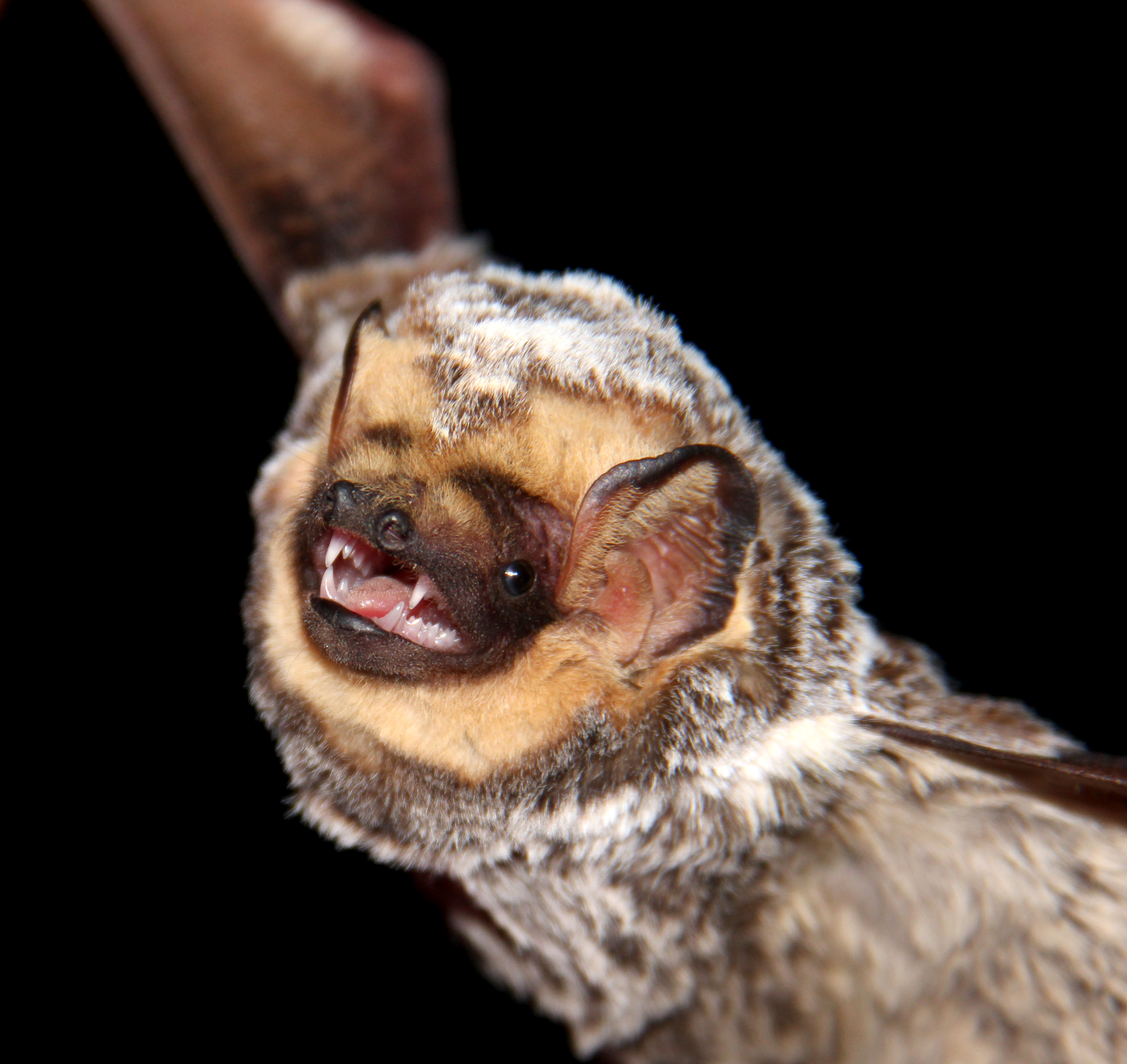
Hoary bat (Lasiurus cinereus). Credit: Veronica Zamora-Gutierrez.
Ecologists have started looking into drones as new tools for wildlife surveys, but how can drone disturbance be minimized in order to produce accurate wildlife counts? In this post, Kayla Kuhlmann describes a drone practice to reduce disruption during acoustic bat surveys as featured in the paper “Miniaturization eliminates detectable impacts of drones on bat activity”, recently published in Methods in Ecology and Evolution.
Female mountain lion collared in Washington USA in late December 2021.
Information on how and even why terrestrial mammals move through their habitat landscapes is important for forming the foundation of how to manage and conserve species. For elusive mountain lions, GPS data is particularly vital for monitoring these important apex predators in relation to their ecosystems and the people they share the land with. In this blog post, the team discusses their novel motion model, published in Methods in Ecology and Evolution, which helps us understand the movement of mountain lions from GPS location data.
The BoomBox ABR deployed with a Bushnell TrophyCam camera trap in Gorongosa National Park, Mozambique
Camera traps are a valuable tool in ecological research, especially for capturing large quantities of information on the behaviour of an array of wildlife within an ecological community. Camera traps are seldom used to experimentally testing key animal behaviour hypotheses, despite the potential offered by the non-invasive technology. In this blog post, Dr. Meredith Palmer and co-authors discuss the application of the ‘BoomBox’ camera trap module that allows researchers to conduct a unique suite of manipulative experiments on free-living species in complex environments, as published in their Methods in Ecology and Evolution article ‘BoomBox: An Automated Behavioral Response (ABR) Camera Trap Module for Wildlife Playback Experiments’.




 Methods Blog