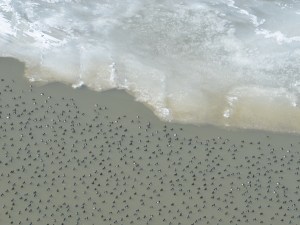
Imagine your favourite beach filled with thousands of ducks and gulls. Now envision coming back a week later and finding condos being constructed on that spot. This many ducks in one place surely should indicate this spot is exceptionally good for birds and must be protected from development, right?
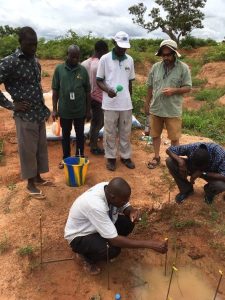
Dr. Dao (crouching on right) and team with Dr. Tovi Lehmann (with sandals), Dr. Yaro (with white cap), and Moussa Diallo (front).
The fact that mosquitoes are insects of massive importance is of little dispute. With malaria still killing almost half a million people annually and after recent outbreaks of Zika, dengue and West-Nile viruses the threat of mosquito-borne diseases is becoming common knowledge. The meme of ‘Mosquitoes are the No.1 killer of all time,’ is also growing more popular (I even heard it from my 8-year-old kid one day after he returned from school!). Yet, with all we think we know about the little bug(ger)s, it’s probably only the tip of the iceberg.
Much work was done over the past century to try to answer basic questions about mosquitoes like:
How big are their populations?
How long do they live?
Where do they go when we don’t see or feel them?
Different methods have been developed to provide insights and notions on the mosquitoes’ movements, survival, and populations estimates; but the limitations and conditions of these methods mean that our knowledge is still incomplete.
One of the gold-standard tools for answering questions like those above is Mark-Release-Recapture (MRR). It was developed almost a century ago and has been modified and remodified through the years, as different marking technologies became available. Continue reading “Life-Long Mosquito Marking: Are Stable Isotopes the Key?”
Understanding Population Responses to Environmental Change
Rapid climatic change has increased interest about how populations respond to environmental change. This has broad applications, for example in the management of endangered and economically important species, the control of harmful species, and the spread of disease. At the population level changes in abundance are driven by changes in vital rates, such as survival and fecundity. So studies that track individual survival and reproduction over time can provide useful insights into the drivers of such changes. They allow us to make future population level predictions on things like abundance, extinction risk and evolutionary strategies.
Predicting the future isn’t a simple task though. Anyone whose washing has got soaked through after the weather forecast suggested the day would be dry and sunny will know that (though the accuracy of short term weather forecasts has increased dramatically in recent years). Ideally, if we want to predict what will happen to populations as their environment changes, we would identify the drivers of variation in their survival and reproduction. We do this by asking questions like ‘are years of low survival associated with high rainfall?’ But, this is not a simple task; identifying drivers and the time periods over which they act and accurately estimating their effects requires long-term demographic data. Continue reading “Exploring Population Responses to Environmental Change When There’s Never Enough Data”
For ecology to stay ethical and maintain public support, we need to revisit invertebrate ethics in research. With our recent advances in understanding invertebrate cognition and shifts in public opinion, an ethical re-examination of currently used methodologies is needed. In our article – ‘Keeping invertebrate research ethical in a landscape of shifting public opinion’ – that’s exactly what we aim to do.
Knowing how many individuals there are in a population is a fundamental objective in ecology and conservation biology. But estimating abundance is often extremely difficult. It’s particularly difficult in the management of exploited marine, anadromous and freshwater populations. In marine fisheries, abundance estimation traditionally relies on demographic models, costly and time consuming mark recapture (MR) approaches if they are feasible at all, and the relationship between fishery catches and effort (catch per unit effort or CPUE). CPUEs can be subject to bias and uncertainty. This is why they tend to be considered relatively unreliable and contentious.
Close-Kin Mark-Recapture: Reducing Bias and Uncertainty
There is an alternative method though. It’s known as “Close-Kin Mark-Recapture” (CKMR), and is grounded in genomics and was first proposed by Skaug in 2001. The method is based on the principle that an individual’s genotype can be considered a “recapture” of the genotypes of each of its parents. Assuming the sampling of offspring and parents is independent of each other, the number of Parent-Offspring pairs (POP) genetically identified in a large collection of both groups can be used to estimate abundance. Continue reading “A More Reliable Method for Estimating Abundance: Close-Kin Mark-Recapture”
Researchers at Washington State University and Smith-Root recently invented an environmental DNA (eDNA) filter housing that automatically preserves captured eDNA by desiccation. This eliminates the need for filter handling in the field and/or liquid DNA preservatives. The new material is also biodegradable, helping to reduce long-lasting plastic waste associated with eDNA sampling. This video explains their new innovation in the field of eDNA sampling technology: … Continue reading The Self-Preserving eDNA Filter: How It Works and Why You Should Use It
Vector-borne viruses (like those transmitted by mosquitoes) are (re)emerging and they’re hurting local economies and public health. Some typical examples are the West Nile, Zika, dengue, chikungunya and yellow fever viruses. The eco-evolutionary and epidemiological histories of these viruses differ massively. But they share one important factor: their transmission potential is highly dependent on the underlying mosquito population dynamics.
Vírus transmitidos por vetores (ex. mosquitos, carraças) estão a (re)emergir e a ter consequências negativas para a saúde pública e para as economias locais. Exemplos típicos recentes de vírus transmitidos por mosquitos incluem o vírus West Nile na América do Norte, Israel e Europa, e os vírus Zika, dengue, chikungunya, Mayaro e febre amarela na América do Sul e África. A epidemiologia, ecologia, e evolução destes vírus são altamente diversas, mas todos eles partilham um fator crítico: o seus potenciais de transmissão são altamente dependentes da dinâmica de população das espécies de mosquitos envolvidas.
Um dos objetivos principais do controlo de doenças infeciosas é prevenir o inicio (ou alterar o curso) de epidemias. Para esse fim, modelos dinâmicos de transmissão têm sido usados com sucesso desde meados do século XX (ex. no contexto de malaria). Esses modelos são aproximações computacionais dos sistemas biológicos reais, permitindo simular uma multitude de cenários nos nossos computadores pessoais, e com tal testar, reconstruir e projetar o potencial e comportamento epidemiológico de patógenos. Quando tais simulações são comparadas com observações reais (ex. número de casos reportados por um sistema de vigilância), os modelos oferecem respostas sobre a mecânica de transmissão e os fatores epidemiológicos ou demográficos que terão contribuído para determinados padrões observados nos dados. Enquanto que modelos dinâmicos são uma das peças fundamentais da epidemiologia contemporânea, dados imperfeitos ou a falta deles pode tornar difícil (se não impossível) a conceção, implementação e utilidade esses modelos. As razões pelas quais dados podem ser imperfeitos são várias, desde sistemas de vigilância fracos, erros humanos, falta de investimento, etc. Continue reading “Mosquitos, o clima e a transmissão de patógenos: como o índice P pode contribuir para saúde pública e educação”
We’ve got six papers that are freely available to absolutely everyone this month too. You can find out about two of the Open Access papers in the Applications and Practical Tools section below. In the third, Chen et al. show that tree assemblages in tropical forest ecosystems can present a strong signal of extensive distributional interspersion.
A new self-preserving filter housing automatically preserves eDNA, while reducing the risk of contamination, and creating less plastic waste.
Researcher collecting an eDNA sample using the self-preserving filter housing.
In 2015 the inventor of the Keurig disposable coffee cartridge (K-Cups) told reporters that sometimes he regrets ever inventing the technology. The single-use design simply produces too much non-recyclable trash. Well, that very same problem is what ultimately led to the creation of a self-preserving filter for environmental DNA (eDNA); a recently reported Practical Tool in Methods in Ecology and Evolution.
eDNA scientists rely on single-use sampling equipment because eDNA surveys are highly sensitive to potential contamination. “We started out simply looking for biodegradable plastics that could be molded into a filter housing, with the objective of reducing plastic waste.” says Dr. Austen Thomas who led the team of researchers and engineers who invented the Smith-Root eDNA Sampler. “That’s when we realized that some of the biodegradable compounds function by being highly hydrophilic.” Continue reading “Making a Self-Preserving eDNA Filter”





 Methods Blog