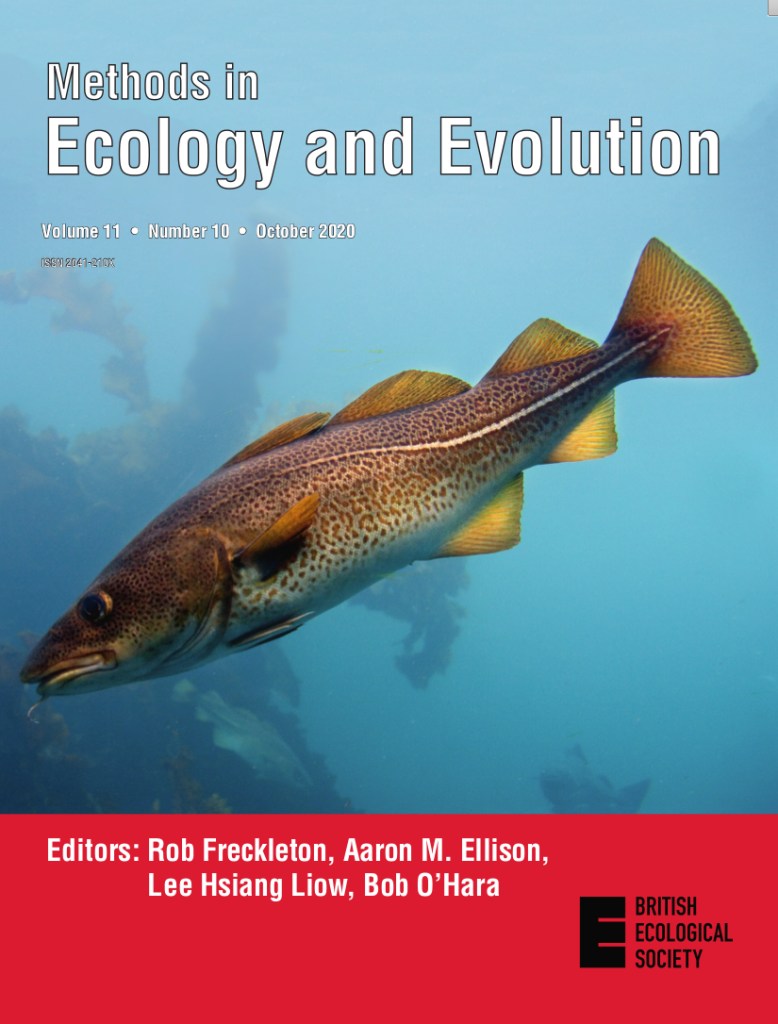
We have a larger issue of 17 articles this month, featuring the ethics of wild animal research, an eco-acoustic monitoring network, a programmable optomotor and much more.
Senior Editor Rob Freckleton has selected six featured articles – find out about them below.
We also have three Applications, one Practical Tools and seven articles that are freely available to everyone – no subscription required!
A central component of an organism’s fitness is its ability to successfully reproduce. This includes finding a potential mate and successful mating. For plants, movement of pollen from an anther to a conspecific stigma is essential for successful reproduction, but directly tracking movement of individual pollen grains heretofore has been impossible (with the exception of those species of orchids and milkweeds whose pollen comes in large packages (pollinia)). Knowing how pollen move around, whether or not they successfully fertilize ovules, is also central to understanding the evolution and ecology of flowering plants (angiosperms) and floral traits.
Since I’ve been working from home and self-isolating for health reasons since the end of last summer, I thought that a post around the strategies that have helped me during this time might be useful.
So, first and foremost, your mental health. It’s really hard to concentrate on anything work-related if you’re not in the right mental state. Of course, these are not ordinary times, so making sure that family, friends and those we care about are doing well, would be my first step. When I feel anxious about the times ahead, the single most important thing that helps me to deal with anxiety is having those who I care for the most, close by. If that’s not possible because they’re self-isolating, keeping in touch remotely regularly is the next best thing. Developmental psychologists recognise that human motivation is linked to a hierarchy of needs: if the most basic needs are not met, more complex needs cannot be fulfilled. In a pandemic, it’s likely that our priorities will change and we need to adapt to them, this might take a while and that’s to be expected.
The latest issue of Methods in Ecology and Evolution is now online! This month’s issue is a little shorter than our last few. But, as they say, good things come in small packages!
Senior Editor Lee Hsiang Liow has selected six Featured Articles this month. You can find out about all of them below. We’ve also got five Applications articles and a Practical Tools article in the April issue that we’re going to cover. Those six papers are freely available to everyone – no subscription required!
There are many reasons that we might be interested in whether individuals, species or populations overlap in multidimensional space. In ecology and evolution, we might be interested in climatic overlap, morphological overlap, phenological or biochemical overlap. We can use analyses of overlap to study resource partitioning, evolutionary histories and palaeoenvironmental conditions, or to inform conservation management and taxonomy. Even these represent only a subset of the possible cases in which we might want to investigate overlap between entities. Databases such as GBIF, TRY and WorldClim make vast amounts of data publicly available for these investigations. However, these studies require complex multivariate data and distilling such data into meaningful conclusions is no walk in the park.
Today, science extends beyond the research bench or the field site more often than ever before. Scientists are continuously interacting with educators and the general public, and people are reciprocating the interest with a drive to be involved.
With this integration of science and the public, citizen-science efforts to crowdsource information have become increasingly popular (check out Zooniverse, SciStarter, NASA Citizen Science Projects, Project FeederWatch, and Foldit to get involved!). In the birding community, enthusiasts have been observing and recording birds for decades, but now there are methods for immediate data sharing among the community (eBird).
The answer to this question depends on a reef’s location, given that shark abundances can vary with primary productivity and other oceanographic features. It also depends on which time period you chose as your reference point. Shark abundances can fluctuate over the course of a few hours – as well as over days to years to decades and beyond. Even if you chose the same time and place as the person before you, you might have come up with a slightly different answer. This variation in how we determine baselines – overlaid on a backdrop of natural variation in shark communities over space and time – can contribute to differing perceptions about what’s natural or what a depleted population can possibly be restored to.
Hackathons have become a regular feature in the data-science world. Get a group of people with a shared interest together, give them data, food, and a limited amount of time and see what they can produce (often with prizes to be won). Translated into the world of academia as research hackathons, these events are a fantastic way to foster collaboration, interdisciplinary working and skills sharing.
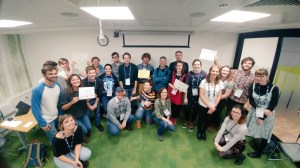
The Quantitative Ecology hackathon was an intense day of coding resulting in creative and innovative research ideas using social and ecological data. Teams worked through the day to develop their ideas with support from experts in R, open science and statistics. We ended up with five projects addressing questions from, ‘Who has the least access to nature?’ to ‘Where should citizen scientists go to collect new data?’.
The latest issue of Methods in Ecology and Evolution is now online! This month’s issue is a little shorter than our last few. But, as they say, good things come in small packages!
Executive Editor Aaron Ellison has selected six Featured Articles this month. You can find out about all of them below. We’ve also got five Applications articles in the March issue that we’re going to cover.
Each year Methods in Ecology and Evolution awards the Robert May Prize to the best paper in the journal by an author at the start of their career. Today we present the shortlisted papers for 2019’s award, based on articles published in volume 10 of the journal. The winner will be chosen by the journal’s Senior Editors in a few weeks. Keep an eye on the blog … Continue reading 2019 Robert May Early Career Researcher Prize Shortlist





 Methods Blog