plantR: Managing species records from biological collections

Post provided by Renato Lima

Many biodiversity studies, covering a wide range of goals, need species records. These records are becoming readily available online, however there is minimal standardisation for these records at this stage, therefore requiring final users to spend a significant amount of time formatting records prior to using data. To overcome this, Renato Lima et al. have created plantR – an open-source package that provides a comprehensive toolbox to manage species records from biological collections. In this blog post, Renato discusses the workflow of the package and describes how this package can help researchers better assess data quality and avoid data leakage.

Continue reading “plantR: Managing species records from biological collections”

An Ecologist and a Programmer Walk Into a Bar…

Post provided by Daniel Vedder, Markus Ankenbrand, and Juliano Sarmento Cabral

Five years ago, a new institute opened its doors at the University of Würzburg: the Center for Computational and Theoretical Biology (CCTB). The idea was simple. Take six computational research groups, covering topics from image analysis to genomics and ecological modelling, put them in a building together, and see what happens.

Despite our disparate areas of expertise, this “experiment” has worked really well. It soon turned out that one of our greatest strengths as an institute lay in the cumulative computer know-how we have, or have acquired together. In our experience, many biologists are still somewhat wary of computational techniques, and struggle with them even when they use them. Part of the reason for this unease, we believe, is that few biologists are thoroughly trained in computer science.

Continue reading “An Ecologist and a Programmer Walk Into a Bar…”

Creating a research and conservation tool to support pollinator survival

Post provided by Matthias Becher, Grace Twiston-Davies & Juliet Osborne

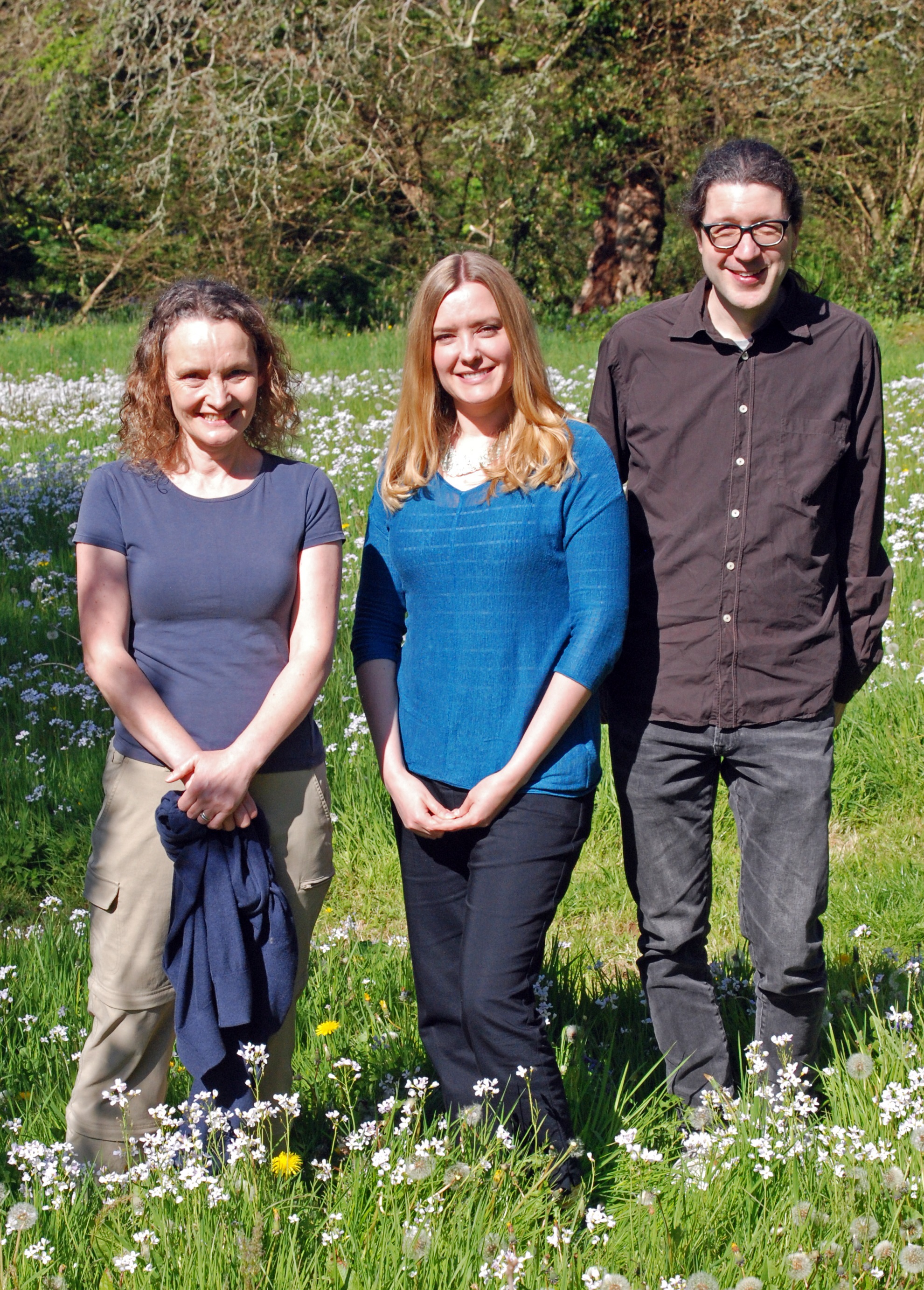
The BEEHAVE Team Osborne Becher and Twiston-Davies. Credit: Pete Kennedy.

Everyone, well, almost everyone, loves honey – that sweet, liquid gold laboriously collected by busy bees from countless little flowers. But of course, much more important than honey or wax or even cosmetic royal jelly products are the pollination services that bees provide to wildflowers and crops. In this blog post, authors Matthias Becher, Grace Twiston-Davies & Juliet Osborne discuss their latest paper published in Methods in Ecology & Evolution, “BEE-STEWARD: a research and decision support software for effective land management to promote bumblebee populations”.

Continue reading “Creating a research and conservation tool to support pollinator survival”

Mapping Animal Movement in R: The Science and the Art

Earlier this year, the BES Movement Ecology Special Interest Group held a competition to find the best animal movement maps in four categories: ‘pretty’, ‘nerdy’, ‘dynamic’ and ‘RMap’ (for maps produced entirely using R).

The results of the vote are in, and the winner of the RMap Category is Pratik Gupte from the University of Groningen, who used R to create this beautiful map of elephant movements across thermal landscapes. Here, we asked Pratik for the story behind the elephant map.

Continue reading “Mapping Animal Movement in R: The Science and the Art”

10th Anniversary Volume 10: Evidence synthesis technology and automating systematic reviews

Post provided by Eliza M. grames

To celebrate the 10th Anniversary of the launch of Methods in Ecology and Evolution, we are highlighting an article from each volume to feature on the Methods.blog. For Volume 10, we have selected ‘An automated approach to identifying search terms for systematic reviews using keyword co‐occurrence networks’ by Grames et al. (2019).

In this post, Eliza Grames shares the motivation behind the litsearchr search approach, and developments since the article’s publication.

Continue reading “10th Anniversary Volume 10: Evidence synthesis technology and automating systematic reviews”

Individual History and the Matrix Projection Model

Post provided by Rich Shefferson

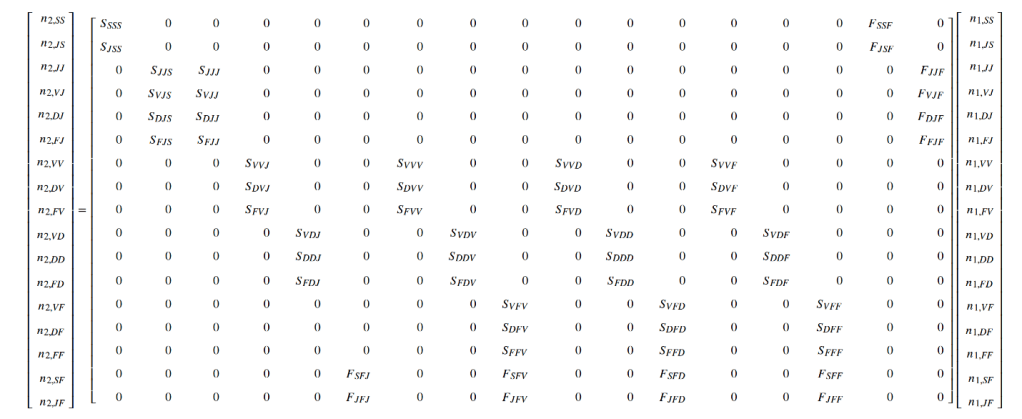
A single time-step projection of a historical matrix projection model (hMPM), for a 7 life stage life history model of Cypripedium parviflorum, the small yellow lady’s slipper. In this case, the vector of biologically plausible stage pairs in time 2 is equal to the full projection matrix multiplied by the vector of biologically plausible stage pairs in time 1.

Matrix projection modeling is a mainstay of population ecology. Ecologists working in natural area management and conservation, as well as in theoretical and academic realms such as the study of life history evolution, develop and use these models routinely. Matrix projection models (MPMs) have advanced dramatically in complexity over the years, originating from age-based and stage-based matrix models parameterized directly from the data, to complex matrices developed from statistical models of vital rates such as integral projection models (IPMs) and age-by-stage models. We consider IPMs to be a class of function-based MPM, while age-by-stage MPMs may be raw or function-based, but are typically the latter due to a better ability to handle smaller dataset. The rapid development of these methods can leave many feeling bewildered if they need to use these methods but lack sufficient understanding of scientific programming and of the background theory to analyze them properly.

Continue reading “Individual History and the Matrix Projection Model”

10th Anniversary Volume 8: Phylogenetics Editor’s Choice

To celebrate our 10th Anniversary, we are highlighting a key article from each of our volumes. For Volume 8, we selected ggtree: an r package for visualization and annotation of phylogenetic trees with their covariates and other associated data by Yu et al. (2016).

In this post, our Associate Editors Samantha Price and Francisco Balao share their favourite MEE papers in the field of phylogenetics.

Continue reading “10th Anniversary Volume 8: Phylogenetics Editor’s Choice”

10th Anniversary Volume 8: Phylogenetic tree visualization with multivariate data

Post provided by Guangchuang Yu and Tommy Tsan-Yuk Lam

To celebrate the 10th Anniversary of the launch of Methods in Ecology and Evolution, we are highlighting an article from each volume to feature in the Methods.blog. For Volume 8, we have selected ‘ggtree: an r package for visualization and annotation of phylogenetic trees with their covariates and other associated data‘ by Yu et al. (2016).

In this post, the authors share their inspiration behind the ggtree package for R and present new resources of ggtree and a series of other related packages.

The team publishing the ggtree paper is working in the field of emerging infectious diseases. Particularly the corresponding author Tommy Lam (TL) has been advocating the integration of different biological and epidemiological information in the studies of fast-evolving viral pathogens. The lead author Guangchuang Yu (GY) joined The University of Hong Kong to pursue his doctorate degree under the supervision of TL and Yi Guan (co-author in the paper), as he was very curious about the application of genomics and phylogenetics in the study of emerging infectious diseases.

Continue reading “10th Anniversary Volume 8: Phylogenetic tree visualization with multivariate data”

Reliably Predicting Pollinator Abundance with Process-Based Ecological Models

Post provided by Emma Gardner and Tom Breeze

Bumblebee. Picture credit: Tom Breeze.

Pollination underpins >£600 million of British crop production and wild insects provide a substantial contribution to the productivity of many crops. There is mounting evidence that our wild pollinators are struggling and that pollinator populations may be declining. Reliably modelling pollinator populations is important to target conservation efforts and to identify areas at risk of pollination service deficits. In our study, ‘Reliably predicting pollinator abundance: Challenges of calibrating process-based ecological models’, we aimed to develop the first fully validated pollinator model, capable of reliably predicting pollinator abundance across Great Britain.

Continue reading “Reliably Predicting Pollinator Abundance with Process-Based Ecological Models”

10th Anniversary Volume 3: paleotree: A Retrospective

Post provided by David bapst

To celebrate the 10th Anniversary of the launch of Methods in Ecology and Evolution, we are highlighting an article from each volume to feature on the Methods.blog. For Volume 3, we have selected ‘paleotree: an R package for paleontological and phylogenetic analyses of evolution‘ by David W. Bapst (2012). In this post, David discusses the background to the Application he wrote as a graduate student, and how the field has changed since.

I was a fourth year graduate student when I first had the idea to make an R package. Quite a few people thought it was a bit silly, or a bit of a time-waste, but I thought it was the right thing to do at the time, and I think it has proven to be the right decision in hindsight.

Continue reading “10th Anniversary Volume 3: paleotree: A Retrospective”