Creating Bigger, Better and More Joined-up Habitat Networks

Below is a press release about the Methods paper ‘How to manipulate landscapes to improve the potential for range expansion‘ taken from the University of Liverpool.

©Bidgee
©Bidgee

Scientists at the University of Liverpool have developed a new ‘route planner’ tool that could help conservationists aid the movement of species as they adapt to a changing climate.

The environmental ranges of many animal and plant species are starting to alter with climate change, as temperatures change and force species to migrate to more suitable climes.

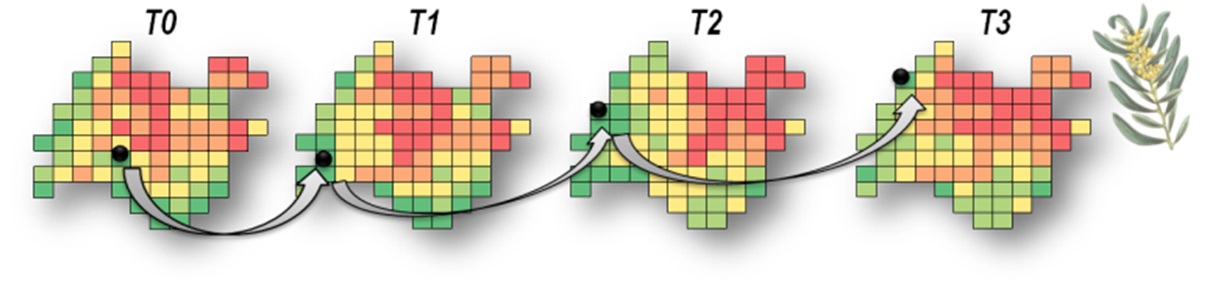
To be able to do this successfully, they will need sufficient habitat in their existing range, their future range, and any intermediate areas to enable populations to survive and thrive. Many conservation initiatives to restore habitats and increase connectivity are trying to address this issue. However, existing modelling tools mainly treat the landscape as static, and it is difficult to use these to plan restoration. Continue reading “Creating Bigger, Better and More Joined-up Habitat Networks”

Planning Habitat for Very Long-Distance Connectivity under Climate Change

Post provided by JENNY HODGSON

Climate change and habitat fragmentation are interacting threats: it is likely that many species cannot reach newly suitable areas at the cool edge of their range because there is not enough habitat, in the right places, to support range expansion over multiple generations. Conservation efforts are already underway to restore large areas of habitat, and to improve the “connectivity” within networks of habitat. However, there are multiple ways of measuring connectivity and few of them address the scale of shifts that are likely to be needed under climate change. This could be a problem if it leads to inefficient conservation prioritisation.

The Conductance Metric

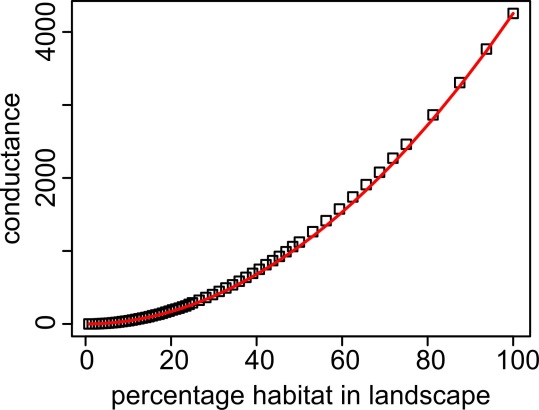
How conductance generally depends on the amount of habitat in the landscape. Squares show the conductance of landscapes with a random selection of cells chosen to be habitat. The red line is based only on the 100% point and the expectation that conductance is proportional to amount of habitat squared.

We first developed the conductance metric in 2012 and we found that it is correlated to the speed with which a species can spread through a landscape, from a specified source location to a specified target. A key difference between this and most other connectivity metrics is that it incorporates both reproduction within habitat patches and dispersal between habitat patches, over multiple generations (further explanation here). Sometimes there could be many very well-connected patches in a network, and yet no easy way for a species to cross the landscape from end to end. This could be a problem for the species’ survival, if staying within its current regions of occupancy is unsustainable, for example if it is being pushed northwards by climate change. Continue reading “Planning Habitat for Very Long-Distance Connectivity under Climate Change”

European Bison, Rewilding and Dung Fungal Spore

Post provided by AMBROISE BAKER

In the US, July is National Bison Month but most people in Europe are totally oblivious to it. I wasn’t even aware of it before being asked to write this blog post in connection with our recent Methods in Ecology and Evolution paper about quantifying population sizes of large herbivores. Some will argue that it is because we don’t ‘do’ day, month, state or national animals on this side of the Atlantic as much as the Americans do.

The European bison survived from extinction thanks to about 50 individuals kept in zoos. The species has been reintroduced in the wild in several European countries but remains ‘Vulnerable’ according to the IUCN criteria.
The European bison survived extinction thanks to ~50 individuals kept in zoos. It has been reintroduced in several countries but remains ‘Vulnerable’. ©4028mdk09

But another reason is that the European bison, Bison bonasus bonasus, is simply not sufficiently well-known or associated with European nature in the public’s mind. This is particularly true in Western Europe where this species has been extinct since medieval times.

Early European accounts from North America reported huge bison populations – with estimates of up to 60 million – moving to and fro in the great bison belt. These past migratory movements across the Great Plains are familiar well beyond the US and feed our view of untamed wilderness prior to the impact of European ’civilisation’. In contrast, there are hardly any records of European bison numbers until just before the last wild one was reported killed in Poland in 1921. Continue reading “European Bison, Rewilding and Dung Fungal Spore”

A New Modelling Strategy for Conservation Practice? Ensembles of Small Models (ESMS) for Modelling Rare Species

Post provided by FRANK BREINER, ARIEL BERGAMINI, MICHAEL NOBIS and ANTOINE GUISAN

Rare Species and their Protection

Erythronium dens-canis L. – a rare and threatened species used for modelling in Switzerland. ©Michael Nobis

Rare species can be important for ecosystem functioning and there is also a high intrinsic interest to protect them as they are often the most original and unique components of local biodiversity. However, rare species are usually those most threatened with extinction.

In order to help prioritizing conservation efforts, the International Union for Conservation of Nature (IUCN) has published criteria to categorize the status of threatened species, which are then published in Red Lists. Changes in a species’ geographical distribution is one of the several criteria used to assign a threat status. For rare species, however, the exact distribution is often inadequately known. In conservation science, Species Distribution Models (SDMs) have recurrently been used to estimate the potential distribution of rare or insufficiently sampled species. Continue reading “A New Modelling Strategy for Conservation Practice? Ensembles of Small Models (ESMS) for Modelling Rare Species”

Ecological Transcriptomics for Endangered Species: Avoiding the “Successful Operation, but the Patient Died” Problem

Post provided by TILL CZYPIONKA, DANIEL GOEDBLOED, ARNE NOLTE and LEON BLAUSTEIN

Ecological Transcriptomics and Endangered Species

 The small size of the rockpool and the salamander population makes non-invasive sampling a necessity (from left: Tamar Krugman, Alan Templeton, Leon Blaustein). © Arne Nolte
The small size of the rockpool and the salamander population makes non-invasive sampling a necessity (from left: Tamar Krugman, Alan Templeton, Leon Blaustein). © Arne Nolte

Friday was Endangered Species Day – so this is a good time to reflect on what science and scientists can do to support conservation efforts and to reduce the rate of species extinctions. One obvious answer is that we need to study endangered species to understand their habitat requirements as well as their potential for acclimatization and adaptation to changing environmental conditions. This information is crucial to for the design of informed conservation planning. However, for most endangered species the relevant phenotypes are not known a priori, which leaves the well-intentioned scientist asking “which traits should I measure?”. Transcriptome analysis is often a good way to answer to this question.

Transcriptome analysis measures the expression levels of thousands of genes in parallel. This amount of data circumvents the need to decide on a reduced number of traits of unknown relevance and allows for a relatively unbiased phenotypic screen of many traits. In particular, physiological changes, which often influence a species’ distributional range, can be studied using transcriptome analysis. Also, transcriptomics provide a direct connection to the genetic level. This is essential for in-depth analyses of aspects of evolution and might even be helpful for a new kind of conservation planning, which aims to foster endangered species by promoting (supposedly) beneficial hybridization. The integration of transcriptomic analysis with ecological studies is known as ‘Ecological transcriptomics’. Continue reading “Ecological Transcriptomics for Endangered Species: Avoiding the “Successful Operation, but the Patient Died” Problem”

What is Dark Diversity?

Post provided by ROB LEWIS & MEELIS PÄRTEL

Our understanding of how biological diversity works has been advanced by a long history of observing species and linking patterns to ecological processes. However, we generally don’t focus as much on those species that aren’t observed, or in other words ‘absent species’. But, can absent species provide valuable information?

Dark diversity – a set of species absent from a particular site but which belong to its species pool – has the potential to be as ecologically meaningful as observed diversity. Part of the species pool concept, understanding dark diversity is relatively straightforward.

The Basic Theory of Dark Diversity

To begin learning about dark diversity, there are two important terms that we need to define: ‘species pool’ and ‘focal community’. A ‘species pool’ is a set of species present in a particular region or landscape that can potentially inhabit a particular observed community because of suitable local ecological conditions.

A ‘focal community’ is the set of species that have been observed in a particular region or landscape (this is the ‘observed community’ and can also be referred to as alpha diversity). For a given focal community to become established, the species within it must have overcome dispersal pressures as well as environmental and biotic filters.

A

Continue reading “What is Dark Diversity?”

Bringing Ecologists and Statisticians Together for the Conservation of Endangered Species

Post provided by Cecilia Pinto and Luigi Spezia

The Benefits of High Frequency Data

One of the tagged flapper skates showing the three different kinds of tags. ©Cecilia Pinto

High frequency data, like those obtained from individual electronic tags, carries the potential of giving us detailed information on the behaviour of species at the individual level. Such data are particularly useful for marine species, as we can’t observe them directly for long periods of time.

Understanding how individuals use water columns – both at daily and seasonal scales – can help define conservation measures such as restricting fishing activity to reduce by-catch or defining protected areas to help recovering populations or protect spawning and nursery areas. High frequency data have become popular as they give insight to detailed individual foraging behaviour and therefore the specific energetic needs that are linked to reproduction and fitness. Continue reading “Bringing Ecologists and Statisticians Together for the Conservation of Endangered Species”

Spatially-explicit Power Analysis: A First Step for Occupancy-Based Monitoring

Post provided by Martha Ellis and Jody Tucker

Where’s Waldo? Trying to find this fisher somewhere in a giant landscape is going to be tricky! ©Mike Schwartz
Where’s Waldo? Trying to find this little guy somewhere in a giant landscape is going to be tricky! © Mike Schwartz

The seemingly basic question of whether a population is increasing, decreasing, or stable can be one of the most difficult to answer. Collecting data on rare and elusive species is hard. Imagine trying to detect a handful of fisher or wolverine across hundreds of thousands of acres – it is physically demanding, time consuming and logistically complicated. And that’s just to do it once! To monitor a population for changes, you have to repeat these surveys regularly over many years. The long-term monitoring that is necessary for conservation requires careful planning and a substantial commitment of resources and funding. So before we spend these valuable resources, it’s critical to know whether the data we are collecting can help us to answer our questions. Continue reading “Spatially-explicit Power Analysis: A First Step for Occupancy-Based Monitoring”

Space-time continuum and conservation planning: Helping Species Adapt to Climate Change

Post provided by Diogo André Alagador

The world’s most threatened felid (Iberian lynx) is endemic in a region predicted to be severely impacted by climate change: the Iberian Peninsula. ©lynxexsitu.es
The world’s most threatened felid (Iberian lynx) is from a region predicted to be severely impacted by climate change: the Iberian Peninsula. ©lynxexsitu.es

Climate change is driving many species to alter their geographic distributions. The ranges of some species contract, expand or shift as individuals track favorable climate conditions. In some cases, threatened species are moving out of protected areas. These trends are expected to intensify in the coming years.

To increase conservation effectiveness within protected areas in the future, researchers at the Research Center on Biodiversity and Genetic Resources at the University of Évora and the Department of Mathematics of the Faculty of Sciences and Technology from the NOVA University in Lisbon, Portugal, have come up with a set of modelling tools to optimize the scheduling of conservation area allocation as the climate changes. These take into account restrictions of conservation area expansion derived from the prevailing socio-economic activities. “The objective is to select the best dispersal corridors for each species considering a budget restriction or competition with other socioeconomic activities” said Diogo Alagador. “These selections are complex and non-trivial as they incorporate decisions on the spatial and temporal trends of large sets of species.”

The concept of a spatio-temporal corridor for a species in an environmental heterogeneous region.

Continue reading “Space-time continuum and conservation planning: Helping Species Adapt to Climate Change”

Being Certain about Uncertainty: Can We Trust Data from Citizen Science Programs?

Post provided by VIVIANA RUIZ GUTIERREZ

Citizen Science: A Growing Field

Thousands of volunteers around the world work on Citizen Science projects. ©GlacierNPS

As you read this, thousands of volunteers of all ages and backgrounds are collecting information for over 1,100 citizen science projects worldwide. These projects cover a broad range of topics: from volunteers collecting samples of the microbes in their digestive tracts, to tourists providing images of endangered species (such as tigers) that are often costly to survey.

The popularity of citizen science initiatives has been increasing exponentially in the past decade, and the wealth of knowledge being contributed is overwhelming. For example, almost 300,000 participants have submitted around 300 million bird observations from 252 countries worldwide to the eBird program since 2002. Amazingly, rates of submissions have exceeded 9.5 million observations in a single month! Continue reading “Being Certain about Uncertainty: Can We Trust Data from Citizen Science Programs?”