A new tool to identify important sites for conservation using tracking data

Post provided by Martin Beal, Steffen Oppel, Jonathan Handley, Richard Phillips, Paulo Catry, and Maria Dias.

Identifying areas around the world that can best contribute to the conservation of wild animals is a major challenge. Historically, this required conducting extensive surveys in the field, but with the advent of miniature tracking technology we can now follow animals and allow them to indicate which areas they depend on most. In this collaborative post, international researchers from ISPA – Instituto Universitário in Lisbon, the Royal Society for the Protection of Birds, BirdLife International, and British Antarctic Survey present a new conservation tool as outlined in the paper “track2KBA: An R package for identifying important sites for biodiversity from tracking data” recently published in Methods in Ecology and Evolution.    

Continue reading “A new tool to identify important sites for conservation using tracking data”

MEEin3: A standardisation framework for bio-logging data to advance ecological research and conservation

We are very excited to share the second episode of MEEin3 with you! Listen to Dr Ana Sequeira share the story behind the paper ‘A standardisation framework for bio-logging data to advance ecological research and conservation‘. Ana is a Senior Research Fellow at the University of Western Australia, with research focusing on understanding the movement of marine megafauna. But what inspired this article, what was … Continue reading MEEin3: A standardisation framework for bio-logging data to advance ecological research and conservation

Flora Incognita – more than just a plant identification app

Post provided by Michael Rzanny & Jana Wäldchen

Species identification is an essential tool for recording biodiversity, especially in an era of habitat loss and climate change. Developing skills to correctly identify plants to a species or even a genus level can take many years of training, but a new app called Flora Incognita aims to empower citizens with botanical expertise while also collecting data for scientific analysis.

In this blog post, Michael Rzanny and Jana Wäldchen reveal the inspiration behind this new app and discuss highlights from their new paper “The Flora Incognita app – interactive plant species identification” recently published in Methods in Ecology & Evolution

Continue reading “Flora Incognita – more than just a plant identification app”

Ultrasound for trees? Using focused ultrasound technology as a new method of DNA extraction

Post provided by Hal Holmes

Each year Methods in Ecology and Evolution awards the Robert May Prize to the best paper in the journal by an author at the start of their career. Hal Homes has been shortlisted for their article ‘Focused ultrasound extraction (FUSE) for the rapid extraction of DNA from tissue matrices’. In this blog, Hal discusses how their paper came to be and the future applications of FUSE technology.

Continue reading “Ultrasound for trees? Using focused ultrasound technology as a new method of DNA extraction”

Searching for snow leopards

Post provided by Ian Durbach and Koustubh Sharma

Snow leopard captured via camera trap in Mongolia. Picture credit: Snow Leopard Conservation Foundation/Snow Leopard Trust/Panthera (OR SLCF/SLT/PF).

Snow leopards are notoriously elusive creatures and monitoring their population status within the remote, inhospitable habitats they call home, can be challenging.  In this post, co-authors Ian Durbach and Koustubh Sharma discuss the applications of their Methods in Ecology and Evolution article, ‘Fast, flexible alternatives to regular grid designs for spatial capture–recapture’, for monitoring snow leopard populations.

Continue reading “Searching for snow leopards”

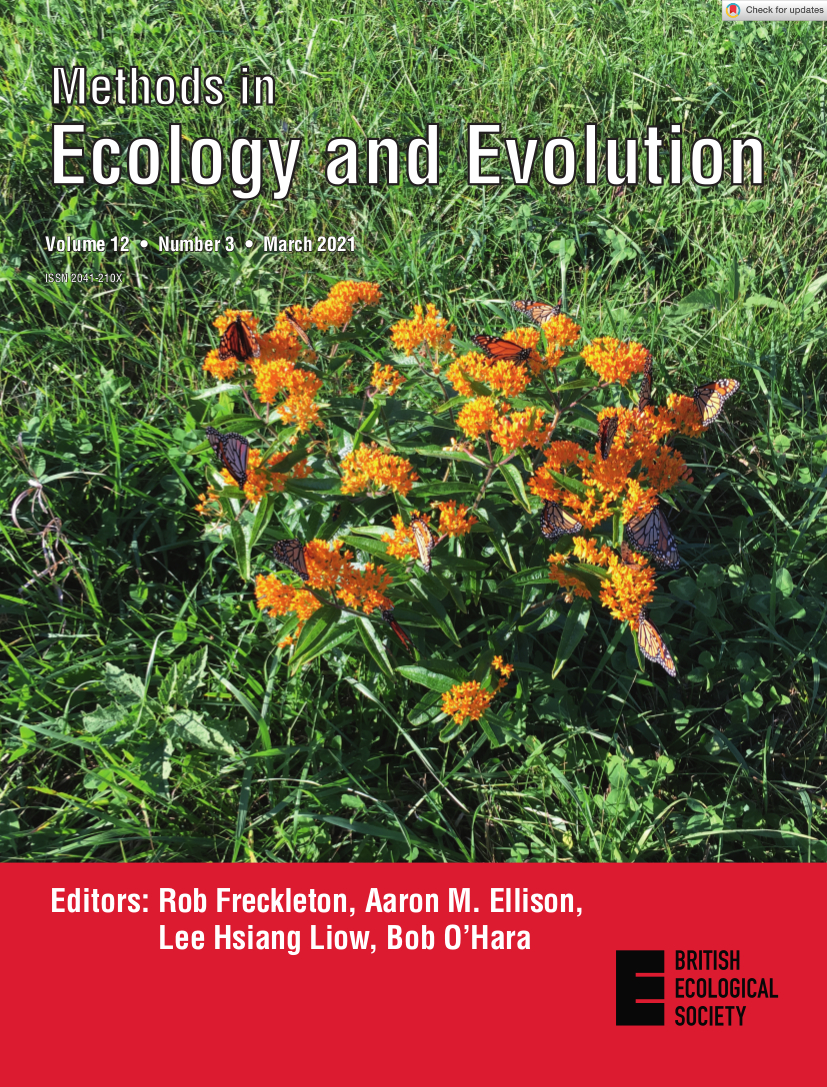
Cover Stories: The journey from designing to employing an automated radio telemetry system to track monarch butterflies

Post provided by Kelsey E. Fisher

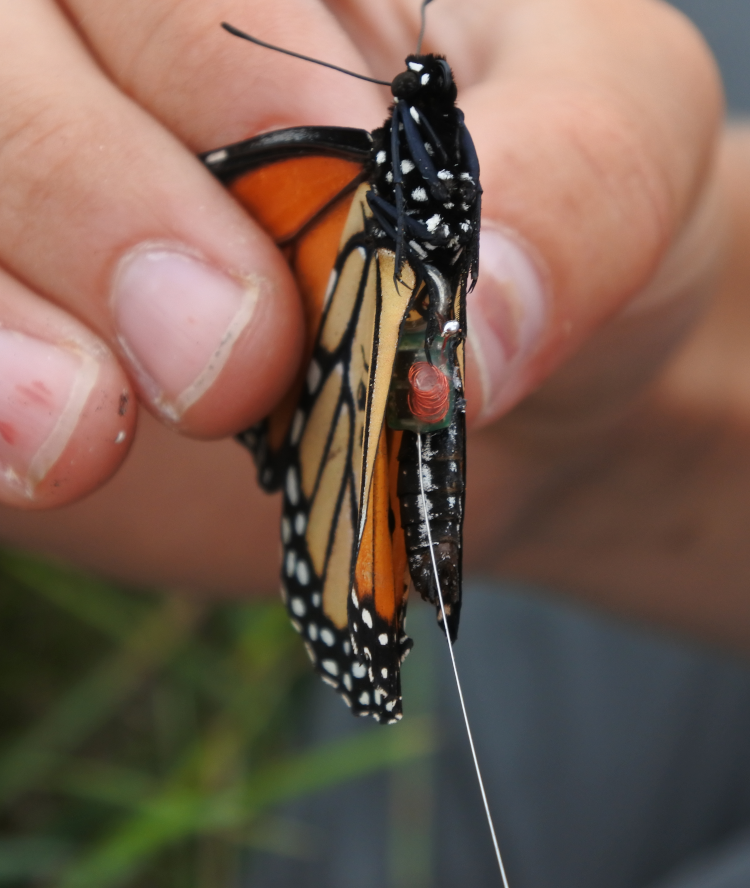
Kelsey Fisher describes the motivations and challenges in the development of a novel automated radio telemetry method to track the movement of butterflies at the landscape scale published in their new Methods article ‘Locating large insects using automated VHF radio telemetry with a multi‐antennae array’.

LB-2X transmitter attached to a monarch butterfly.

Understanding animal movement across varying spatial and temporal scales is an active area of fundamental ecological research, with practical applications in the fields of conservation biology and natural resource management. Advancements in tracking technologies, such as GPS and satellite systems, allow researchers to obtain more location information for a variety of species than ever before. It’s an exciting time for movement ecologists! However, entomologists studying insect movement are still limited because of the large size of tracking devices relative to the small size of insects.

Continue reading “Cover Stories: The journey from designing to employing an automated radio telemetry system to track monarch butterflies”

10th Anniversary Volume 11: Updates on the ClimEx Handbook

Post provided by Aud H. Halbritter

To celebrate the 10th Anniversary of the launch of Methods in Ecology and Evolution, we are highlighting an article from each volume to feature in the Methods.blog. For Volume 11, we have selected ‘The handbook for standardized field and laboratory measurements in terrestrial climate change experiments and observational studies (ClimEx)’ by Halbritter et al. (2019).

Continue reading “10th Anniversary Volume 11: Updates on the ClimEx Handbook”

10th Anniversary Volume 10: Evidence synthesis technology and automating systematic reviews

Post provided by Eliza M. grames

To celebrate the 10th Anniversary of the launch of Methods in Ecology and Evolution, we are highlighting an article from each volume to feature on the Methods.blog. For Volume 10, we have selected ‘An automated approach to identifying search terms for systematic reviews using keyword co‐occurrence networks’ by Grames et al. (2019).

In this post, Eliza Grames shares the motivation behind the litsearchr search approach, and developments since the article’s publication.

Continue reading “10th Anniversary Volume 10: Evidence synthesis technology and automating systematic reviews”

Anniversary Volume 9: Estimating Effective Detection Area of Static Passive Acoustic Data

Post provided by Hanna K Nuuttila

To celebrate the 10th Anniversary of the launch of Methods in Ecology and Evolution, we are highlighting an article from each volume to feature in the Methods.blog. For Volume 9, we have selected ‘Estimating effective detection area of static passive acoustic data loggers from playback experiments with cetacean vocalisations’ by Nuuttila et al. (2018).  In this post, the authors discuss the background and key concepts of the article, and the application of the article for assessing abundance of cetaceans.

Continue reading “Anniversary Volume 9: Estimating Effective Detection Area of Static Passive Acoustic Data”

Tracking the fate of fish

Post provided by David Villegas Ríos

David Ríos tells us about investigating the movement of aquatic animals using telemetry technology and the new Methods article ‘Inferring individual fate from aquatic acoustic telemetry data’.

Photo by Carla Freitas

Aquatic animal telemetry has revolutionized our understanding of the behaviour of aquatic animals. One of the important advantages of telemetry methods, including acoustic telemetry, is that they provide information at the individual level. This is very relevant because it enables investigating the natural variability in behaviour within populations (like here or here), but also because one can investigate what happens to each individual animal and relate it to its natural behaviour. Knowing “what happens to each individual” is normally referred to as “fate” and it can take many forms: some fish may end-up eaten by predators, other may be fished, some of them may disperse, etc. Knowing the fate of each individual fish is crucial as it links ecological processes at the individual level to evolutionary outcomes at the population level.

Continue reading “Tracking the fate of fish”