Using Artificial Intelligence to Track Birds’ Dark-of-Night Migrations

Below is a press release about the Methods in Ecology and Evolution article ‘MistNet: Measuring historical bird migration in the US using archived weather radar data and convolutional neural networks‘ taken from the University of Massachusetts Amherst.

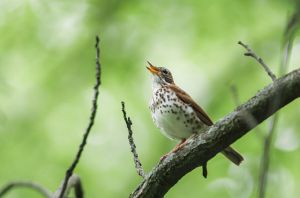
Wood thrush. ©CheepShot

On many evenings during spring and fall migration, tens of millions of birds take flight at sunset and pass over our heads, unseen in the night sky. Though these flights have been recorded for decades by the National Weather Services’ network of constantly-scanning weather radars, until recently these data have been mostly out of reach for bird researchers.

“That’s because the sheer magnitude of information and lack of tools to analyse it made only limited studies possible,” says artificial intelligence (AI) researcher Dan Sheldon at the University of Massachusetts Amherst. Continue reading “Using Artificial Intelligence to Track Birds’ Dark-of-Night Migrations”

A Celebration of World Rivers Day

Post provided by Alfred Burian, Antonia Ford and Quentin Mauvisseau

Celebrating our river ecosystems world-wide on the 22nd of September.
Celebrating our river ecosystems world-wide on the 22nd of September. ©Bob Wick, BLM.

It’s the 22nd of September and that means it’s this year’s UN World Rivers Day! In over 60 countries around the globe events are going on today to bring attention to the many values of our waterways. And we, the Aquatic Ecology Special Interest Group of the BES, are joining in with the celebrations! We’re highlighting recent methodological advancements that will help us to manage and conserve our rivers in the future. So let’s get started…

Multiple Stressors and Molecular Tools

Today, human activities across the world are impacting rivers to varying degrees. As scientists, we frequently see the interaction of multiple different stressors such as flow regulations, pollution or climate change affecting our rivers. The combined impact of stressors like these may be worse than any of their individual impacts. To understand and manage the effect of them, we need cost-effective and reliable analytical tools that can capture site-specific and ecosystem-wide effects.

Recent methodological advances that will help us to achieve these goals often rely on the application of new or improved molecular tools. Emerging techniques include environmental DNA (eDNA) based applications to monitor endangered and invasive species as well as stable isotope ecology, which provides us with new insights into animal diets and energy flows through aquatic food webs. We’d like to take the opportunity to introduce some of the novel developments in both of these exciting fields. Continue reading “A Celebration of World Rivers Day”

Solving the Midpoint Melee: Introducing New Methods for Plant Cover Classes

Post provided by KATHI IRVINE and TOM RODHOUSE

Collecting ordinal data. ©NPS

Or better yet, this post could be named ‘Our Cathartic Journey to Convince Ecologists to STOP Using the Midpoint Values for Analysing Plant Cover Classes’. Our work picks up where another recent Methods.blog post (Stuck between Zero and One) and Methods in Ecology and Evolution article (‘Analysing continuous proportions in ecology and evolution’) by Douma and Weedon left off. They introduced the benefits of using beta and Dirichlet regression. We’re going to tackle the sticky wicket of ordinal data. So, what should you do if you assign a range (like 0.2 to 0.3) instead of record a value (like 0.22) for a continuous proportion?

What is Ordinal Data?

It’s probably a good idea to start by defining the type of data we’re talking about. The best example is from plant surveys. Biologists visually assess the percentage of a pre-defined area covered by a certain plant species. They then record a ‘cover class value’ as an estimate of abundance. Each cover class value corresponds to the percentage of the area that is taken up by the plant in question (e.g., record a 0 for 0%, record a 1 for >0-5%, record a 2 for >5-25%, …, record a 6 for >95%). Continue reading “Solving the Midpoint Melee: Introducing New Methods for Plant Cover Classes”

Researchers Develop Tools to Help Manage Seagrass Survival

Below is a press release about the Methods in Ecology and Evolution article ‘Analysing the dynamics and relative influence of variables affecting ecosystem responses using functional PCA and boosted trees: a seagrass case study‘ taken from Queensland University of Technology.

©Paul Asman and Jill Lenoble

A new QUT-led study has developed a statistical toolbox to help avoid seagrass loss which provides shelter, food and oxygen to fish and at-risk species like dugongs and green turtles. Seagrasses are a critical habitat that have been declining rapidly globally.

The research has been published in Methods in Ecology and Evolution describing key monitoring and management designs to maximise seagrass resilience to human activities. They will help to better inform seagrass dredging operations and development of coastal areas.

Led by statistical data researcher and lecturer Dr Paul Wu, from QUT’s School of Mathematical Sciences, the study identified and analysed factors that drove variations in a global seagrass dredging case study. Continue reading “Researchers Develop Tools to Help Manage Seagrass Survival”

Making Tags Less of a Drag: Optimising Biologging Devices with Computational Fluid Dynamics

Post provided by WILLIAM KAY

Drag and Biologging Devices

A harbour seal tagged with a biologging device. ©Dr Abbo van Neer

Michael Phelps is one of the most decorated Olympic athletes of all time and the world’s fastest swimmer. And yet, he could swim faster. Wearing the Speedo LZR Racer supersuit Michael Phelps could reduce his hydrodynamic drag, or water resistance, by upwards of 40%. That could increase his swim speed by more than 4%! In competition, that’s the difference between silver and gold. But, if Phelps forgot to remove his “drag socks” – cumbersome footwear designed to increase water resistance for strength training – his speed would be dramatically reduced. He’d be lucky to walk away with bronze!

Professional swimmers have adapted to the use of performance enhancing technologies to decrease their drag, but that’s nothing compared to the adaptations made by wild animals. Creatures in the marine environment have evolved incredible adaptations to decrease drag, such as extreme streamlining in marine mammals and seabirds. This allows them to move underwater as quickly and efficiently as possible. Seals, for example, are pretty ungainly on land, but in the water they’re sleek and rapid. They have a body shape designed to maximise speed while swimming.

When we study marine animals we often use tracking devices, which can be attached using harnesses, glue, or suction-cups. These ‘biologging devices‘, or tags, are similar to Fitbits. Attaching them to animals allows us to record, amongst other things, all of the animal’s movements and behaviours. This information is crucial to understanding their ecology and for improving their conservation management. Continue reading “Making Tags Less of a Drag: Optimising Biologging Devices with Computational Fluid Dynamics”

Atlantis: A Model for Biophysical, Economic and Social Elements of Marine Ecosystems

Post provided by ASTA AUDZIJONYTE, Heidi Pethybridge, Javier Porobic, Rebecca Gorton, Isaac Kaplan, and Elizabeth A. Fulton

Increased Demands on a Crowded Ocean

Multiple demands on, and uses of, the ocean. ©Frank Shepherd

The ocean was once a limitless frontier, primed for exploitation of fish and other marine life. Today, a scan of the coastline (in our case off Australia and the US) shows an ocean landscape dotted with aquaculture pens, wind farms, eco-tours, and oil rigs, as well as commercial and recreational fishing boats. This presents marine and maritime managers with the huge challenge of balancing competing social, conservation, and economic objectives. Trade-offs arise even from success stories. For example, seal and sea lion populations are recovering from centuries of hunting, which is great. But now they’re preying heavily on economically valuable species like salmon and cod, creating potential tensions between fisheries and conservation communities. Ecosystem-based management is one way that we can start to address these trade-offs. Continue reading “Atlantis: A Model for Biophysical, Economic and Social Elements of Marine Ecosystems”

Thermal Images in R

Post provided by REBECCA SENIOR (@REBECCAASENIOR)

Why use Thermal Images?

Temperature is important in ecology. Rising global temperatures have pushed ecologists and conservationists to better understand how temperature influences species’ risk of extinction under climate change. There’s been an increasing drive to measure temperature at the scale that individual organisms actually experience it. This is made possible by advances in technology.

Enter: the thermal camera. Unlike the tiny dataloggers that revolutionised thermal ecology in the past decade or so, thermal images capture surface temperature, not atmospheric temperature. Surface temperature may be as (if not more) relevant for organisms that are very small or flat, or thermoregulate via direct contact with the surface. Invertebrates and herps are two great examples of these types of organisms – and together make up a huge proportion of terrestrial biodiversity. Also, while dataloggers can achieve impressive temporal extent and resolution, they can’t easily capture temperature variation in space.

Like dataloggers, thermal cameras are becoming increasingly affordable and practical. The FLIR One smartphone attachment, for example, weighs in at 34.5 g and costs around ~US$300. For that, you get 4,800 spatially explicit temperature measurements at the click of a button. But without guidelines and tools, the eager thermal photographer runs the risk of accumulating thousands of images with no idea of what to do with them. So we created the R package ThermStats. This package simplifies the processing of data from FLIR thermal images and facilitates analyses of other gridded temperature data too. Continue reading “Thermal Images in R”

New eDNA Programme Makes Conservation Research Faster and More Efficient

Below is a press release about the Methods in Ecology and Evolution article ‘Anacapa Toolkit: An environmental DNA toolkit for processing multilocus metabarcode datasets‘ taken from UCLA.

It’s estimated that a person sheds between 30,000 to 40,000 skin cells per day. These cells and their associated DNA leave genetic traces of ourselves in showers, dust — pretty much everywhere we go.

Other organisms shed cells, too, leaving traces throughout their habitats. This leftover genetic material is known as environmental DNA, or eDNA. Research using eDNA began about a decade ago, but was largely limited to a small cadre of biologists who were also experts in computers and big data. However, a new tool from UCLA could be about to make the field accessible and useful to many more scientists.

A team of UCLA researchers recently launched the Anacapa Toolkit — open-source software that makes eDNA research easier, allowing researchers to detect a broad range of species quickly and producing sortable results that are simple to understand. Continue reading “New eDNA Programme Makes Conservation Research Faster and More Efficient”

Conservation or Construction? Deciding Waterbird Hotspots

Below is a press release about the Methods in Ecology and Evolution article ‘A comparative analysis of common methods to identify waterbird hotspots‘ taken from Michigan State University.

A mixed flock of waterbirds on the shore of Lake St. Clair. ©Michigan DNR

Imagine your favourite beach filled with thousands of ducks and gulls. Now envision coming back a week later and finding condos being constructed on that spot. This many ducks in one place surely should indicate this spot is exceptionally good for birds and must be protected from development, right?

It depends, say Michigan State University researchers.

In a new paper published in Methods in Ecology and Evolution, scientists show that conservation and construction decisions should rely on multiple approaches to determine waterbird “hotspots,” not just on one analysis method as is often done. Continue reading “Conservation or Construction? Deciding Waterbird Hotspots”

Life-Long Mosquito Marking: Are Stable Isotopes the Key?

Post provided by ROY FAIMAN

Importance of Marking (Wild) Mosquitoes

Dr. Dao (crouching on right) and team with Dr. Tovi Lehmann (with sandals), Dr. Yaro (with white cap), and Moussa Diallo (front).

The fact that mosquitoes are insects of massive importance is of little dispute. With malaria still killing almost half a million people annually and after recent outbreaks of Zika, dengue and West-Nile viruses the threat of mosquito-borne diseases is becoming common knowledge. The meme of ‘Mosquitoes are the No.1 killer of all time,’ is also growing more popular (I even heard it from my 8-year-old kid one day after he returned from school!). Yet, with all we think we know about the little bug(ger)s, it’s probably only the tip of the iceberg.

Much work was done over the past century to try to answer basic questions about mosquitoes like:

  • How big are their populations?
  • How long do they live?
  • Where do they go when we don’t see or feel them?

Different methods have been developed to provide insights and notions on the mosquitoes’ movements, survival, and populations estimates; but the limitations and conditions of these methods mean that our knowledge is still incomplete.

One of the gold-standard tools for answering questions like those above is Mark-Release-Recapture (MRR). It was developed almost a century ago and has been modified and remodified through the years, as different marking technologies became available. Continue reading “Life-Long Mosquito Marking: Are Stable Isotopes the Key?”