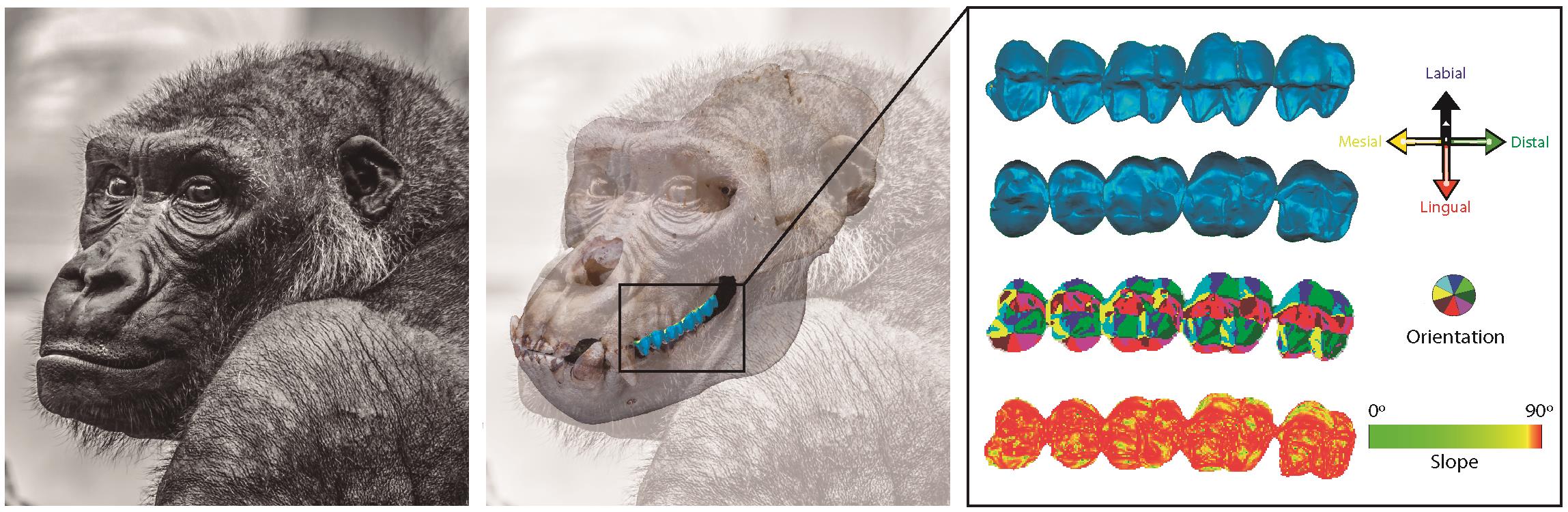
By charting the slopes and crags on animals’ teeth as if they were mountain ranges, scientists at the Smithsonian’s National Museum of Natural History have created a powerful new way to learn about the diets of extinct animals from the fossil record.
Understanding the diets of animals that lived long ago can tell researchers about the environments they lived in and help them piece together a picture of how the planet has changed over deep time. The new quantitative approach to analysing dentition, reported on 21 November in the journal Methods in Ecology and Evolution, will also give researchers a clearer picture of how animals evolve in response to changes in their environment.
A 3D reconstruction of the teeth of a western gorilla (Gorilla gorilla).
Years of research on the evolution of ancient life, including the dinosaurs, have been questioned after a fatal flaw in the way fossil data are analysed was exposed by scientists from the universities of Reading and Bristol.
Studies based on the apparently flawed method have suggested Earth’s biodiversity remained relatively stable – close to maximum carrying capacity – and hinted many signs of species becoming rapidly extinct are merely reflections on the poor quality of the fossil record at that time.
However, new research by scientists at the University of Reading suggests the history of the planet’s biodiversity may have been more dynamic than recently suggested, with bursts of new species appearing, along with crashes and more stable periods.
If you are attending Evolution, as well as attending the fabulous talks mentioned by Hélène below, do stop by booth 125 to see our BES colleague Simon Hoggart. Simon is the Assistant Editor of Journal of Animal Ecology and would be happy to answer your questions about any of our journals or any of the other work we do here at the BES.
RPANDA: a time machine for evolutionary biologists
Imagine “Doc”, Marty’s friend in Back to the Future, trying to travel back millions of years in an attempt to understand the history of life. Instead of building a time machine from a DeLorean sports car powered by plutonium, he could dig fossils, or more likely, he would use molecular phylogenies.
Molecular phylogenies are family trees of species that can be built from data collected today: the genes (molecules) of present-day species (Fig 1). They are often thought of as trees, in reference to Darwin’s tree of life. The leaves represent the present: species that can be found on Earth today. The branches represent the past: ancestral species, which from time to time split, giving rise to two independent species. The structure of the tree tells us which species descend from which ancestors, and when their divergence happened.
Fig 1: The phylogenetic tree of all birds (adapted from Jetz et al. 2012). Each bird order is represented by a single bird silloutter and a specific colour (the most abundant order of Passeriformes, for example is represented in dark orange). Each terminal leaf represents a present-day bird species, while internal branches represent the evolutionary relationships among these species.
Damselflies marked in the field, which will hopefully be recaptured later. This small insect at our field site had only about 10% recapture probability.
The quantification of survival selection in the field has a long history in evolutionary biology. A considerable milestone in this field was the highly influential publication by Russel Lande and Steve Arnold in the early 1980s.
The practical implementation of Lande and Arnold’s method involved simply fitting a linear model with standardized response (survival) and explanatory (trait) variables values with quadratic terms (multiplied by two). This straightforward method allowed evolutionary biologists to measure selection coefficients using commonly available statistical software and these estimates could be used directly within a quantitative genetic framework. Continue reading “Measuring Survival Selection in Natural Populations: How important is recapture probability?”
Timed for Evolution 2013, we have just put up a Virtual Issue highlighting some of the papers with an evolutionary theme published in the last year. The link between ecology and evolution is important to MEE: the research papers we have highlighted include excellent examples of these such as modelling dispersal and testing for niche conservatism. Barcoding methods are included, which increasingly are used in … Continue reading Virtual Issue: Evolution 2013
Methods will be attending the next ITN Speciation conference 2012 in Jyväskylä, Finland and to mark the occasion, the editorial team has put together a list of some our most relevant work in speciation and evolution. Applications – concise papers describing new software, equipment, or other practical tools: PASSaGE: Pattern Analysis, Spatial Statistics and Geographic Exegesis. Version 2 by Micheal Rosenberg and Corey Anderson RBrownie: … Continue reading Top 10 speciation and evolution papers
It seems that from the number of submissions we receive at the journal, Methods in Ecology and Evolution has filled an important niche. As our editor-in-chief, Rob Freckleton, wrote to introduce our second volume: “those doing science need to be kept up to date on new approaches, and those developing new methods need a place to publish, as well as be supported in getting their … Continue reading Volume 3 Issue 1: Now online
Here is a round-up of interesting methods and methods-related papers published in the past few weeks. Please do pass on any interesting-looking papers / links and I will include them. In Heredity Blanya et al. review the use of Drosophila subobscura as a tool in research on the microevolutionary consequences of climate change. There are several methods-relevant papers in the latest issue of Evolution: Céline … Continue reading Methods Digest – November 2009





 Methods Blog