Large drones make a big splash: Using smaller drones to conduct less disruptive wildlife surveys

Post provided by Kayla Kuhlmann

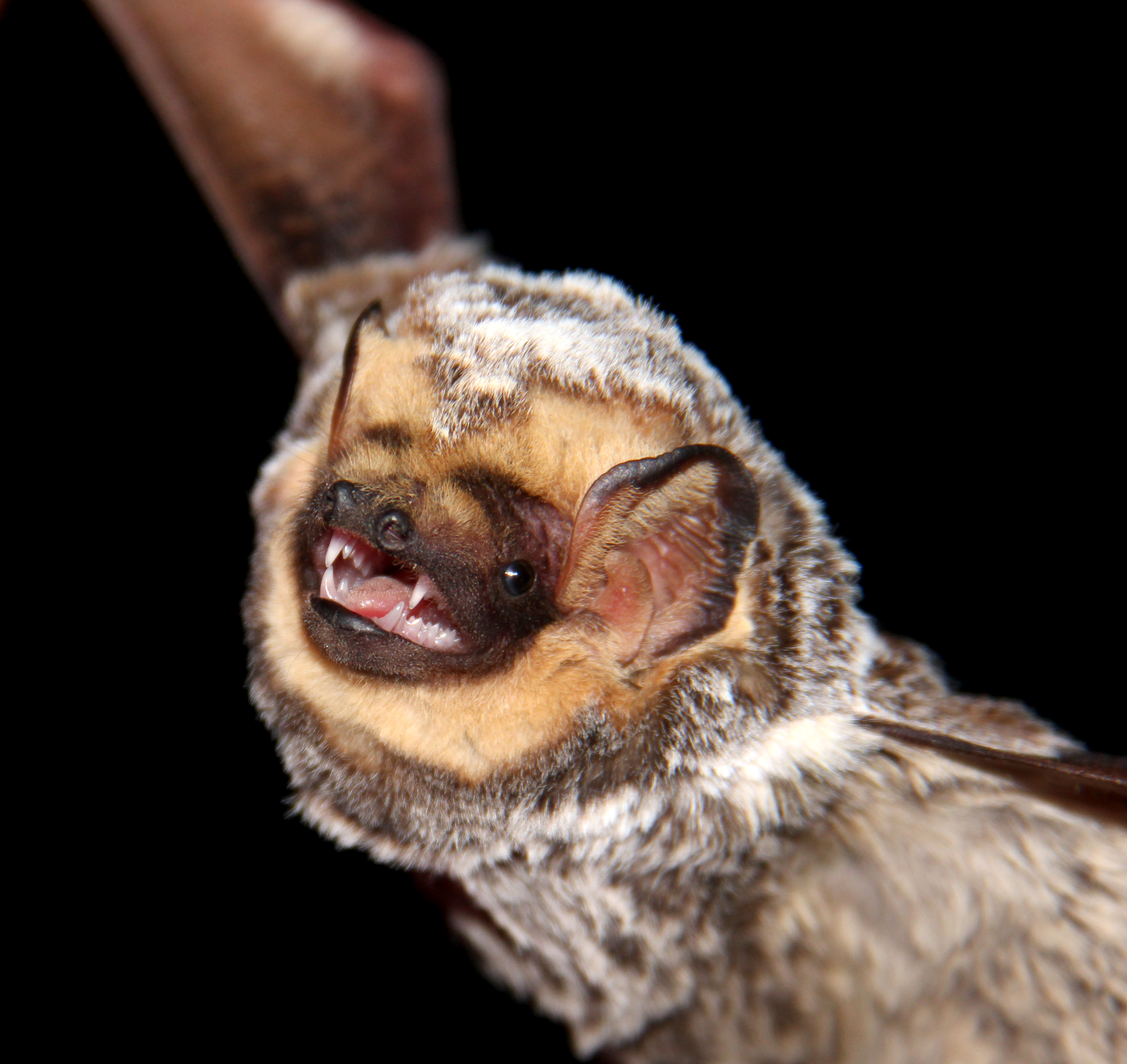
Hoary bat (Lasiurus cinereus). Credit: Veronica Zamora-Gutierrez.

Ecologists have started looking into drones as new tools for wildlife surveys, but how can drone disturbance be minimized in order to produce accurate wildlife counts? In this post, Kayla Kuhlmann describes a drone practice to reduce disruption during acoustic bat surveys as featured in the paper “Miniaturization eliminates detectable impacts of drones on bat activity”, recently published in Methods in Ecology and Evolution.

Continue reading “Large drones make a big splash: Using smaller drones to conduct less disruptive wildlife surveys”

Revealing the hidden lives of cryptic mountain lions using GPS data and a Moving-Resting Motion model

Post provided by Mark Elbroch, Chaoran Hu, Tom Meyer, Vladimir Pozdnyakov & Jun Yan

Female mountain lion collared in Washington USA in late December 2021.

Information on how and even why terrestrial mammals move through their habitat landscapes is important for forming the foundation of how to manage and conserve species. For elusive mountain lions, GPS data is particularly vital for monitoring these important apex predators in relation to their ecosystems and the people they share the land with. In this blog post, the team discusses their novel motion model, published in Methods in Ecology and Evolution, which helps us understand the movement of mountain lions from GPS location data.

Continue reading “Revealing the hidden lives of cryptic mountain lions using GPS data and a Moving-Resting Motion model”

Non-invasive playback experiments allow for rigorous studies of wildlife interactions

Post provided by Meredith Palmer, Chris “Akiba” Wang, Jacinta Plucinski & Robert M. Pringle

The BoomBox ABR deployed with a Bushnell TrophyCam camera trap in Gorongosa National Park, Mozambique

Camera traps are a valuable tool in ecological research, especially for capturing large quantities of information on the behaviour of an array of wildlife within an ecological community. Camera traps are seldom used to experimentally testing key animal behaviour hypotheses, despite the potential offered by the non-invasive technology. In this blog post, Dr. Meredith Palmer and co-authors discuss the application of the ‘BoomBox’ camera trap module that allows researchers to conduct a unique suite of manipulative experiments on free-living species in complex environments, as published in their Methods in Ecology and Evolution article ‘BoomBox: An Automated Behavioral Response (ABR) Camera Trap Module for Wildlife Playback Experiments’.

Continue reading “Non-invasive playback experiments allow for rigorous studies of wildlife interactions”

MEEin3: The Movebank System

Check out the latest episode of our new podcast, MEEin3! Here we interview Roland Kays from the North Carolina Museum of Natural Sciences and North Carolina State University to learn about the Movebank database featured in his recent article ‘The Movebank system for studying global animal movement and demography‘. What were the inspirations and challenges in developing this home for animal tracking data? Listen now! … Continue reading MEEin3: The Movebank System

plantR: Managing species records from biological collections

Post provided by Renato Lima

Many biodiversity studies, covering a wide range of goals, need species records. These records are becoming readily available online, however there is minimal standardisation for these records at this stage, therefore requiring final users to spend a significant amount of time formatting records prior to using data. To overcome this, Renato Lima et al. have created plantR – an open-source package that provides a comprehensive toolbox to manage species records from biological collections. In this blog post, Renato discusses the workflow of the package and describes how this package can help researchers better assess data quality and avoid data leakage.

Continue reading “plantR: Managing species records from biological collections”

MEEin3: Identifying latent behavioral states in animal movement

We are pleased to share the latest episode of MEEin3 with you! Listen now to this episode, where we interview Dr Josh Cullen about their recent publication titled “Identifying latent behavioral states in animal movement with M4, a non-parametric Bayesian method“. You can find more about Josh’s research by visiting their personal webpage and scholar page.  Continue reading MEEin3: Identifying latent behavioral states in animal movement

Measuring canopy fuel loads in boreal forests accurately and efficiently using a smartphone

Our Associate Editor Ryan Chisholm of the National University of Singapore tells us about the recent Practical Tools article he handled for MEE which presents a method for estimating canopy fuel load from hemispherical photographs. Fire is a natural process in many ecosystems, but large-scale intense fires can threaten biodiversity, as well as human life and property. Although the annual global area burnt has decreased … Continue reading Measuring canopy fuel loads in boreal forests accurately and efficiently using a smartphone

Do-it-yourself fishing and climate scenario experiments with a marine ecosystem model

Post provided by Michael Heath, Tom Doherty,  Jack Laverick & Douglas Speirs

Herring is a planktivorous fish species. Credit: Atle Grimsby.

World Fisheries Day, celebrated on November 21, is dedicated to highlighting the critical importance of healthy ocean ecosystems and to ensure sustainable stocks of fisheries in the world. Pressure to find ecologically sustainable strategies for harvesting food from the sea is getting ever stronger, especially in the face of changing climate. However, the question is complex because the harvestable species live in a complex food web where everything is directly or indirectly connected to everything else. Models for carrying out scenario analyses on the impact of fisheries management options on food webs are usually the preserve of trained experts.

In this blog post, Michael Heath of the University of Strathclyde guides us through how using a new marine modelling package and online app, published in their recent Methods in Ecology and Evolution paper ‘StrathE2E2: An R package for modelling the dynamics of marine food webs and fisheries.’, makes these analyses easily accessible to anyone with just basic website skills.

Continue reading “Do-it-yourself fishing and climate scenario experiments with a marine ecosystem model”

Cover Stories: Overlooked primary producers key to accurate trophic position estimation

Post provided by Matthew Ramirez, Alexi Besser, Seth Newsome, and Kelton McMahon

The cover of our October issue shows a katydid feeding on a leaf in the Tirimbina Rainforest National Wildlife Refuge of Costa Rica. Once digested, nitrogen from the leaf is incorporated into the katydid’s tissues in the form of amino acids, with slight modification to their stable nitrogen isotope values (δ15N). In this post the authors discuss the importance of understanding and accounting for variability in primary producer amino acid δ15N values when characterizing where consumers are positioned within food webs, detailed in their Methods in Ecology and Evolution article “Meta-analysis of primary producer amino acid δ15N values and their influence on trophic position estimation.”

Continue reading “Cover Stories: Overlooked primary producers key to accurate trophic position estimation”

Monsters Behind the Movies

Post provided by Ben Whittaker & Chloe Robinson

“There’s no such thing as monsters” you whisper to yourself while creeping into bed, regretting your decision to spend the whole night watching horror movies. Thunder rumbles in the distance as rain begins tapping on the windowpane. The lamps flicker and black out. “Just a power cut” you chuckle nervously, clutching the bed covers up to your face. Laid in the darkness, you become aware of every creak and bump echoing throughout the empty house. But what is that shuffling sound? Is it coming closer? The shuffling stops right outside your bedroom door, which gently rattles and then slowly groans open. A dreadful chill runs down your spine. “There’s no such thing as monsters?”

In this special Halloween post, blog editors Chloe Robinson and Ben Whittaker conjure stories of the real-life monsters that have inspired movie makers. Continue reading at your own peril and be warned that Methods in Ecology and Evolution holds no liability for ensuing nightmares, hauntings, or extra-terrestrial abduction.  

Continue reading “Monsters Behind the Movies”