Revealing Biodiversity on Rocky Reefs using Natural Soundscapes

Post Provided by SYDNEY HARRIS

The Biodiversity Struggle

Typical rocky reef habitat in northeast New Zealand, characterized by encrusting red algae and Kelp forest. ©Sydney Harris
Typical rocky reef habitat in north east New Zealand, characterized by encrusting red algae and Kelp forest. ©Sydney Harris

By now we’re all familiar with the global biodiversity crisis: increasing numbers of species extinct or at risk of extinction; widespread habitat loss and a seemingly endless set of political, logistical and financial obstacles hampering swift action for conservation. The international Convention on Biological Diversity (CBD) has set twenty global diversity targets, many of which require participating nations to conduct accurate and efficient monitoring to assess their progress and inform policy decisions. Governing bodies and organizations worldwide have agreed that immediate, efficient action is essential to preserving our planet’s increasingly threatened ecosystems.

But how? Diversity measurement techniques are a tricky business. Accurately recording diversity can be time-consuming, labor-intensive, expensive, invasive and highly susceptible to human error. Often these methods involve the employment of trained specialists to individually identify hundreds or even thousands of species, a process that can take many months to complete.

Marine habitats are particularly difficult to access because of the physical limitations of humans underwater, and are often flawed due to the influence of our presence on marine organisms. However, the oceans contain many of the world’s most diverse systems, and, despite the limitations of current methods, the need to monitor marine diversity is a top priority for the global conservation movement. Continue reading “Revealing Biodiversity on Rocky Reefs using Natural Soundscapes”

Demography and Big Data

Post provided by BRITTANY TELLER, KRISTIN HULVEY and ELISE GORNISH

Follow Brittany (@BRITTZINATOR) and Elise (@RESTORECAL) on Twitter

To understand how species survive in nature, demographers pair field-collected life history data on survival, growth and reproduction with statistical inference. Demographic approaches have significantly contributed to our understanding of population biology, invasive species dynamics, community ecology, evolutionary biology and much more.

As ecologists begin to ask questions about demography at broader spatial and temporal scales and collect data at higher resolutions, demographic analyses and new statistical methods are likely to shed even more light on important ecological mechanisms.

Population Processes

Midsummer Opuntia cactus in eastern Idaho, USA. © B. Teller.

Traditionally, demographers collect life history data on species in the field under one or more environmental conditions. This approach has significantly improved our understanding of basic biological processes. For example, rosette size is a significant predictor of survival for plants like wild teasel (Werner 1975 – links to all articles are at the end of the post), and desert annual plants hedge their bets against poor years by optimizing germination strategies (Gremer & Venable 2014).

Demographers also include temporal and spatial variability in their models to help make realistic predictions of population dynamics. We now know that temporal variability in carrying capacity dramatically improves population growth rates for perennial grasses and provides a better fit to data than models with varying growth rates because of this (Fowler & Pease 2010). Moreover, spatial heterogeneity and environmental stochasticity have similar consequences for plant populations (Crone 2016). Continue reading “Demography and Big Data”

My Entropy ‘Pearl’: Using Turing’s Insight to Find an Optimal Estimator for Shannon Entropy

Post provided by Anne Chao (National Tsing Hua University, Taiwan)

Shannon Entropy

Not quite as precious as my entropy pearl
Not quite as precious as my entropy pearl ©Amboo Who

Ludwig Boltzmann (1844-1906) introduced the modern formula for entropy in statistical mechanics in 1870s. Since its generalization by Claude E. Shannon in his pioneering 1948 paper A Mathematical Theory of Communication, this entropy became known as ‘Shannon entropy’.

Shannon entropy and its exponential have been extensively used to characterize uncertainty, diversity and information-related quantities in ecology, genetics, information theory, computer science and many other fields. Its mathematical expression is given in the figure below.

In the 1950s Shannon entropy was adopted by ecologists as a diversity measure. It’s interpreted as a measure of the uncertainty in the species identity of an individual randomly selected from a community. A higher degree of uncertainty means greater diversity in the community.

Unlike species richness which gives equal weight to all species, or the Gini-Simpson index that gives more weight to individuals of abundant species, Shannon entropy and its exponential (“the effective number of common species” or diversity of order one) are the only standard frequency-sensitive complexity measures that weigh species in proportion to their population abundances. To put it simply: it treats all individuals equally. This is the most natural weighing for many applications. Continue reading “My Entropy ‘Pearl’: Using Turing’s Insight to Find an Optimal Estimator for Shannon Entropy”

On the Tail of Reintroduced Canada Lynx: Leveraging Archival Telemetry Data to Model Animal Movement

Post provided by FRANCES E. BUDERMAN

Animal Movement

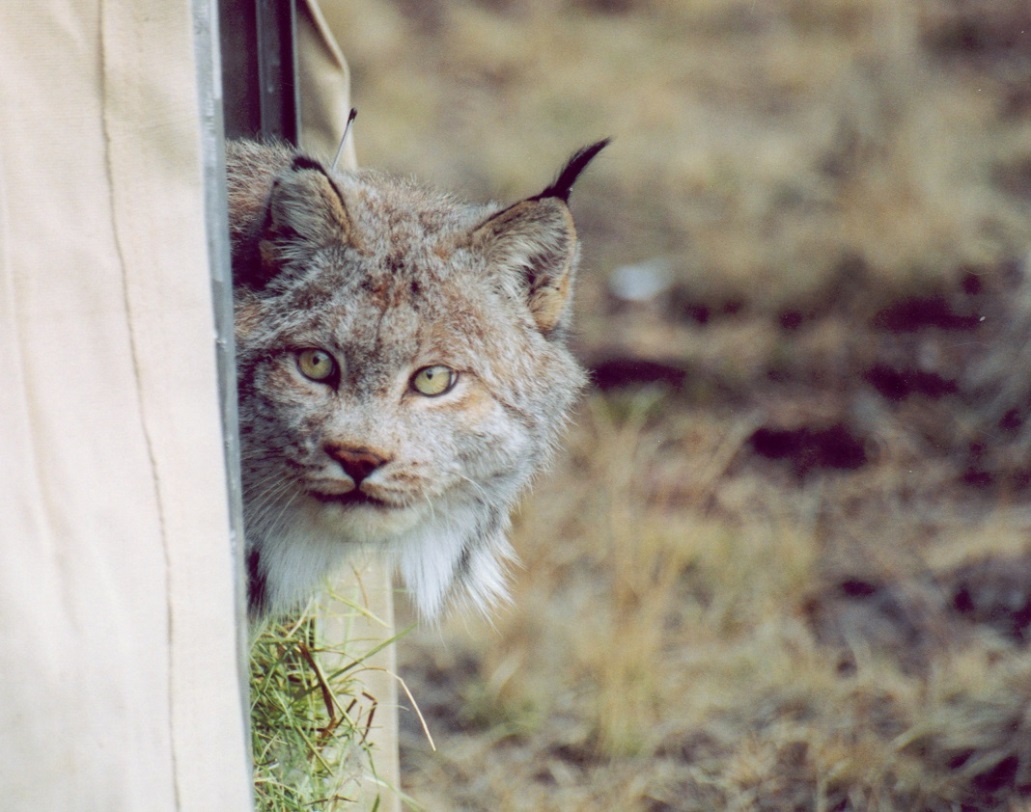
218 Canada lynx were reintroduced to the San Juan Mountains between 1999 and 2006 with VHF/Argos collars. © Colorado Parks and Wildlife

Animal movement is a driving factor underlying many ecological processes including disease transmission, extinction risk and range shifts. Understanding why, when and how animals traverse a landscape can provide much needed information for landscape-level conservation and management practices.

The theoretical underpinnings for modelling animal movement were developed about seventy years ago. Technological developments followed, with radio-collars initially deployed on large mammals such as grizzly bears and elk. We can now monitor animal movement of a wide variety of species, including those as small as a honeybee, at an unprecedented temporal and spatial scale.

However, location-based data sets are often time consuming and costly to collect. For many species, especially those that are rare and elusive, pre-existing data sets may be the only viable data source to inform management decisions. Continue reading “On the Tail of Reintroduced Canada Lynx: Leveraging Archival Telemetry Data to Model Animal Movement”

The Overlooked Commotion of Particle Motion in the Ocean

Below is a press release about the Open Access Methods paper ‘Particle motion: the missing link in underwater acoustic ecology‘ taken from the University of Bristol, the University of Exeter and the Centre for Environment, Fisheries  & Aquaculture Science (CEFAS).

Fish and invertebrates predominantly or exclusively detect particle motion.

A growing number of studies on the behaviour of aquatic animals are revealing the importance of underwater sound, yet these studies typically overlook the component of sound sensed by most species: particle motion. In response, researchers from the Universities of Bristol, Exeter and Leiden and CEFAS have developed a user-friendly introduction to particle motion, explaining how and when it ought to be measured, and provide open-access analytical tools to maximise its uptake. Continue reading “The Overlooked Commotion of Particle Motion in the Ocean”

Issue 7.2: Demography Beyond the Population

Issue 7.2 is now online!

Sagebrush steppe in eastern Idaho, USA
© Brittany J. Teller

The February issue of Methods is now online! As you may have seen already, it includes the BES cross-journal Special Feature: “Demography Beyond the Population“. There are also eight other wonderful articles to read.

We have four articles in the Demography Beyond the Symposium Special Feature. You can read an overview of them by two of the Feature’s Guest Editor Sean McMahon and Jessica Metcalf here (Sean and Jessica are also Associate Editors of Methods).

If you’d like to find out more about each of the individual papers before downloading them, we have blog posts about each one. Daniel Falster and Rich Fitzjohn discuss the development of plant and provide some advice on creating simulation models in Key Technologies Used to Build the plant Package (and Maybe Soon Some Other Big Simulation Models in R). There is a look back at the evolution of Integral Projection Models from Mark Rees and Steve Ellner in How Did We Get Here From There? A Brief History of Evolving Integral Projection Models. In Inverse Modelling and IPMs: Estimating Processes from Incomplete Information Edgar González explains how you can estimate process that you can’t observe. And keep an eye out for Brittany Teller’s blog post coming next week!

Don’t wait too long to get the Demography Beyond the Population Special Feature papers though, they’re freely available for a limited time only

Continue reading “Issue 7.2: Demography Beyond the Population”

Inverse Modelling and IPMs: Estimating Processes from Incomplete Information

Post provided by Edgar J. González

In demography, a set of processes (survival, growth, fecundity, etc.) interacts to produce observable patterns (population size, structure, growth rate, etc.) that change over time. With traditional approaches you follow the individuals of a population over some timespan and track all of these processes.

Demographic patterns and processes (Click to expand)

However, depending on the organism, some processes may be very hard to quantify (e.g. mortality or recruitment in animals or plants with long lifespans). You may have observed the patterns for the organism that you’re studying and, even better, measured some, but not all, of the processes. The question is: can we use this limited information to estimate the processes we couldn’t measure? Continue reading “Inverse Modelling and IPMs: Estimating Processes from Incomplete Information”

How Did We Get Here From There? A Brief History of Evolving Integral Projection Models

Post provided by MARK REES and Steve Ellner

The Early Days: Illyrian Thistle and IBMs

Illyrian Thistle
Illyrian Thistle

Back in 1997 MR was awarded a travel grant from CSIRO to visit Andy Sheppard in Canberra. CSIRO had been collecting detailed long-term demographic data on several plant species and Andy was keen to develop data-driven models for management.

Andy decided Illyrian thistle (Onopordum Illyricum) would be a good place to start, as this was the most complicated in terms of its demography. The field study provided information on size, age and seed production. The initial goal was to quantify the impact of seed feeders on plant abundance, but after a few weeks of data analysis it became apparent that the annual seed production per quadrat was huge (in the 1000s) but there were always ~20 or so recruits. This meant that effects of seed feeders (if any) occurred outside the range of the data, which wasn’t ideal for quantitative prediction.

So the project developed in a different direction. Onopordum is a monocarpic perennial (it lives for several years then flowers and dies) and Tom de Jong and Peter Klinkhamer had recently developed models to predict at what size or age monocarps should flower, so it seemed reasonable to see if this would work. Continue reading “How Did We Get Here From There? A Brief History of Evolving Integral Projection Models”

Key Technologies Used to Build the plant Package (and Maybe Soon Some Other Big Simulation Models in R)

Post provided by RICH FITZJOHN and DANIEL FALSTER

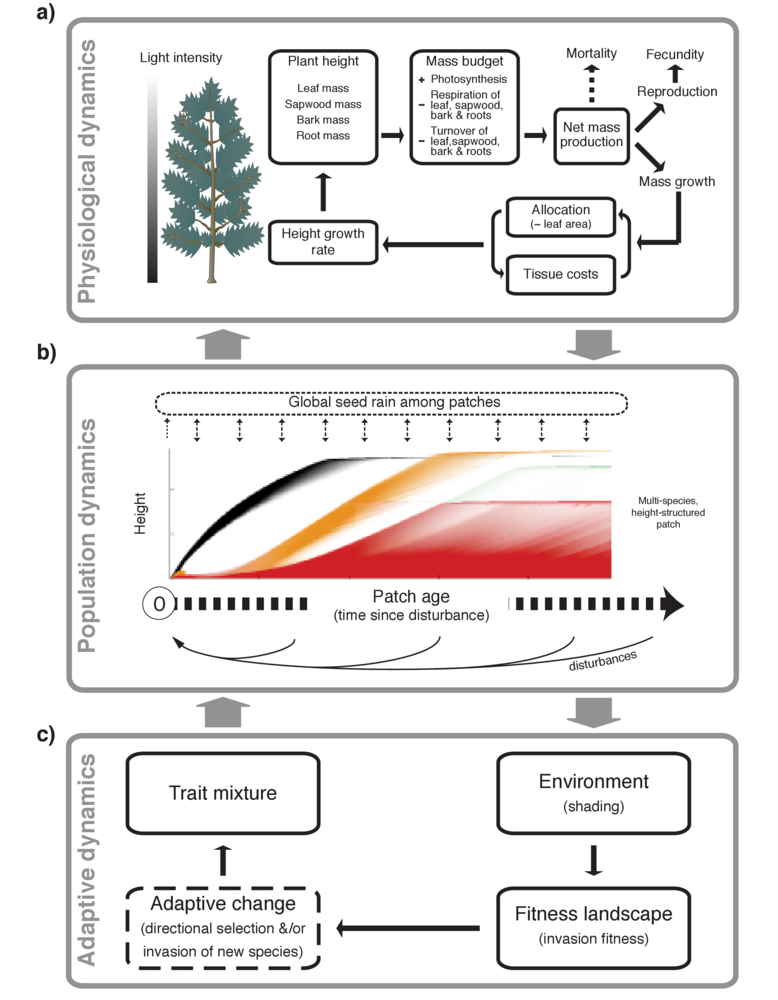
Our paper in Methods in Ecology and Evolution describes a new software package, plantplant is an individual-based simulation model that simulates the growth of individual trees, stands of competing plants, or entire metacommunities under a disturbance regime, using common physiological rules and trait-based functional trade-offs to capture differences among species.

Non-Linear Processes and Thousands of Plants

Since the development of gap models in the 1970s (e.g. Botkin 1972), researchers have been using computer simulations to investigate how elements of plant biology interact with competition and disturbance regimes to influence vegetation demography, structure and diversity. Simulating the competitive interactions among many thousands of plants, however, is no easy task.

Despite widespread recognition of the importance of key non-linear processes — such as size-structured competition, disturbance, and trait-based trade-offs — for vegetation dynamics, relatively few researchers have been brave (or daft) enough to try and incorporate such processes into their models. The situation is most extreme in theoretical ecology, where much contemporary theory (e.g. coexistence theory, neutral theory) is still built around completely unstructured populations.

Features of plant

Key processes modelled within the plant package.

The plant package attempts to change that by providing an extensible, open source framework for studying trait-, size- and patch-structured dynamics. One thing that makes the plant model significant is the focus on traits. plant is one of several attempts seeking to integrate current understanding about trait based trade-offs into a model of individual plant function (see also Moorcroft et al 2001Sakschewski et al 2015).

A second feature that makes the plant software significant, is it that is perhaps the first example where a computationally intensive model has been packaged up in a way that enables widespread usage, makes the model more usable and doesn’t  sacrifice speed.

In this post we will describe the key technologies used to build the plant software. Continue reading “Key Technologies Used to Build the plant Package (and Maybe Soon Some Other Big Simulation Models in R)”

Methods Beyond the Population

Post Provided by SEAN MCMAHON and JESSICA METCALF

Demography Beyond the Population” is a unique Special Feature being published across the journals of the British Ecological Society.  The effort evolved from a symposium of the same name hosted in Sheffield, UK last March. Both the meeting and the Special Feature were designed to challenge ecologists from a range of fields whose research focuses on populations.

The participants were charged with sharing how they are pushing the work they do beyond the stage where the population is the focus into research where the population is just the beginning and the focus spans scales, systems and tools. This encompasses a broad suite of biological research, including range modelling, disease impacts on communities, biogeochemistry, evolutionary theory, and conservation biology. The meeting was a great success, and this Special Feature should be equally valuable to the broad readership of the BES journals.

Methods in Ecology and Evolution has a special place in the Special Feature, hosting four papers. These papers not only introduce new efforts in population biology, they provide the methods that other scientists can use to implement them. With the tools provided by these four papers, researchers will be able to advance forest modelling, evolutionary theory, climate change biology and statistical inference of hidden population parameters.  Seriously good stuff! Continue reading “Methods Beyond the Population”