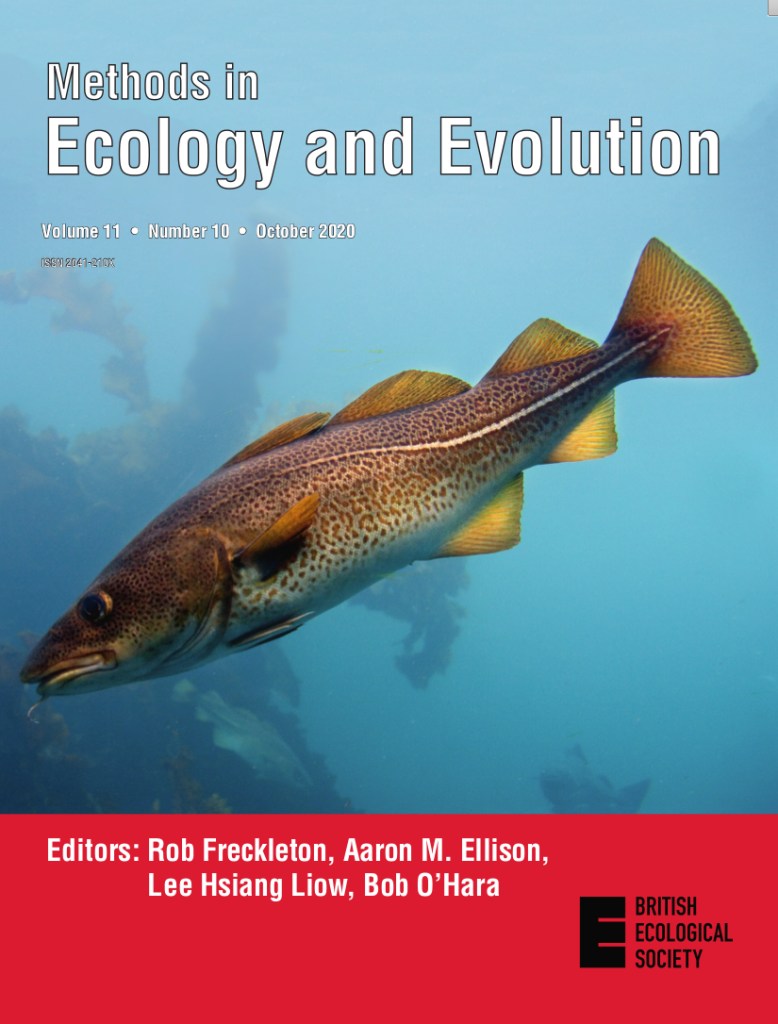
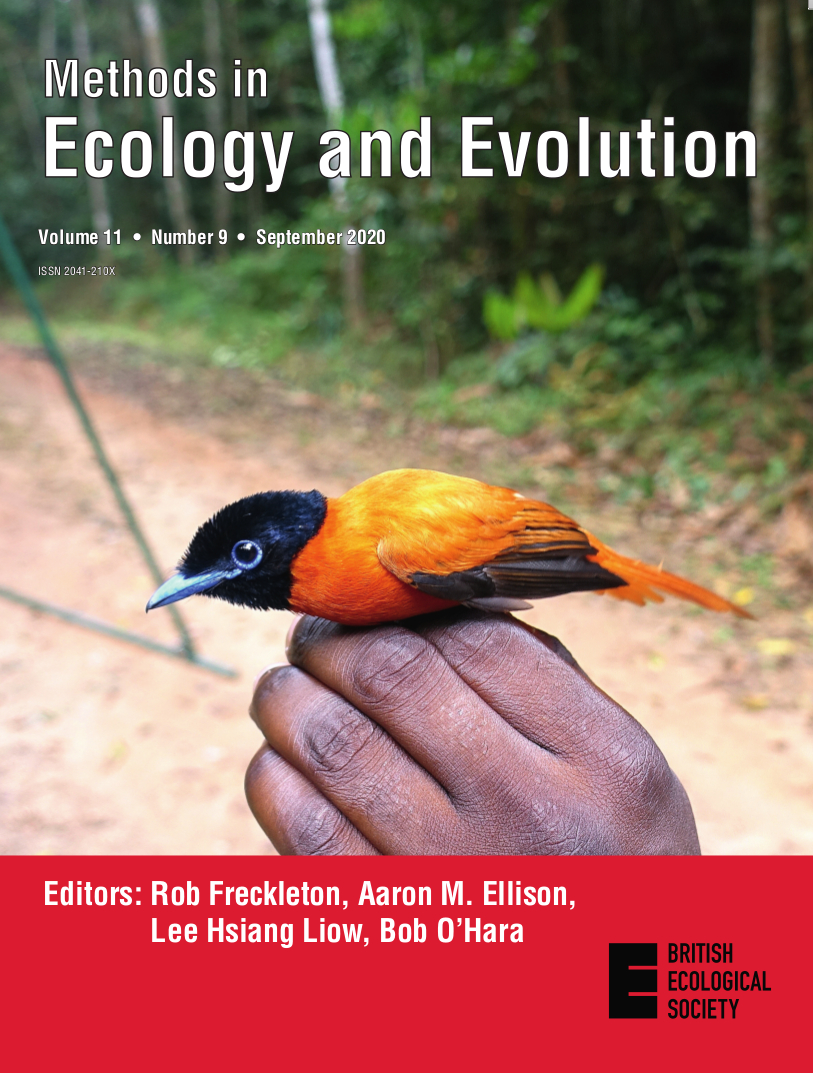
We have a larger issue of 14 articles this month, featuring tools for microbial evolution experiments, automatic biomass estimation of invertebrates, labeling biological samples and much more.
Senior Editor Bob O’Hara has selected five featured articles this month – find out about them below. We also have four Applications, one Practical Tools article and 10 articles that are freely available to everyone – no subscription required!
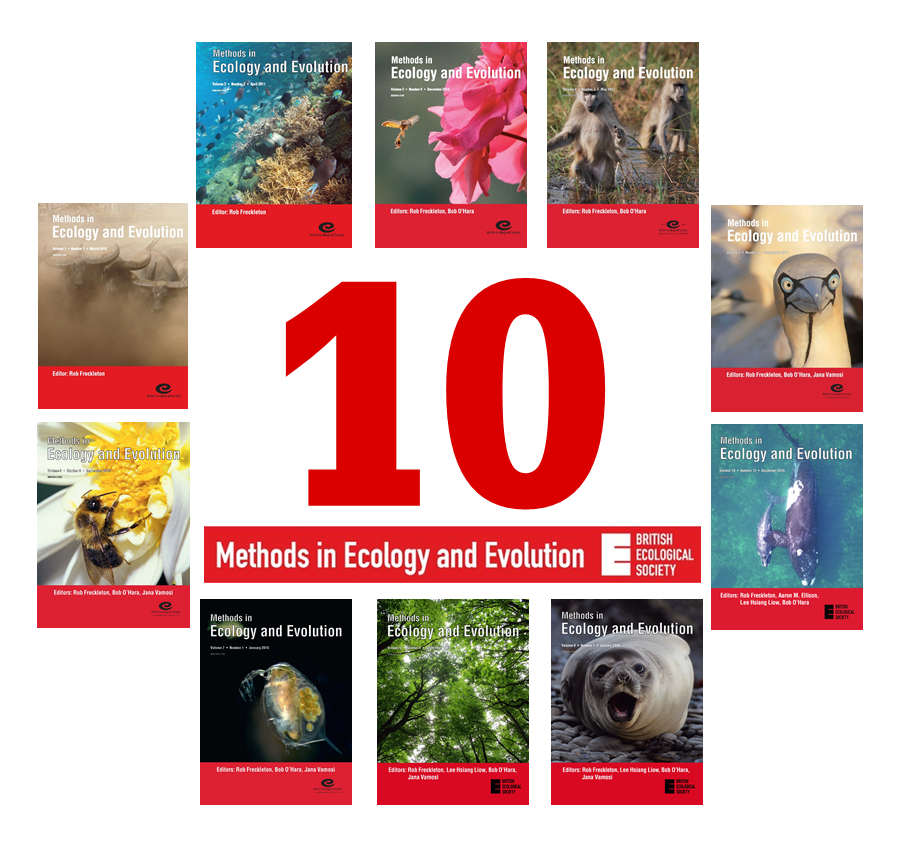
This year is our 10th Anniversary! To celebrate, we’ve made a timeline of highlights from the past decade, from the first paper ever submitted, to a top-cited article with 3,295 citations. We’d like to give a big thanks our dedicated editors, plus all the authors and reviewers who are developing the fields of ecology and evolution with groundbreaking new methods. Here’s to 10 more years! Continue reading Happy 10th Anniversary to us!
A very important ecological feature of a species is its geographic range, which can be described by its size, position and shape. Studying the geographic range can be useful to understand the ecological needs of a species and, thereby, to plan conservation strategies. In ecological studies, mathematical models are the new standard to reconstruct the distribution of living species on Earth because of their accuracy in predicting a species presence or absence at unsampled locations. These methods are able to reconstruct the climatic niche of a species and to project it onto a geographic domain in order to predict the species’ spatial distribution. To do this, besides the occurrences of a species, the models necessarily require the spatial maps of environmental variables, like temperature and precipitation, for all the study area.
This month’s issue features articles on evaluating biodiversity offsetting, managing remotely-collected data, quantifying log decay and much more.
Senior Editor Aaron Ellison has selected six featured articles this month – find out about them below. We also have three Applications and seven articles that are freely available to everyone – no subscription required!
落红不是无情物,化作春泥更护花。 –龚自珍(清) “The fallen petals are not as cruel as they seem; they fertilize those in full bloom instead.” – Gong Zizhen (Qing Dynasty)
A decaying Douglas fir log
This picture shows a decomposing log of Douglas fir, Pseudotsuga menziesii (Mirb.) Franco, in Schovenhorst, The Netherlands, which is one of the deadwood incubation sites of the LOGLIFE “tree cemetery” project. 25 angiosperm and gymnosperm species covering a diverse range of functional traits were selected and incubated in the “common garden experiment”. This project was founded in 2012, aiming to disentangle the effects of different species’ wood traits and site-related environmental drivers on decomposition dynamics of wood, and its associated diversity of microbial and invertebrate communities.
For LGBTQ+ Pride month, we are inviting LGBTQ+-identifying ecologists and evolutionary biologists to share their experiences of being LGBTQ+ in their field and present their thoughts on how the STEM can improve lives for LGBTQ+ individuals. For this post, wife-wife team Chloe and Jessica Robinson from Centre for Biodiversity Genomics at the University of Guelph, share their experiences of being married ecologists in STEM.
Jessica (left) and Chloe Robinson (right) met whilst studying at Swansea University.
C: “Find a job you love, and you’ll never have to work a day in your life” is a quote many of us are familiar with and it is something I have always strived to achieve. In my experience, by adding “Find a job you love & someone who shares your passion and you’ll never have to work a day in your life” to this quote gives the recipe for a happy marriage also. That ‘someone’ for me is my wife, Jessica.
For Pride Month, we are inviting LGBTQ+-identifying ecologists and evolutionary biologists to share their experiences of being LGBTQ+ in their field and present their thoughts on how the STEM can improve lives for LGBTQ+ individuals. First up we have Vishwadeep Mane, a first-year microbiology PhD student at the Indian Institute of Science (IISc), Bengaluru.
Vishwadeep Mane shares his experience of being LGBTQ+ in microbiology.
Hello Everyone! Namaste! The world today is on the brink of a whole new era, an era of rethinking better. The Pandemic portrayed the necessity of sustainable reforms that are imperative for adapting to newer situations. Nevertheless, it brought the whole world together, gave us a reason to fight, love and respect. This month marks the ‘rebellion’ that gave voices to many unheard stories and changed the course of life of many individuals. To a greater extent, it helped in making this world a place for all with equality and respect. This ‘rebellion’ gave the moment of ‘Pride’ to possibly everyone unique in their own way. Happy Pride Month to all of you!
Jolien Goossens tells us about the challenges of installing acoustic receivers on the seabed and the tripod they designed to overcome them.
Installing scientific instruments in the marine environment comes with many challenges. Equipment has to withstand the physical forces of tides, currents and storms. Researchers have to take into account the effects of biofouling, corrosion and human activities. Even access to the study site can pose its difficulties, as diving is limited by depth and weather conditions. Practical deployment mechanisms are therefore needed to sustain consistent data flows.
Acoustic telemetry enables the observation of animal movements in aquatic environments. Individual animals are fitted with a transmitter, relaying a signal that can be picked up by acoustic receivers. To facilitate a convenient installation of these instruments, we developed and tested a new design, mounting a receiver with an acoustic release on a tripod frame. This frame enables the recovery of all equipment and better yet, improves the quality of the data.
Accelerometers, Ground Truthing, and Supervised Learning
Accelerometers are sensitive to movement and the lack of it. They are not sentient and must recognise animal behaviour based on a human observer’s cognition. Therefore, remote recognition of behaviour using accelerometers requires ground truth data which is based on human observation or knowledge. The need for validated behavioural information and for automating the analysis of the vast amounts of data collected today, have resulted in many studies opting for supervised machine learning approaches.
Ground-truthing. The acceleration data stream (recorded using the animal-borne data logger, bottom-left) is synchronised with simultaneously recorded video (near top right). Picture credit: Kamiar Aminian
In such approaches, the process of ground truthing involves time-synchronising acceleration signals with simultaneously recorded video, having an animal behaviour expert create an ethogram, and then annotate the video according to this ethogram. This links the recorded acceleration signal to the stream of observed animal behaviours that produced it. After this, acceleration signals are chopped up into finite sections of pre-set size (e.g. two seconds), called windows. From acceleration data within windows, quantities called ‘features’ are engineered with the aim of summarising characteristics of the acceleration signal. Typically, ~15-20 features are computed. Good features will have similar values for the same behaviour, and different values for different behaviours.
Today we bring the second part of an interview with Dennis Murray and Brett Sandercock about their brand new book in population ecology methods: “Population Ecology in Practice.” This time we talked about their experience as editors, including some useful advice for new editors.
If you missed the first part of the interview, check it out here.
Population Ecology in Practice introduces a synthesis of analytical and modelling approaches currently used in demographic, genetic, and spatial analyses. Chapters provide examples based on real datasets together with a companion website with study cases and exercises implemented in the R statistical programming language.