The annual flagellation of scientist is here – we all know the impact factor is awful, but some people still think it is important. So, here is ours… 6.344
Once more, it is a number with three decimal places. Continue reading “The MEE 2015 Impact Factor”
As a consequence of human activities the global climate is changing at a rate that is unprecedented in at least the past few centuries, leading to the suggestion that this era should be referred to as the “Anthropocene”. While climate hind-casting and pollen histories in sediments are advancing our understanding of how past ecological ecosystems responded to previous climate changes, forecasting power really depends on how accurately we can predict ecosystem functions that are likely to change in the future.
Despite substantial recent advances in our ability to predict climate change, considerable uncertainty remains – especially in our understanding of how ecosystem functioning could be influenced by climate change and how this may feed back to affect greenhouse-gas fluxes. The decomposition of organic matter in leaf litter and soils accounts for a global flux that is approximately 7 times as large as global anthropogenic emissions. Understanding how climate change will affect carbon held in dead organic matter pools – including leaf litter, woody debris and soil organic carbon – is essential.
Decomposition and Why it Matters
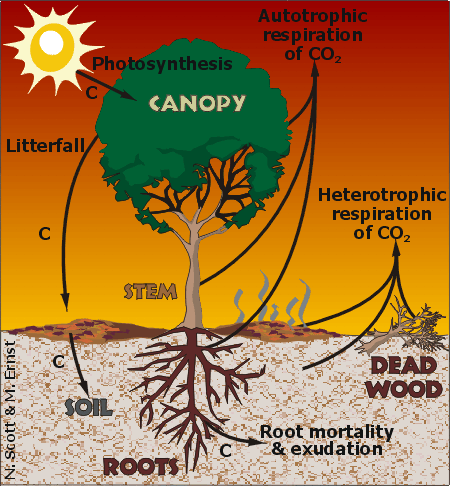
Carbon cycle summary. Note this focuses only in forested or terrestrial ecosystem.
Decomposition is defined as the “physical, chemical and biological mechanisms that transform organic matter into increasingly stable forms” in plant detritus. However, only small part of carbon goes through this process. Most of dead organic matter becomes CO2. Decomposition of organic matter is important because of its link to the global carbon cycle. Simply stated, the carbon cycle consists of carbon inputs via photosynthesis and outputs via respiration. However, while photosynthesis is relatively well studied and understood, respiration – including that of living organisms (autotrophy) and of dead ones (heterotrophy) – is understudied. As a consequence, our understanding of decomposition is much less sophisticated. A substantial amount of greenhouse-gas (CO2, CH4, N2O) production occurs either directly or indirectly from organic matter decomposition, including woody debris. Similar amounts of CO2 efflux exist between fluxes from woody debris decomposition (8.6 Pg yr-1) and fossil fuel burning (9.6 Pg yr-1). So we desperately need a reliable technique to quantify CO2 from decomposition. Continue reading “CO2 Efflux Rates from Dead Organic Matter: Get It Right”
Friday was Endangered Species Day – so this is a good time to reflect on what science and scientists can do to support conservation efforts and to reduce the rate of species extinctions. One obvious answer is that we need to study endangered species to understand their habitat requirements as well as their potential for acclimatization and adaptation to changing environmental conditions. This information is crucial to for the design of informed conservation planning. However, for most endangered species the relevant phenotypes are not known a priori, which leaves the well-intentioned scientist asking “which traits should I measure?”. Transcriptome analysis is often a good way to answer to this question.
Our understanding of how biological diversity works has been advanced by a long history of observing species and linking patterns to ecological processes. However, we generally don’t focus as much on those species that aren’t observed, or in other words ‘absent species’. But, can absent species provide valuable information?
To begin learning about dark diversity, there are two important terms that we need to define: ‘species pool’ and ‘focal community’. A ‘species pool’ is a set of species present in a particular region or landscape that can potentially inhabit a particular observed community because of suitable local ecological conditions.
A ‘focal community’ is the set of species that have been observed in a particular region or landscape (this is the ‘observed community’ and can also be referred to as alpha diversity). For a given focal community to become established, the species within it must have overcome dispersal pressures as well as environmental and biotic filters.
High frequency data, like those obtained from individual electronic tags, carries the potential of giving us detailed information on the behaviour of species at the individual level. Such data are particularly useful for marine species, as we can’t observe them directly for long periods of time.
Understanding how individuals use water columns – both at daily and seasonal scales – can help define conservation measures such as restricting fishing activity to reduce by-catch or defining protected areas to help recovering populations or protect spawning and nursery areas. High frequency data have become popular as they give insight to detailed individual foraging behaviour and therefore the specific energetic needs that are linked to reproduction and fitness. Continue reading “Bringing Ecologists and Statisticians Together for the Conservation of Endangered Species”
This month’s issue contains two Applications articles and two Open Access articles, all of which are freely available.
– piecewiseSEM: A practical implementation of confirmatory path analysis for the R programming language. This package extends the method to all current (generalized) linear, (phylogenetic) least-square, and mixed effects models, relying on familiar R syntax. The article also includes two worked examples.
–RPANDA: An R package that implements model-free and model-based phylogenetic comparative methods for macroevolutionary analyses. It can be used to:
Characterize phylogenetic trees by plotting their spectral density profiles
Compare trees and cluster them according to their similarities
Identify and plot distinct branching patterns within trees
Compare the fit of alternative diversification models to phylogenetic trees
Estimate rates of speciation and extinction
Estimate and plot how these rates have varied with time and environmental variables
Today, we are pleased to be welcoming a new member of the Methods in Ecology and Evolution Associate Editor Board. Will Pearse joins us from McGill University in Canada and you can find out a little more about him below. Will Pearse “I am an evolutionary ecologist and use phylogeny to link the evolution of species’ traits with their ecological community assembly. I’m interested in phylogenetic methods, macro-evolution of species’ traits, community assembly … Continue reading New Associate Editor: Will Pearse
Animals caught on camera by amateur photographers and posted on the web could become an important new tool for studying evolution and other ecological questions, researchers from South Africa have found. Their study – the first of its kind – is published today in Methods in Ecology and Evolution.
Colour polymorphism – when a species has two or more colour types – has fascinated biologists since Darwin. The occurrence of these different colour types often varies geographically, providing a useful way of studying how different colour morphs – or phenotypes – evolve.
Formatting manuscripts for submission can take a long time.
Formatting a manuscript for journal submission can be time-consuming and frustrating work, especially for the first version. To make things a little bit simpler for our authors, we now have just a few small formatting requirements for initial submissions.
To have a paper considered in Methods in Ecology and Evolution it just needs to:
Be double line spaced and in a single column
Be within the word count (6000-7000 words for Standard Articles, 3000 words for Applications)
Follow the standard manuscript structure: Author details, Abstract (must be numbered according to journal style), Keywords, Introduction, Materials and Methods, Results, Discussion
This means that you do not need to worry about the format of your references, the placement of your figures (they can be within the text, at the end of the document or uploaded as separate files), whether or not you have used scientific names or anything else like that. Continue reading “New Initial Submission Requirements”