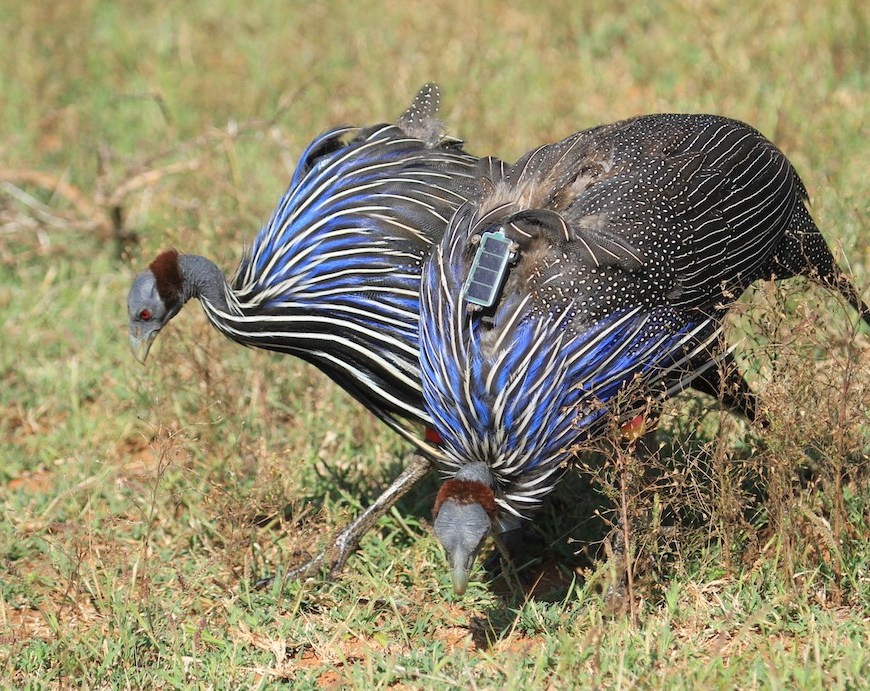
Miniaturisation of technology has made GPS tags increasingly accessible for studying animal behaviour. However, limitations in battery life introduces challenging trade-offs in data collection. In this blog post, Charlotte Christensen and Damien Farine discuss how these sampling trade-offs can impact studies that use GPS tags to study social animals.
Studying animal behaviour or ecology can involve measuring movement patterns of small animals. Observing behaviours like foraging, pollination, circadian activity or predation is laborious because it involves long periods of waiting for the behaviour and triggering a camera or poring over hours of video footage to find the behaviour. Existing automated motion tracking tools for small animals are expensive and unsuitable for field use, or need specific conditions like bright light to work. In this blog post, Yash Sondhi and co-authors discuss their tool “Portable Locomotion Activity Monitor (pLAM)” which enables automated monitoring small animal motion tracking in a cost-effective manner, suitable for lab or field use and can track motion under any light environment.
Michael Phelps is one of the most decorated Olympic athletes of all time and the world’s fastest swimmer. And yet, he could swim faster. Wearing the Speedo LZR Racer supersuit Michael Phelps could reduce his hydrodynamic drag, or water resistance, by upwards of 40%. That could increase his swim speed by more than 4%! In competition, that’s the difference between silver and gold. But, if Phelps forgot to remove his “drag socks” – cumbersome footwear designed to increase water resistance for strength training – his speed would be dramatically reduced. He’d be lucky to walk away with bronze!
Professional swimmers have adapted to the use of performance enhancing technologies to decrease their drag, but that’s nothing compared to the adaptations made by wild animals. Creatures in the marine environment have evolved incredible adaptations to decrease drag, such as extreme streamlining in marine mammals and seabirds. This allows them to move underwater as quickly and efficiently as possible. Seals, for example, are pretty ungainly on land, but in the water they’re sleek and rapid. They have a body shape designed to maximise speed while swimming.
“Man must rise above Earth to the top of the atmosphere and beyond, for only then will he fully understand the world in which he lives” – Socrates (469-399 BC)
Since the launch of the first Landsat mission in 1972, several new earth observation satellites made their way into Earth’s orbit. As of 2018, UNOOSA recorded an impressive 1980 active satellites. Of those, 661 were dedicated to earth observation. These numbers show how widespread the use of remote sensing technologies has become.
It’s more important than ever for us to have accurate information to help marine conservation efforts. Jordan Goetze and his colleagues have provided the first comprehensive guide for researchers using diver operated stereo-video methods (or stereo-DOVs) to survey fish assemblages and their associated habitat. But what is Stereo DOV? What makes it a better method than the traditional UVC (Underwater Visual Census) method? And when … Continue reading Stereo DOV: A Non-Invasive, Non-Destructive Way to Study Fish Populations
Understanding animal movement and population size is a challenge for researchers studying any megafauna species. Sea turtles though, add a whole additional level of complexity. These wide-ranging, swift, charismatic animals spend much of their time underwater and in remote places. When trying to track down and count turtles, this obstacle to understanding population size becomes a full-on barricade.
Changes in temperature and available food determine where and when animals move, reproduce, and survive. Our understanding of how environmental change impacts biodiversity and species survival is well-established at the landscape, country and global scales. But, we know less about what could happen at finer space and time scales, such as within habitats, where behavioural responses by animals are crucial for daily survival.
Simulating Movement and Daily Survival with Individual-Based Movement Models
Key questions at these scales are how the states of individuals (things like body temperature and nutritional condition) influence movement decisions in response to habitat change, and how these decisions relate to patchiness in microclimates and food. So we need tools to make reliable forecasts of how fine-scale habitat use will change under future environments. Individual-based movement simulation models are powerful tools for these kinds of studies. They let you construct habitats that vary in temperature and food conditions in both space and time and ask ‘what if’ questions. By populating these models with activity, behaviour, and movement data of animals, we can simulate different habitat conditions and predict how animals will respond to future change. Continue reading “Where do Animals Spend Their Time and Energy? Theory, Simulations and GPS Trackers Can Help Us Find Out”
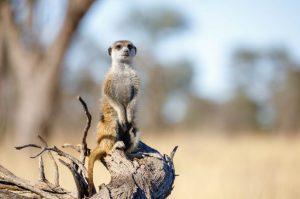
Researchers from EPFL and the University of Zurich have developed a model that uses data from sensors worn by meerkats to gain a more detailed picture of how animals behave in the wild.
Advancement in sensor technologies has meant that field biologists are now collecting a growing mass of ever more precise data on animal behaviour. Yet there is currently no standardised method for determining exactly how to interpret these signals. Take meerkats, for instance. A signal that the animal is active could mean that it is moving; alternatively, it could indicate that it is digging in search of its favourite prey, scorpions. Likewise, an immobile meerkat could be resting – or keeping watch.
The recent focus on the study of animal social networks has led to some fundamental new insights. These have spanned across fields in ecology and evolution, ranging from epidemiology and learning through to evolution and conservation. Whilst network analysis has been used to address questions about sociality, food webs, bipartite networks and more over the past decade it is now extending into a wider variety … Continue reading Animal Social Networks: Joint Special Feature Open Call




 Methods Blog