International Day for Biological Diversity 2015

Happy International Day for Biological Diversity everyone!

As you may know, today (Friday 22 May) is the United Nations Day for Biodiversity and we are celebrating by highlighting some of the best papers that have been published on biodiversity in Methods in Ecology and Evolution. This is by no means an exhaustive list and you can find many more articles on similar topics on the Wiley Online Library (remember, if you are a member of the BES, you can access all Methods articles free of charge).

If you would like to learn more about the International Day for Biological Diversity, you may wish to visit the Convention on Biological Diversity website, follow them on Twitter or check out today’s hashtag: #IBD2015.

Without further ado though, here are a few of the best Methods papers on Biological Diversity:
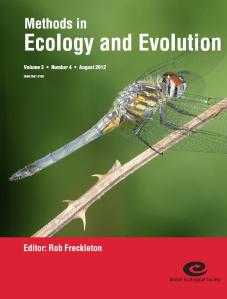
Methods Cover - August 2012Biodiversity Soup

We begin with an Open Access article from one of our Associate Editors, Douglas Yu (et al.). This article was published in the August issue of 2012 and focuses on the metabarcoding of arthropods. The authors present protocols for the extraction of ecological, taxonomic and phylogenetic information from bulk samples of arthropods. They also demonstrate that metabarcoding allows for the precise estimation of pairwise community dissimilarity (beta diversity) and within-community phylogenetic diversity (alpha diversity), despite the inevitable loss of taxonomic information.

Continue reading “International Day for Biological Diversity 2015”

Traits, community ecology and demented accountants

McGill et al. (2006) argued that community ecology had lost its way. Shipley (2010) accused community ecologists of acting like a bunch of demented accountants. Strong words – so what’s the issue exactly?  And what can we do about it?

Dannymanic Image
Doing some end-of-financial-year field work? © Dannymanic

Their beef was that when studying groups of species and their environmental association, ecologists often were not thinking enough about the reasons for variation across species. (In this post we’ll focus on variation in abundance or in environmental response of abundance across species. We’re interpreting “abundance” loosely – counts, biomass, 1-0, whatever.)  While alternative methods are more readily available nowadays, “accountancy” is still common.

Continue reading “Traits, community ecology and demented accountants”

Bat Appreciation Day: The Latest Methodological Advances

Post provided by Kate Jones and the Biodiversity Modelling Research Group

The Funnel-eared bat (Natalus stramineus)
The Funnel-eared bat (Natalus stramineus) – © Veronica Zamora-Gutierrez

Today (17 April) is Bat Appreciation Day! Yes I know, a whole day to appreciate bats. Although my biodiversity modelling research group at University College London would argue that 24 hours is just not enough time to appreciate these cool, yet misunderstood animals, we wanted to mark the day by giving MEE a round-up of the latest methodological advances in bat monitoring and what we hope to see in the next few years.

Bat Detectives and Machine Learning

oisin_pictureOisin Mac Aodha PostDoc – If you have ever tried to spot bats flying around at night you will know that it can be very difficult. However, bats leak information about themselves into the environment in the form of the sounds they make while navigating and feeding. These calls are often too high for us to hear, but we can use devices known as bat detectors to transform them into a form that we can record and listen to. Monitoring bat populations over wide areas or long periods can result in huge amounts of data which is difficult to analyse though. To address this problem, our group, along with Zooniverse, have setup a citizen science project called Bat Detective which asks members of the public help us find bat calls in audio recordings that have been collected from all over Europe (the infographic below gives a bit more information on this). We have had an amazing response to date and our detectives have already located several thousand bat calls. However, to scale up monitoring, we need more automated methods of detecting calls. Using the analysis provided by our Bat Detectives, we are currently working on building algorithms that can automatically tell us if a recording contains a bat call.

In this video we see a visual representation of an audio signal called a spectrogram that features several bat calls. On top you see the result of an automated method we have developed for detecting bat calls. The larger the value, the more certain the algorithm is that there is a bat call at that point in time. Continue reading “Bat Appreciation Day: The Latest Methodological Advances”

Modelling static and dynamic variables

Jessica Stanton discusses the problem of accounting for both static and dynamic variables in designing species distribution models under climate change in our newest author video. Related Read Combining static and dynamic variables in species distribution models under climate change by Jessica C. Stanton, Richard G. Pearson, Ned Horning, Peter Ersts and H. Reşit Akçakaya See other Methods in Ecology and Evolution author videos Continue reading Modelling static and dynamic variables

Biodiversity estimates from DNA sequences

The complexity of new methodologies can present a challenging barrier towards their uptake. Recognising this, Jeff Powell,  author of Accounting for uncertainty in species delineation during the analysis of environmental DNA sequence data, has put together an excellent tutorial to guide people through the implementation of his objective, theory-based method for predicting species boundaries, which explicitly incorporates uncertainty in the classification system into biodiversity estimation. … Continue reading Biodiversity estimates from DNA sequences

Watch the CEE meeting, Integrating ecology into macroevolutionary research

By way of an introduction to this blog post, watch this! Back in March the Centre for Ecology and Evolution in London organised a meeting that brought together top researchers in macroevolution. The idea of the meeting was to highlight how advances in the study of macroevolution could be made by a closer integration with ecology, and the incoroporation of ecological ideas and ecological models. … Continue reading Watch the CEE meeting, Integrating ecology into macroevolutionary research

Methods digest – update

A round up of recent methods-relevant research published recently: it is ages since we did this, largely because the journal has been so busy with papers coming in and being published. Do send through links to any new methods papers to me or to the journal, or post a comment below. In Evolution, Werthelm & Sanderson look at how estimates of diversification rates are influenced … Continue reading Methods digest – update

Virtual Issues on Forests and Global Change

In celebration of the UN’s International Year of Forests, and the British Ecological Society’s Symposium on Forests and Global Change, the Journal of Applied Ecology and Methods in Ecology and Evolution have worked together to bring you two complementary virtual issues in these areas: one dealing with environmental management, and the other the most relevent new methodological developments in forest and global change research. Sample … Continue reading Virtual Issues on Forests and Global Change

A year of podcasts and videos

We have been uploading videos and podcasts for a year now – these have proved really popular, both with authors and readers of the journal. I thought I would just take this opportunity to highlight some of the online content that is supporting articles from the first 3 issues: Our podcasts include:- An introduction to meta analysis Modelling range shifts The Primate Life-History Database Phenological … Continue reading A year of podcasts and videos

Methods digest – June 2010

Here is the methods digest update for June 2010 – do let me know if there is anything that you think I should feature. In Oikos Novak & Wooton have a paper on using indices to quantify the effects of comeptition and Landau & Ryan present new ‘null model tests for presence-absence data’ (NMTPAs). A paper in Conservation Letters by Michael Kearney et al. evaluates species … Continue reading Methods digest – June 2010