Citizen scientist coders for wildlife conservation – a MoveApps story

Post provided by Andrea Kölzsch. I am a movement ecologist and have until recently worked as a PostDoc at the Max Planck Institute of Animal Behavior in Radolfzell, Germany. My research focusses, on the one hand, on the tracking of waterbird movement, but in a more general capacity on the empowering of ecologists to gain knowledge from complex data. The background story of our presently … Continue reading Citizen scientist coders for wildlife conservation – a MoveApps story

Using citizen science photos to perform phenological studies

Post provided by Yves P. Klinger (he/him)

Photos collected by citizen scientists are a rich source of information that is still relatively unexplored. Phenology, the study of recurring biological events, could make use of photos taken by citizen scientists at different times, but accessing and preparing the plethora of publicly available data is challenging. In this post, Yves P. Klinger describes the motivation behind developing a workflow for using citizen science photos for phenological research, as featured in the paper “iPhenology – using open-access citizen science photos to track phenology at continental scale”.

Continue reading “Using citizen science photos to perform phenological studies”

Using citizen science data to track migratory shorebird populations

Post provided by Sam Nicol (He/Him)

Are you an eBirder who loves waders? Do you ever wonder where the birds that you see go after you’ve studiously uploaded your counts to the database? It’s a good question, and in the past, it has been surprisingly hard to answer. In this post, Sam Nicol discusses how citizen science is being used to investigate bird migration.

Continue reading “Using citizen science data to track migratory shorebird populations”

Flora Incognita – more than just a plant identification app

Post provided by Michael Rzanny & Jana Wäldchen

Species identification is an essential tool for recording biodiversity, especially in an era of habitat loss and climate change. Developing skills to correctly identify plants to a species or even a genus level can take many years of training, but a new app called Flora Incognita aims to empower citizens with botanical expertise while also collecting data for scientific analysis.

In this blog post, Michael Rzanny and Jana Wäldchen reveal the inspiration behind this new app and discuss highlights from their new paper “The Flora Incognita app – interactive plant species identification” recently published in Methods in Ecology & Evolution

Continue reading “Flora Incognita – more than just a plant identification app”

10th Anniversary Volume 5: Extracting Signals of Change from Noisy Ecological Data

Post provided by Nick J. B. Isaac

To celebrate the 10th Anniversary of the launch of Methods in Ecology and Evolution, we are highlighting an article from each volume to feature in the Methods.blog.

For Volume 5, we have selected ‘Statistics for citizen science: extracting signals of change from noisy ecological data’ by Isaac et al. (2014).  In this post, the authors discuss the background and key concepts of the article, and the application of the article for assessing biodiversity occurrence datasets.

Continue reading “10th Anniversary Volume 5: Extracting Signals of Change from Noisy Ecological Data”

Issue 11.4: Population Dynamics, Machine Learning, Morphometrics and More

The April issue of Methods is now online!

The latest issue of Methods in Ecology and Evolution is now online! This month’s issue is a little shorter than our last few. But, as they say, good things come in small packages!

Senior Editor Lee Hsiang Liow has selected six Featured Articles this month. You can find out about all of them below. We’ve also got five Applications articles and a Practical Tools article in the April issue that we’re going to cover. Those six papers are freely available to everyone – no subscription required!

On top of all that, the April issue includes articles on camera traps, land cover classification, presence-absence sampling and more.

Continue reading “Issue 11.4: Population Dynamics, Machine Learning, Morphometrics and More”

How Do You Measure Birdsong? Introducing Chipper

Post provided by Abigail Searfoss and Nicole Creanza

Today, science extends beyond the research bench or the field site more often than ever before. Scientists are continuously interacting with educators and the general public, and people are reciprocating the interest with a drive to be involved.

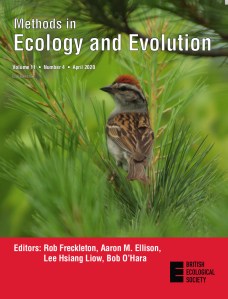
A chipping sparrow. ©Kathy Malone, Nashville
chapter of the Tennessee Ornithology Society.

With this integration of science and the public, citizen-science efforts to crowdsource information have become increasingly popular (check out Zooniverse, SciStarter, NASA Citizen Science Projects, Project FeederWatch, and Foldit to get involved!). In the birding community, enthusiasts have been observing and recording birds for decades, but now there are methods for immediate data sharing among the community (eBird).

Continue reading “How Do You Measure Birdsong? Introducing Chipper”

Ideas Brought to Life Through BES Hackathon

Post provided by Tom August

Introduction to the Hackathon

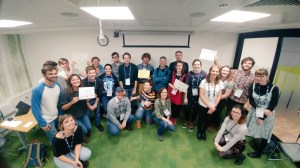
Hackathon participants with their awards.

Hackathons have become a regular feature in the data-science world. Get a group of people with a shared interest together, give them data, food, and a limited amount of time and see what they can produce (often with prizes to be won). Translated into the world of academia as research hackathons, these events are a fantastic way to foster collaboration, interdisciplinary working and skills sharing.

The Quantitative Ecology hackathon was an intense day of coding resulting in creative and innovative research ideas using social and ecological data. Teams worked through the day to develop their ideas with support from experts in R, open science and statistics. We ended up with five projects addressing questions from, ‘Who has the least access to nature?’ to ‘Where should citizen scientists go to collect new data?’.

Continue reading “Ideas Brought to Life Through BES Hackathon”

Teaching Computers to Think like Ecologists

Post provided by CHRIS TERRY

Artificial intelligence (or AI) is an enormously hot topic, regularly hitting the news with the latest milestone where computers matching or exceeding the capacity of humans at a particular task. For ecologists, one of the most exciting and promising uses of artificial intelligence is the automatic identification of species. If this could be reliably cracked, the streams of real-time species distribution data that could be unlocked worldwide would be phenomenal.

ladybird-stock_thumbDespite the hype and rapid improvements, we’re not quite there yet. Although AI naturalists have had some successes, they can also often make basic mistakes. But we shouldn’t be too harsh on the computers, since identifying the correct species just from a picture can be really hard. Ask an experienced naturalist and they’ll often need to know where and when the photo was taken. This information can be crucial for ruling out alternatives. There’s a reason why field guides include range maps!

Currently, most AI identification tools only use an image. So, we set out to see if a computer can be taught to think more like a human, and make use of this extra information. Continue reading “Teaching Computers to Think like Ecologists”
Issue 10.7: Aquatic Ecology, Zeroes, Sequencing and More

The July issue of Methods is now online!

We’ve got a bumper issue of Methods in Ecology and Evolution this month. In the 200+ pages, you’ll find articles about measuring species distributions and abundances, integrated population models, and working at the whole-plant scale.

We’ve got six papers that are freely available to absolutely everyone this month too. You can find out about two of the Open Access papers in the Applications and Practical Tools section below. In the third, Chen et al. show that tree assemblages in tropical forest ecosystems can present a strong signal of extensive distributional interspersion.

Find out a little more about the new issue of Methods in Ecology and Evolution below. Continue reading “Issue 10.7: Aquatic Ecology, Zeroes, Sequencing and More”